
Picture of Design Milk

Design Milk

Design Milk is dedicated to modern design.

Faro Barcelona Grounds Us In Reality With Tierra, Mar y Aire

Faro Barcelona Grounds Us In Reality With ‘Tierra, Mar y Aire’

Nature is our oldest and most creative designer. Those in the business take structures, materiality, even morality from the organic rhythms of the earth, weaving their way through the mire and magic of creation. True sustainability requires that we understand and work within these parameters, using recycled and recyclable materials in tandem. In Tierra, Mar, y Aire, a new lighting collection from Héctor Serrano and presented by Faro Barcelona, the barriers between interior and exterior melt, a metabolization of materiality.
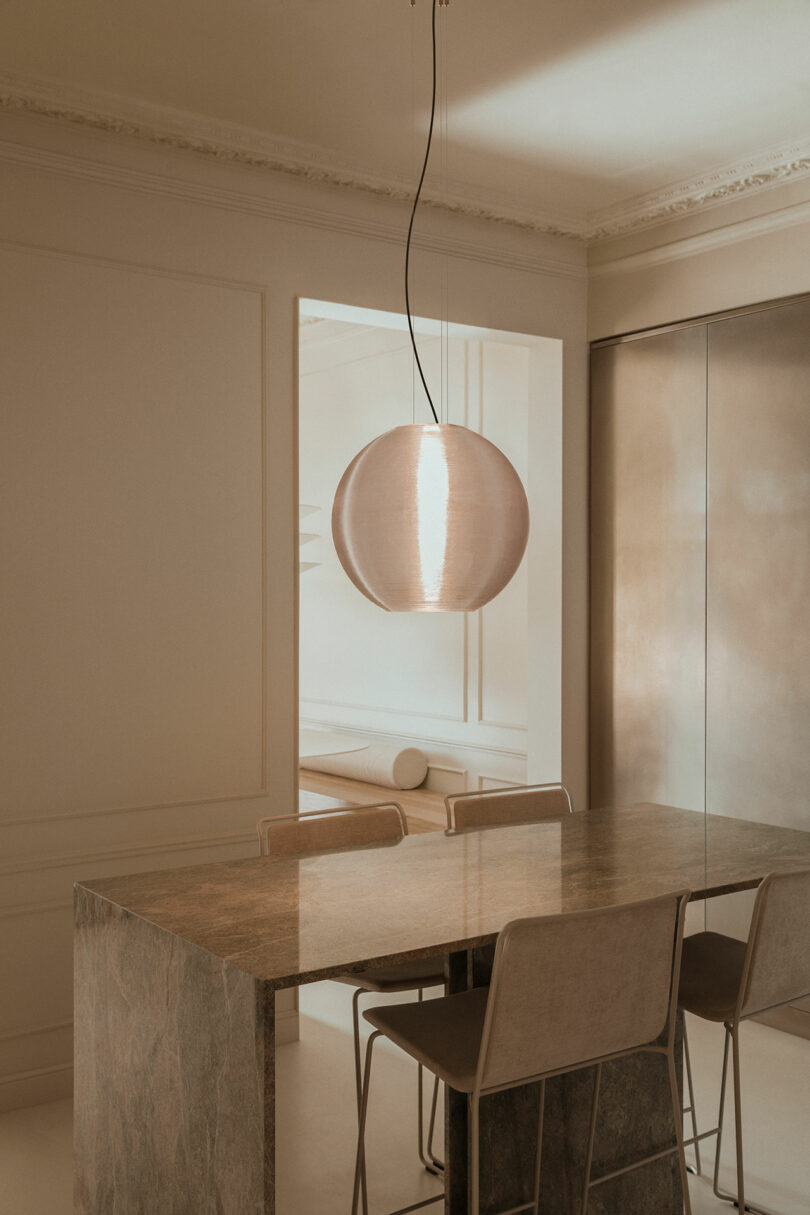
A minimalist dining area with a stone-top table, four beige chairs, and a large pendant light hanging from the ceiling. Neutral tones and soft lighting create a calm atmosphere.

The project starts and ends with materiality at it’s core, mirroring the cycles of our natural world. The properties of each element relate to the composition that is used. For Tierra, a bioplastic formed from PLA and cellulose was utilized, which is both biodegradeable and compostable. Mar is composed of polypropylene derived from recycled fishing nets, and Aire from 100% recycled PETG, the most commonly recycled plastic in the world.
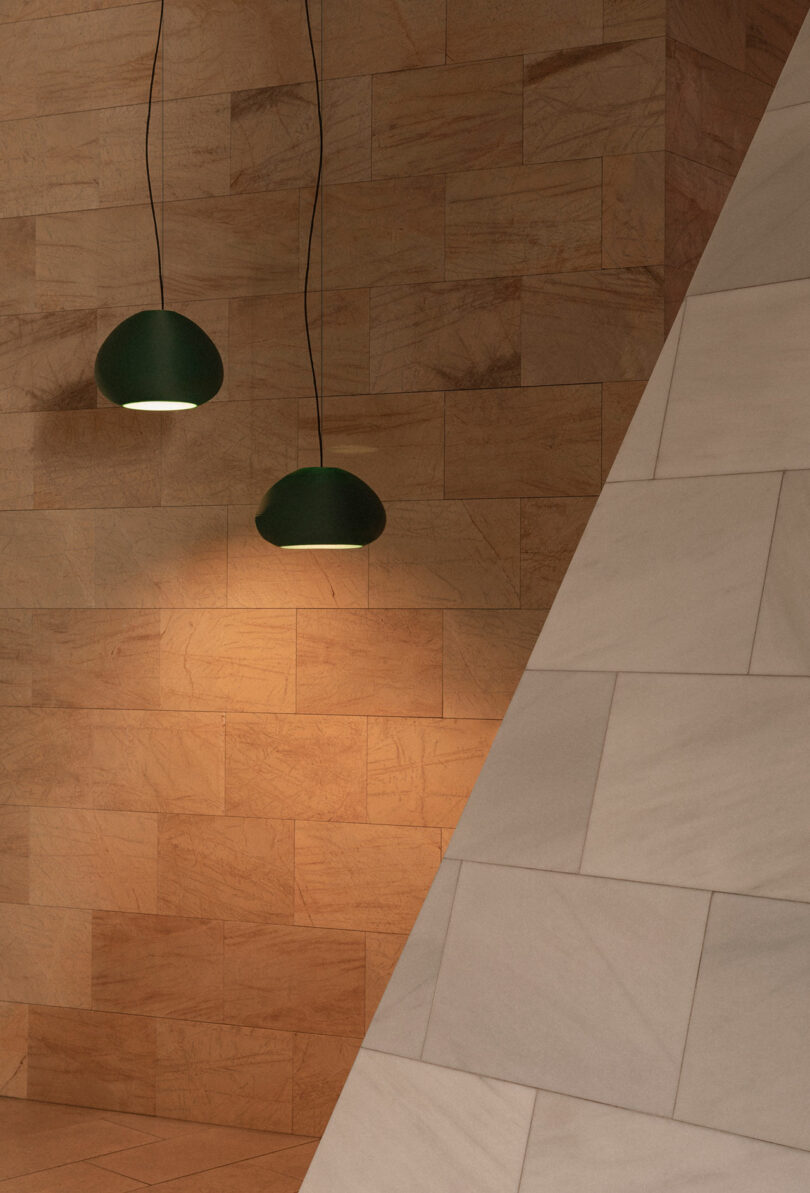
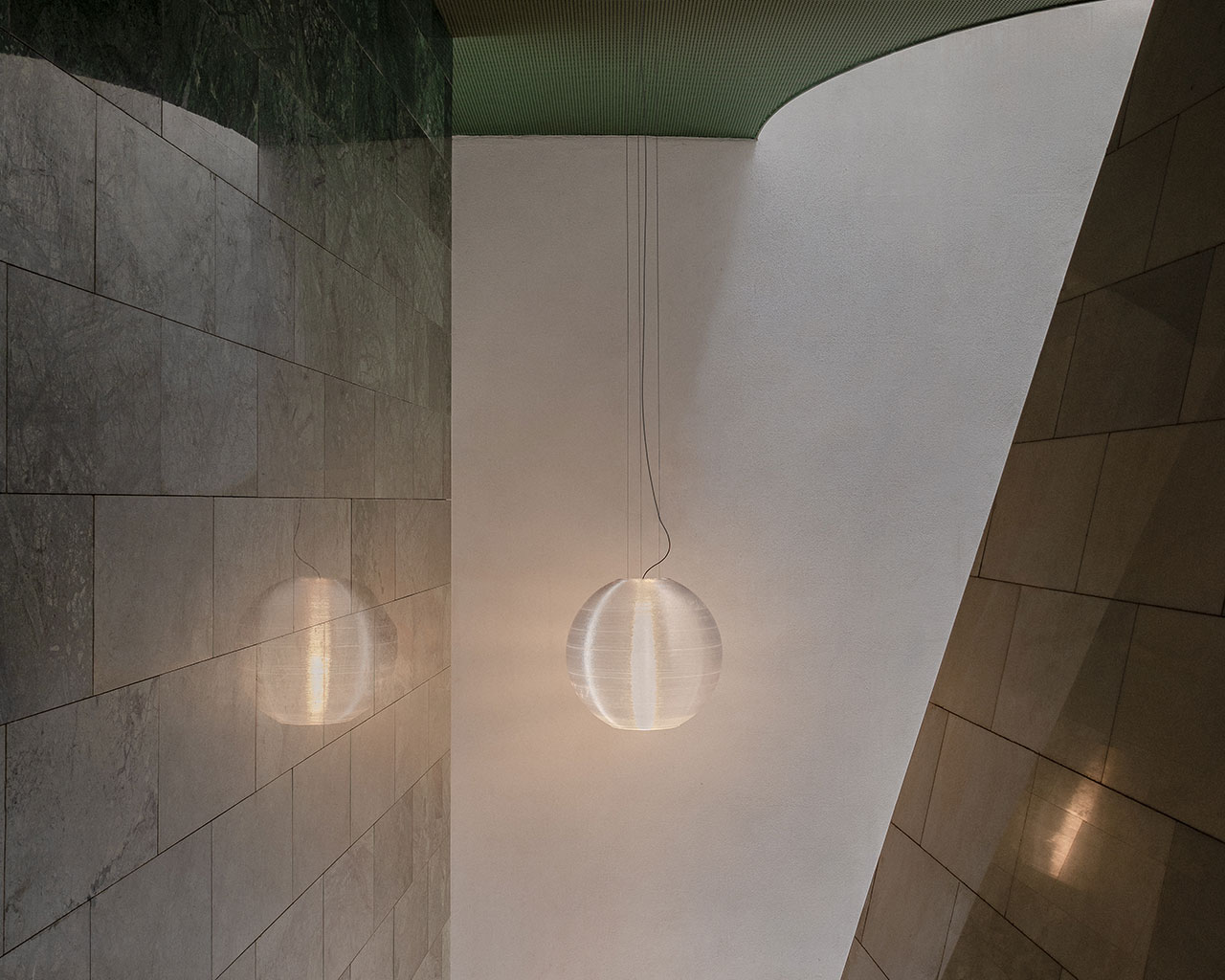
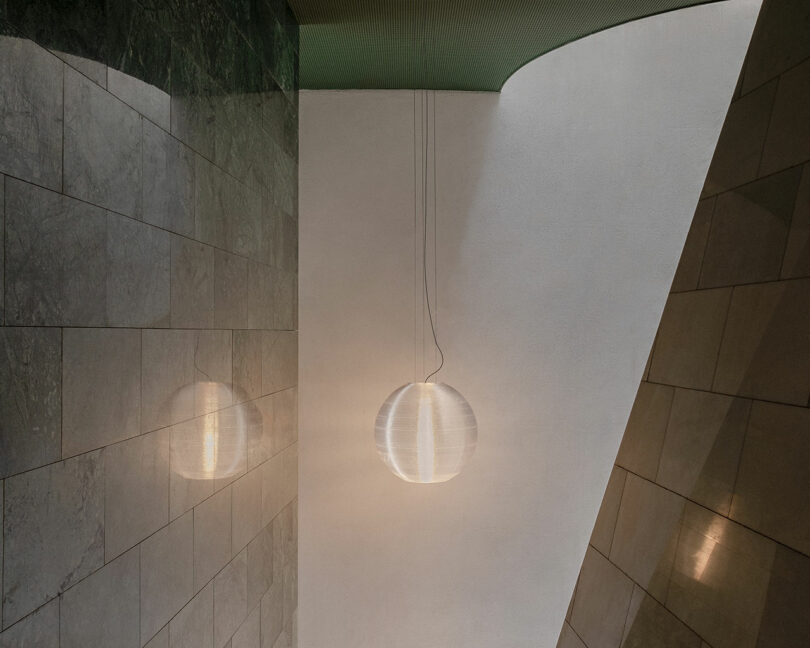
Two green pendant lights hang against a tan stone-tiled wall, with a large diagonal white-tiled structure in the foreground.

Serrano explains, “Circularity must be embedded throughout our entire consumption system; it is no use using sustainable materials if we then continue to live in a throwaway culture. We must rethink the way we produce, transport, consume and recycle our products, and this is where 3D printing offers an alternative, with on-demand, compact and automated production.” Indeed, true circularity involves not just a change of system, but a change of heart. If we are to participate in sustainability that lasts, our relationships with convenience must adapt.
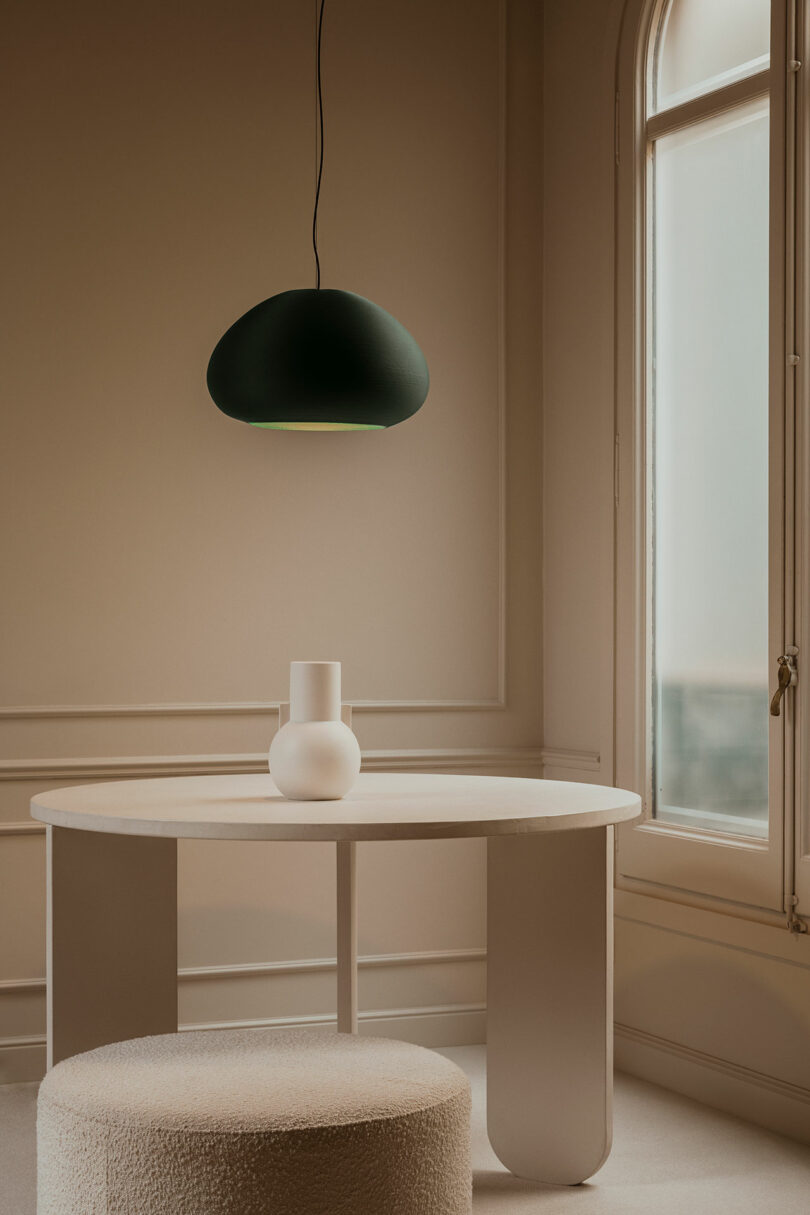
A minimalist room with a round white table, a white vase, a textured ottoman, a black pendant lamp, and a tall window letting in soft light.

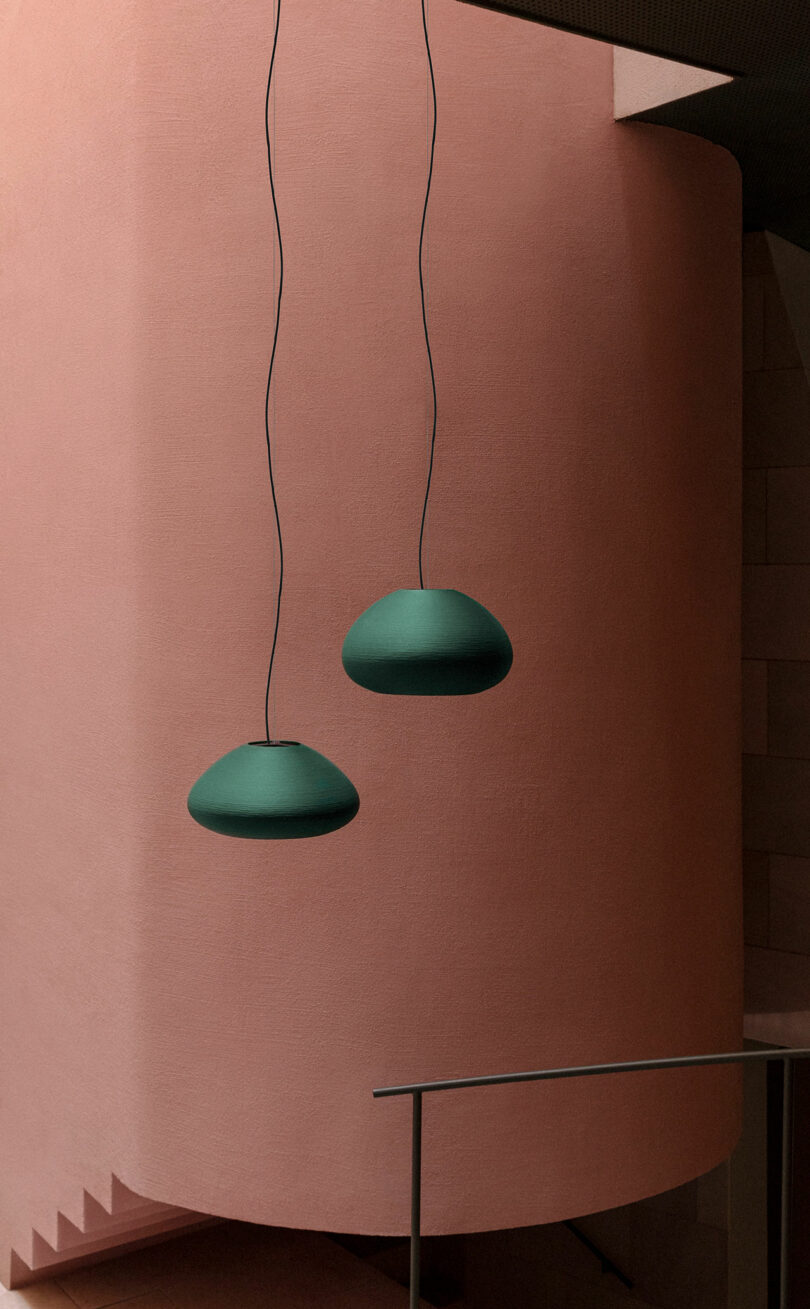
Two green pendant lights hang in front of a curved, pink-textured wall with a staircase and metal railing partially visible.

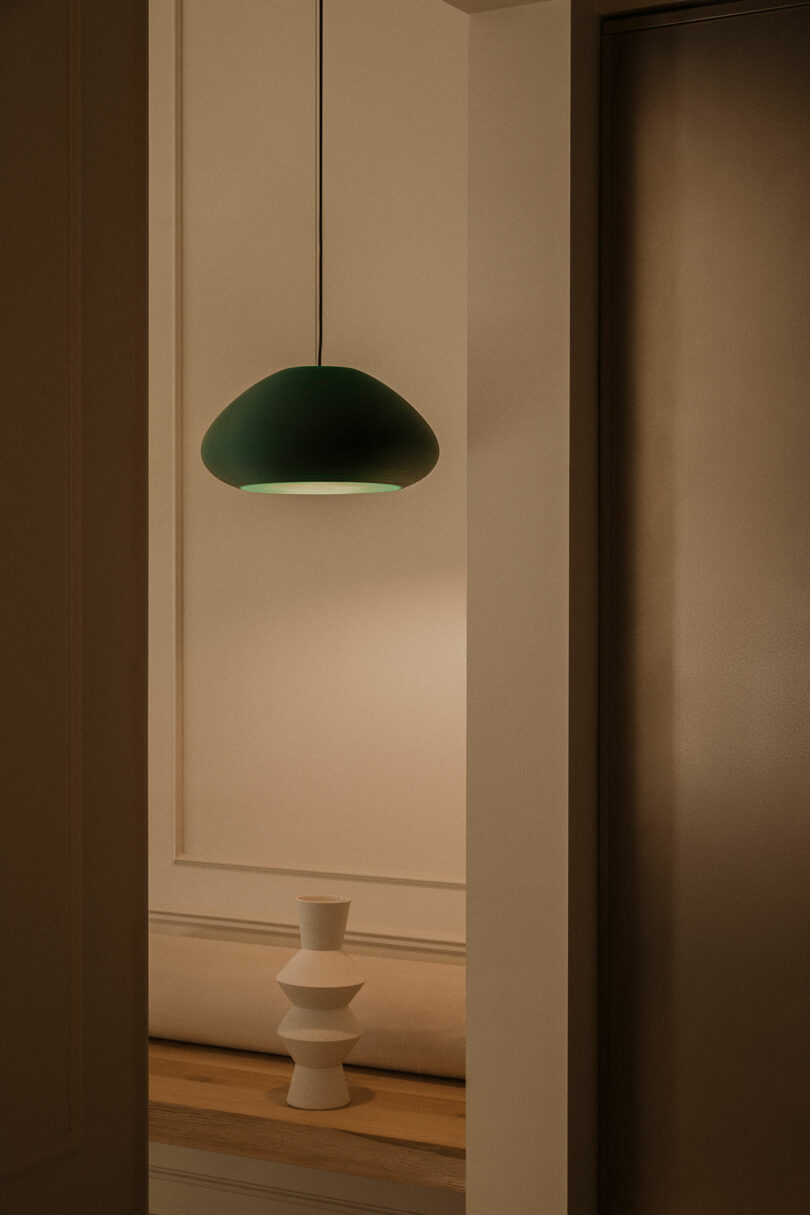
A green pendant lamp hangs above a wooden shelf holding a white geometric vase in a softly lit, minimalist interior space.

This concept of “digital craftsmanship” comes into view: wherein the power of manufacturing is returning to the individual. Not directly into their hands, surely, but under their control. The traditional, top-down approach to design is being upended through additive manufacturing, allowing technical infrastructure to be created with surprising speed, in compact spaces. Here, the traditional ‘factory settings’ we know are now reset for modern ideals. In a broader effort to democratize large-scale 3D printing, more demand creates more widespread use, which is precisely what the technology needs to succeed. In this way, 3D printing gets, cheaper, easier, and more accessible, empowering anyone with a printer to join the conversation.
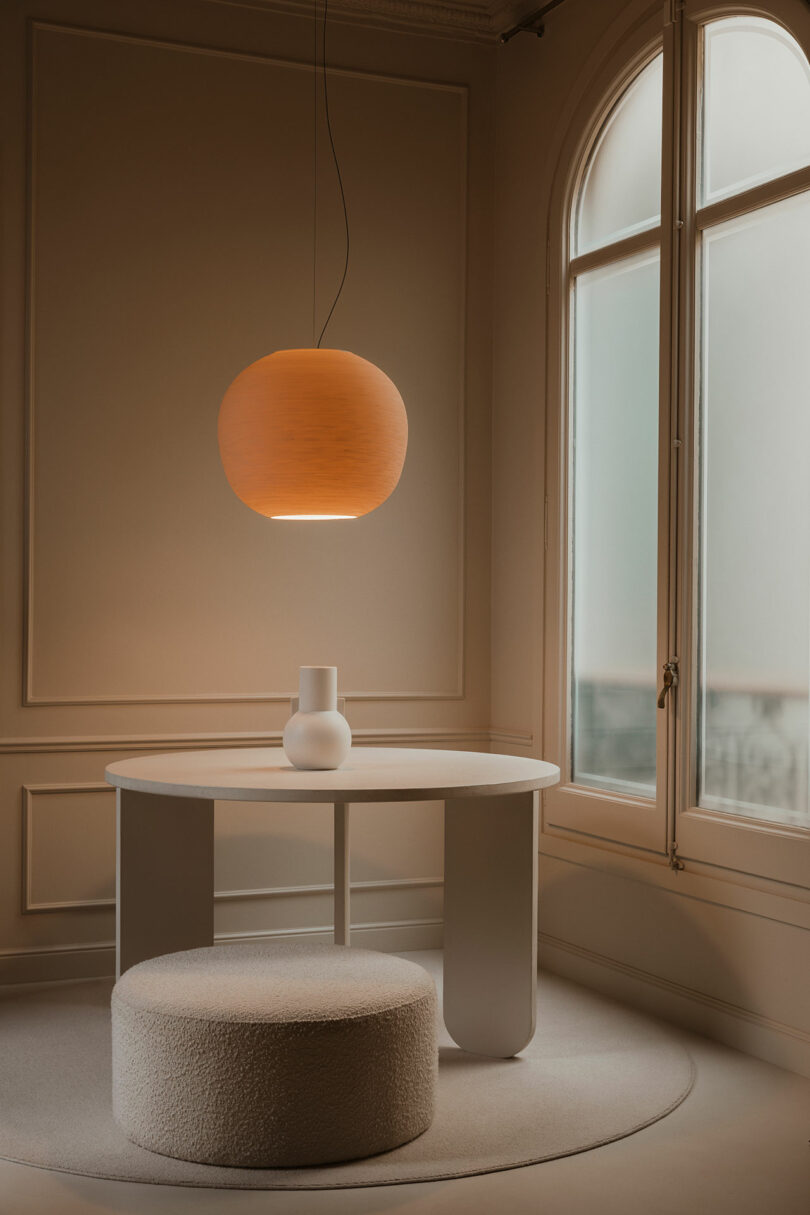
Minimalist room with a round table, white vase, textured ottoman, large window, and a hanging round pendant lamp emitting warm light.

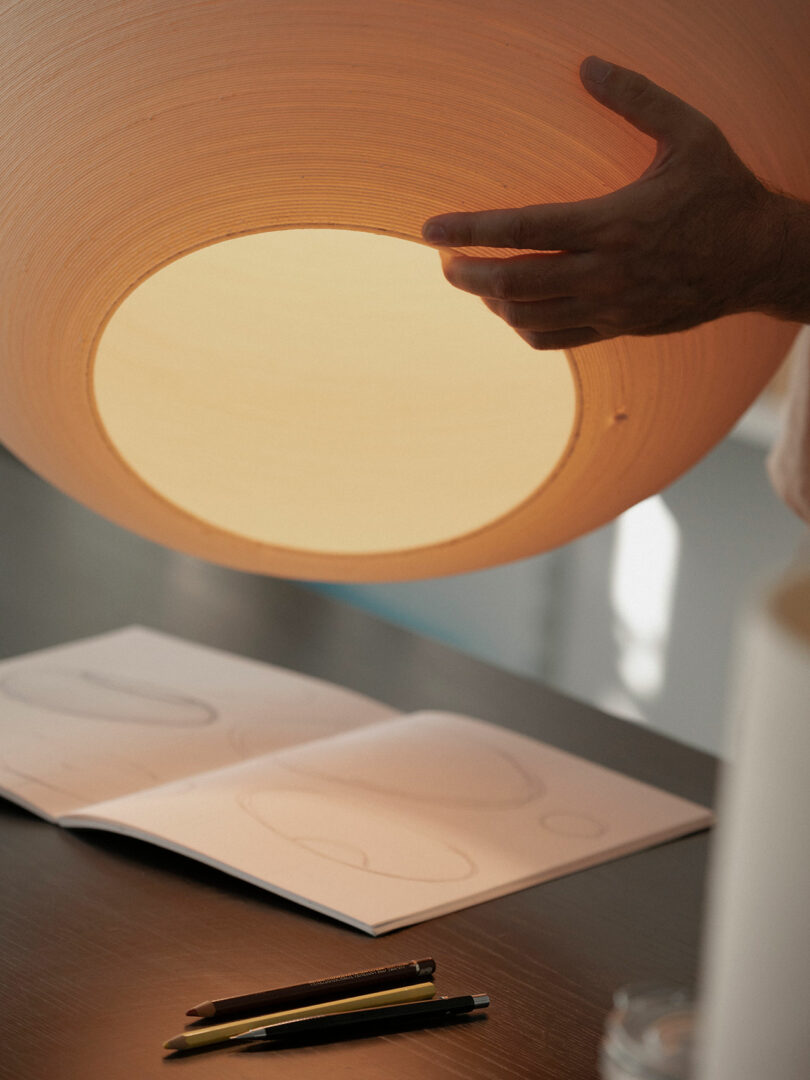
A hand adjusts a large round lampshade above a table with an open sketchbook and three pens.

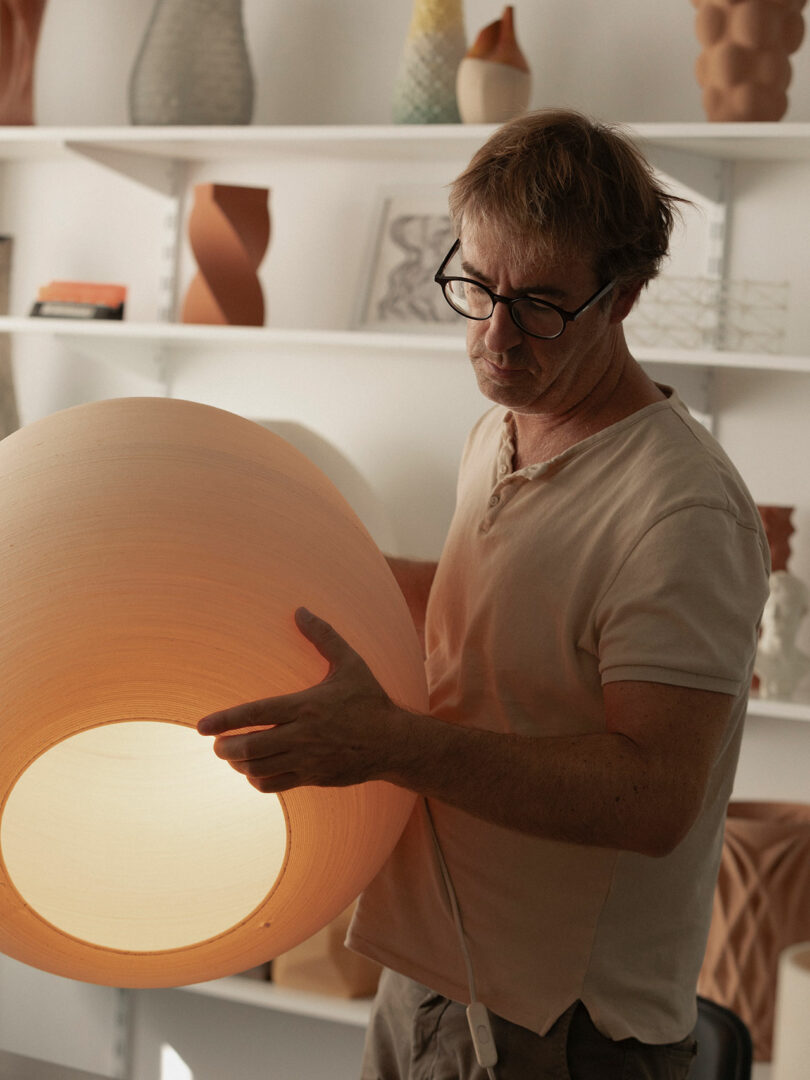
A man wearing glasses inspects a large, round, light-colored lampshade in a studio with shelves holding pottery and art objects in the background.

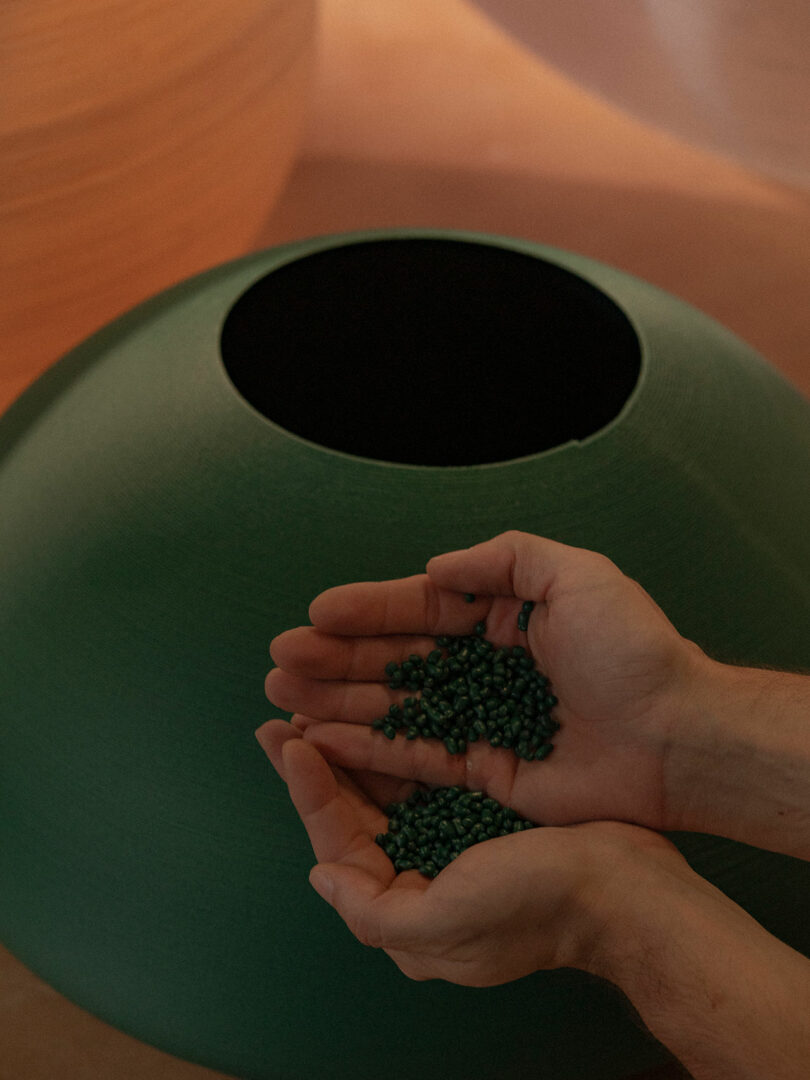
A person holds small green pellets in their cupped hands above a large green container with a round opening.

Not to be restrained by process, Tierra, Mar, y Aire reflects the structures we recognize in nature – hive structures, bubble-like volumes, and marine references dot the collection. These forms are familiar, emotional bonds ignited among our synapses. Millions of years have been spent perfecting the designs we see around us. As we look to our natural world, there is no waste, a perfect balance of flora and fauna. How can we embody these characteristics and make them real, within the parameters of our mortal minds? Serrano paints a new vision of the future, one where we ensure harmony in process and practice.
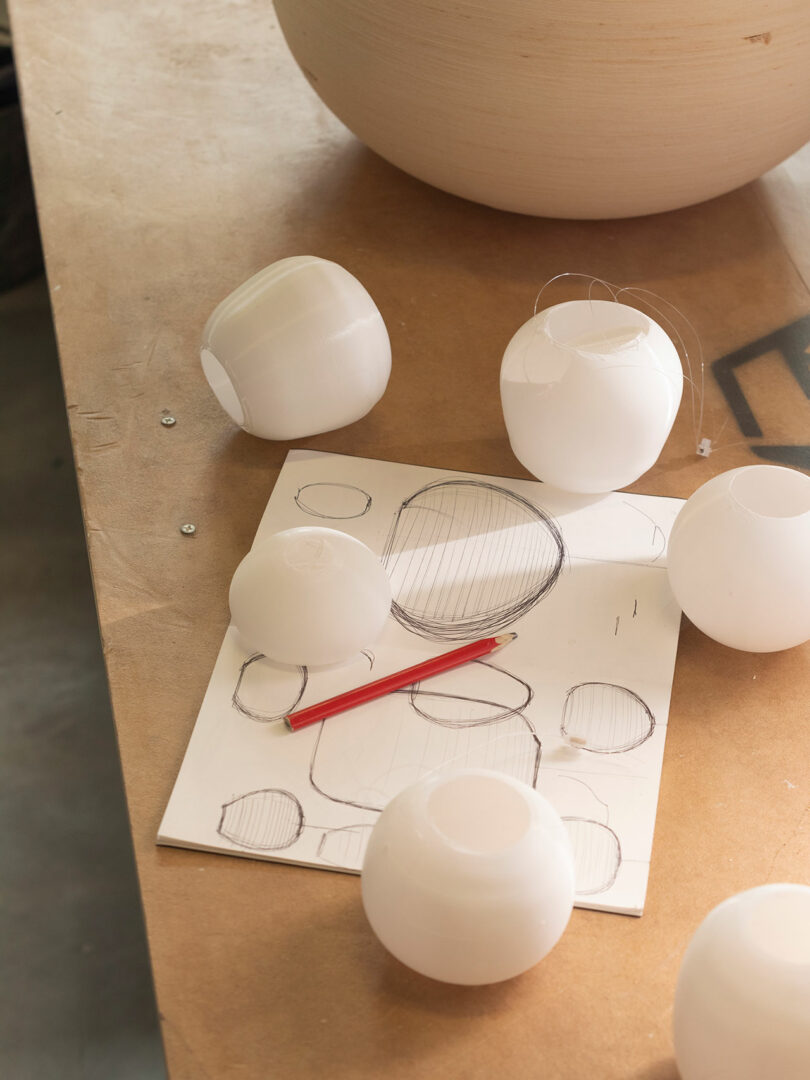
Several white round objects are placed on a table next to a sheet of paper with sketches of similar shapes and a red pencil.

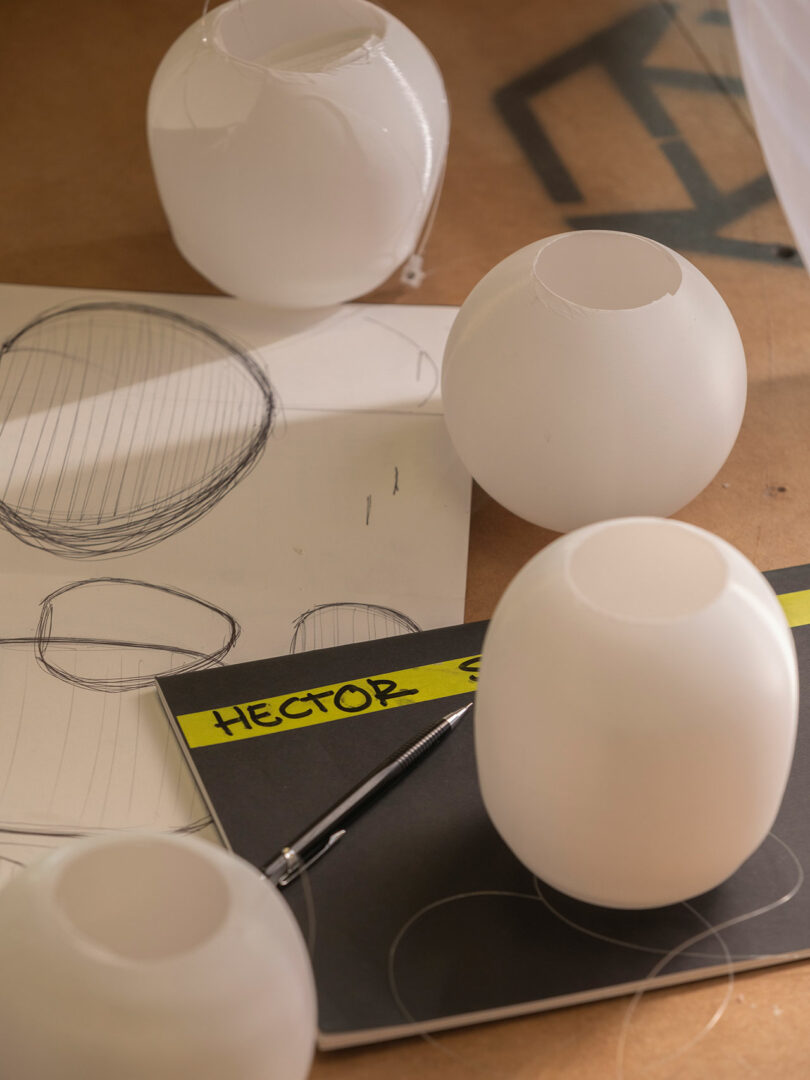
Four white spherical objects are placed on a table with sketchpads showing sphere drawings, a pen, and a folder labeled "HECTOR" in yellow.

To learn more about Tierra, Mar, y Aire by Héctor Serrano for Faro Barcelona, visit hectorserrano.com.

Photography by Javier Márquez.
F5: Jason Roskey on Baja Sur, a Welsh Chair, Sprinter Van + More

F5: Jason Roskey on Baja Sur, a Welsh Chair, Sprinter Van + More

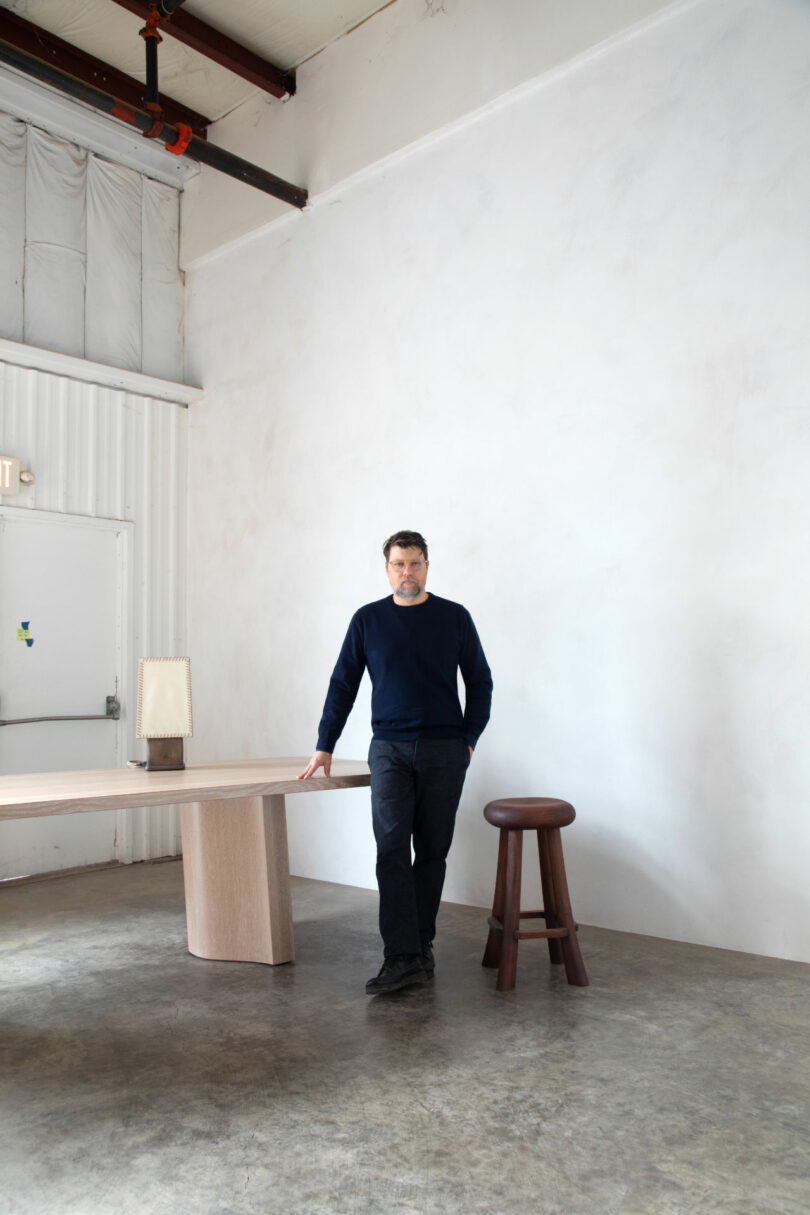
Jason Roskey grew up in Texas in a middle class, blue-collar family, but even at a young age he was inspired by art and architecture. When he was in elementary school and went on field trips to the Kimbell Art Museum in Fort Worth, he was one of the few students interested in the Louis Kahn-designed building and the works inside it.

Roskey later went to college and envisioned a more traditional path for himself. “I didn’t know I could pursue a creative life and career,” he says. “I spent years doing business-type things to make a living. It wasn’t until I moved to New York that I really began discovering furniture and interiors.”

A self-taught woodworker, Roskey built custom pieces by hand in Brooklyn. His practice evolved, and he founded Fern in 2009. Today he operates the company from a studio and workshop in Hudson, New York, continuing the region’s long tradition of quality furniture production. Roskey first designs each item, which is then fabricated in-house by a team of skilled makers.

The studio now offers lighting, which is a natural complement to the sculptural tables and chairs. Fiberglass and hand-laced goat parchment on select fixtures are paired with bases of cast aluminum, blackened steel, and sand-cast bronze. This inaugural collection is now on view alongside signature furnishings in Junctions, the debut show at the Assembly Line Annex in Tribeca, a new exhibition space by General Assembly.

Quick to capture concepts as they come to him, Roskey continues to refine his initial models. “I am always sketching and designing in multiple ways,” he notes. “Often when I have a very pressing idea I will design directly on the bench, working through templates for different shapes.”

Today, Jason Roskey joins us for Friday Five!

A white campervan parked on a dirt clearing surrounded by dense green trees, with forested mountains and a waterfall in the background—perfect for your next Friday Five adventure.

Photo: Courtesy of Fern

1. Camper Van

In 2023 our studio needed a van to move furniture parts, upholstery and other things between fabrication partners. We ordered this 2024 Sprinter Van that splits time between shop duties and as a camping rig. It’s outfitted for a bunk bed, wifi, and a lightweight canoe stores on top.

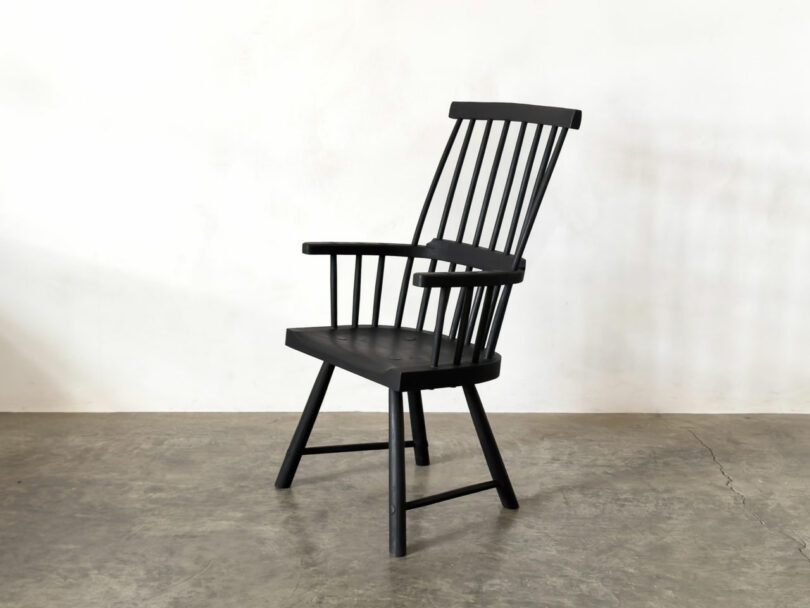
A black wooden Windsor chair with vertical spindles, armrests, and angled legs sits on a concrete floor against a plain white wall—a timeless pick for any Friday Five design roundup.

Photo: Courtesy of Fern

2. John Porritt Welsh Chair

My favorite kind of chairs are vernacular chairs found throughout the world like the farm Windsors of England, Alpine tavern chairs and the Welsh Stick Chair. The Welsh Stick Chair is really the everyman’s Windsor – much less ornate, and often made from local green woods and material from hedgerows. All parts of the chair are made using different hand tools and no parts are turned on a lathe. Because the chairs were historically made by amateur woodworkers or village craftspeople, they each have a unique character. John Porritt is based in Spencertown, New York. A native of the U.K. John has been making this simple style of chair for decades. His are the most refined (and comfortable) that I have come across. While John’s chairs share the simplicity of prior Welsh stick chairs, they are of modern proportions. Visiting John for tea in his old Dutch barn workshop to discuss all things woodworking is a treat. His chairs are among my favorite being made in the country. He is using wood he sources entirely from around his Hudson Valley home that he dries next to his shop’s wood stove. I commissioned John a few years ago to build me this 8-stick Welsh chair. Often his chairs are expertly finished to appear vintage, but he painted this one black to naturally gain a patina over time.

A small waterfall flows between rocks and trees in a lush green forest, with sunlight filtering through the leaves—a perfect spot for a peaceful Friday Five moment.

Photo: Courtesy of Fern

3. Secret Catskills Creek

My favorite way to spend time alone is fly fishing. Standing in a river waving a stick to fool a trout into eating a fly – and then releasing it – might seem silly to some, but it’s my favorite way to unwind. The Catskills region has a variety of types of rivers, and the fishing I do in these parts can be relaxing dry fly fishing using traditional flies but mostly it is long hikes and wading in boulder-strewn streams. The woods, river, geological forms and wildlife inform so much of the work I do.

A brown horse stands in dry grass near bushes, with palm trees and beige buildings in the background under a clear blue sky, offering a serene scene perfect for this week's Friday Five.

Photo: Courtesy of Fern

4. Baja Sur

I haven’t explored a lot of Mexico, but I’ve seen enough to know I love it. In college, we would make trips to the border towns – places that are no longer safe to visit. It felt like such an adventure in those days. My family and I try to make it to Baja Sur every few years. The area is made up of my favorite types of landscapes – a collision of mountains, the desert and the ocean within a close proximity.

Photo: Courtesy of Fern

5. Paris, Texas Poster

The film “Paris, Texas” by Wim Wenders made such an impact on me when I saw it while attending college in West Texas. Here was this film that kind of wasn’t really about Texas at all, but also it was. Wenders portrayal of American alienation resonated with me, a kid from a small town who didn’t really have a clue where he was going or how to get there. Of course there is the hauntingly beautiful Ry Cooder soundtrack, too.

Works by Fern’s Jason Roskey:

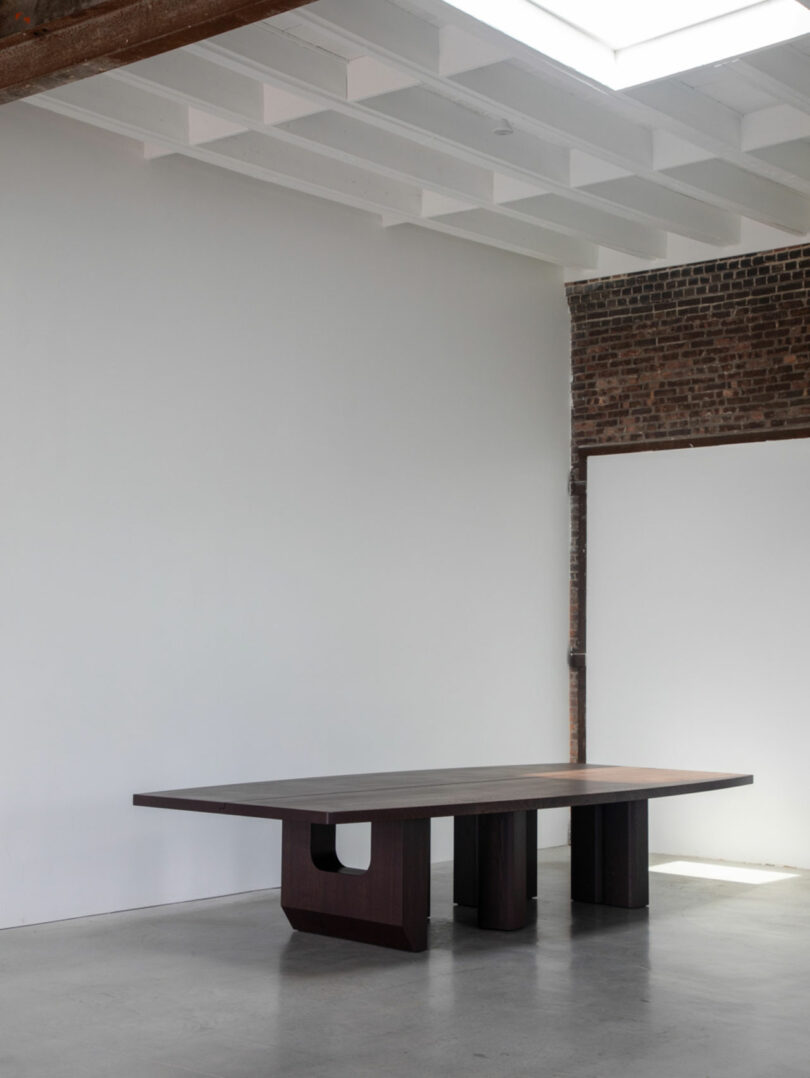
A large, dark wooden table with geometric legs stands in a minimalist room with white walls, a brick accent, and a skylight above—perfect for gathering the team for your next Friday Five discussion.

Photo: courtesy of Fern

Tulia Dining Table
Inspired by the rock formations of Texas’ Palo Duro Canyon, the Tulia Dining Table features monumental sized base components constructed from laminated hardwoods.

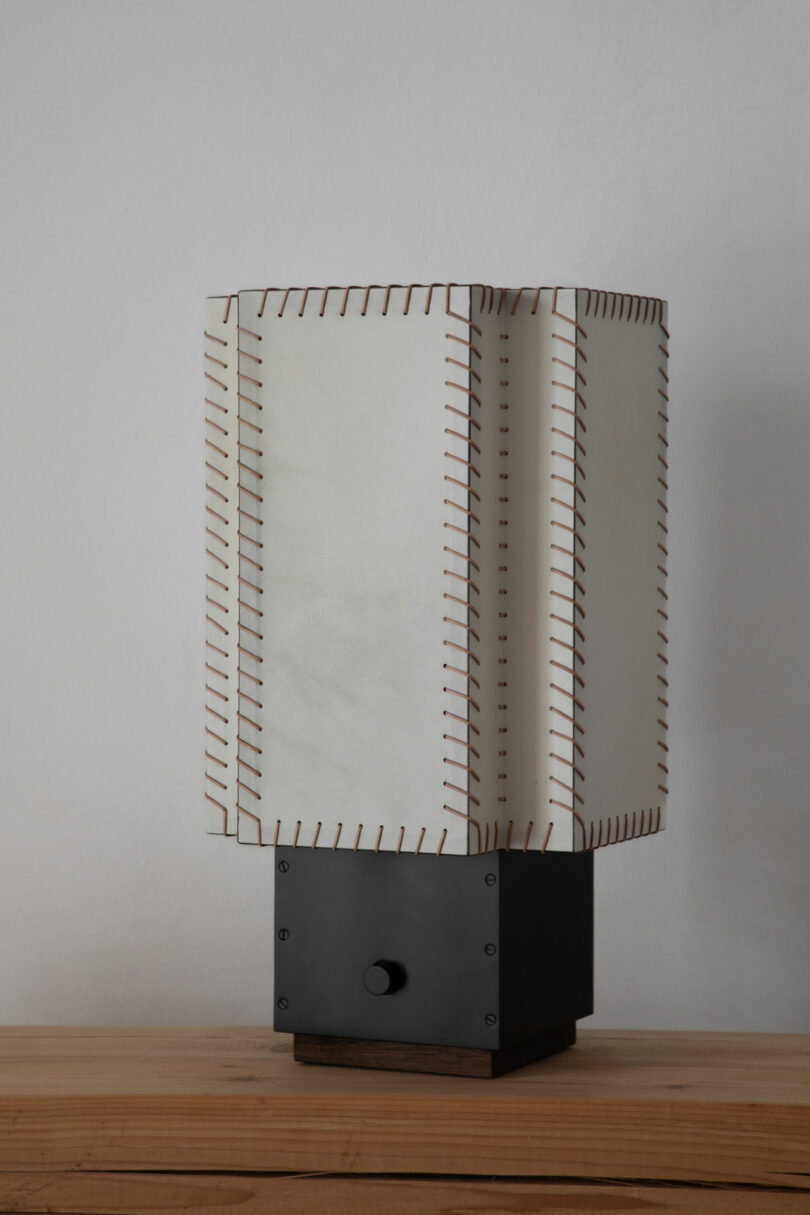
Rectangular table lamp with a white stitched shade and a black square base, featured in Friday Five, placed on a wooden surface against a plain white wall.

Photo: courtesy of Fern

Torre Table Lamp
Torre series of lamps reference Brutalist architecture forms, Casa Luis Barragán, using refined wood and metal working techniques.

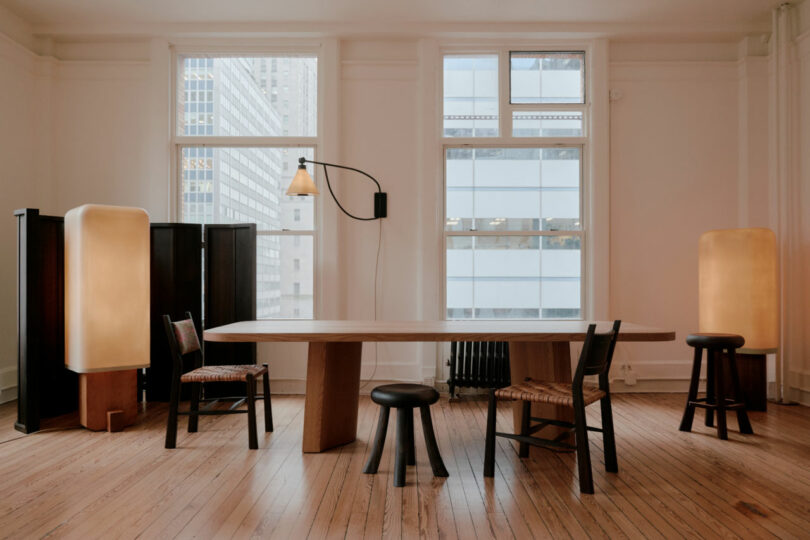
A minimalist office or dining room, perfect for a Friday Five gathering, features a large wooden table, four chairs, ambient floor lamps, and expansive windows framing a stunning cityscape.

Photo: courtesy of William Jess Laird

Junctions Exhibition at Assembly Line Annex
Junctions by Jason Roskey of Fern is a new collection of lighting and furniture crafted entirely in the Hudson Valley. Working with parchment, fiberglass, metal, and wood, the pieces investigate the interplay of weight and lightness.

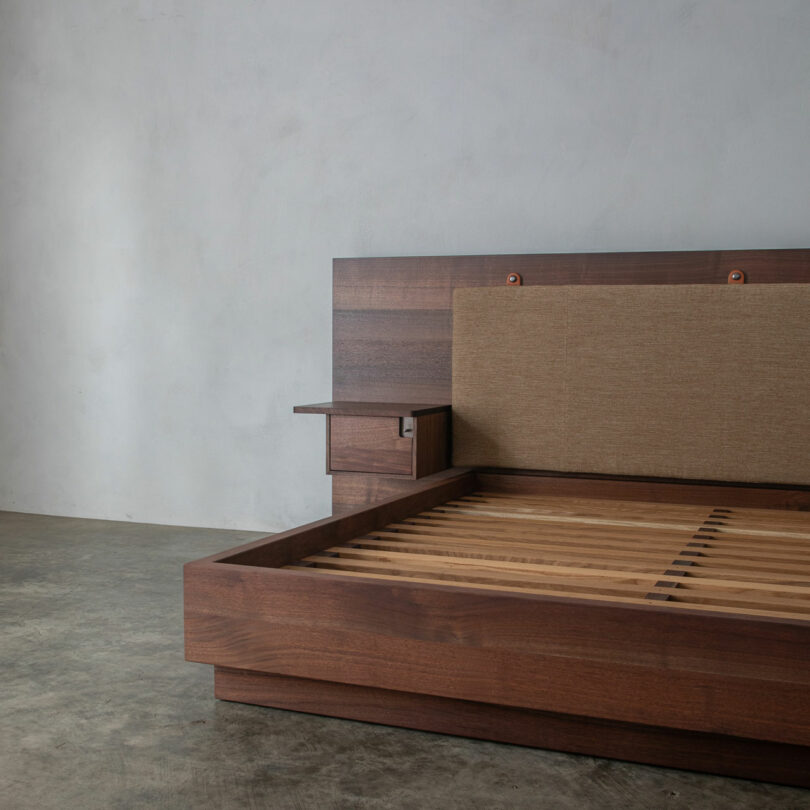
A Friday Five favorite: this wooden platform bed frame features a slatted base, built-in headboard, side shelf, and beige upholstered panel, all set against a plain wall and concrete floor.

Photo: courtesy of Fern

Ridge Bed
The Ridge Bed is a solid hardwood platform bed featuring a solid headboard with an upholstered pad that utilizes leather and darkened or white bronze hardware. The bed has two floating cabinets with cast bronze pulls, and cord management through the rear of side tables. Platform base available in plinth or standard styles.

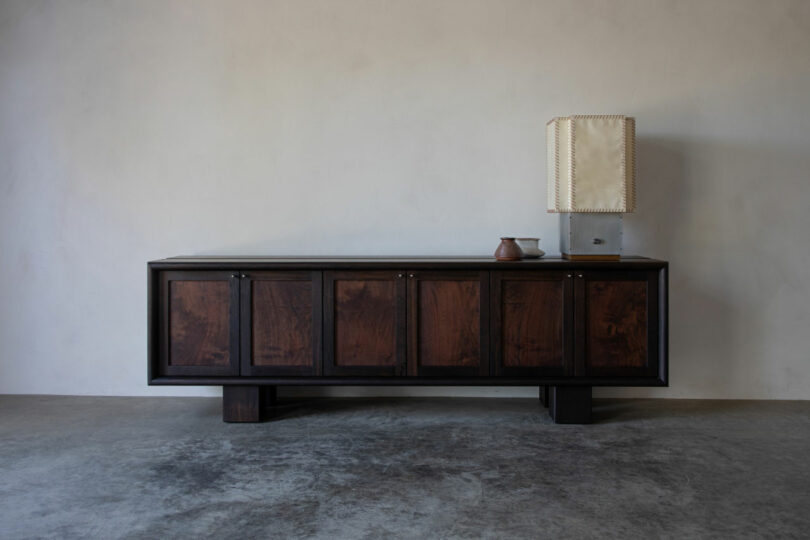
A dark wooden sideboard with four cabinet doors, featured in our Friday Five, stands against a plain wall and holds a ceramic vase and a square lamp with a stitched-edged shade.

Photo: courtesy of Fern

Elwha Cabinet
Influenced by natural valleys and extreme river environments, a deep ravine is carved into the case surround of the Elwha Cabinet. Doors are accessed with sand casted white bronze that reflect a warm silver tone.

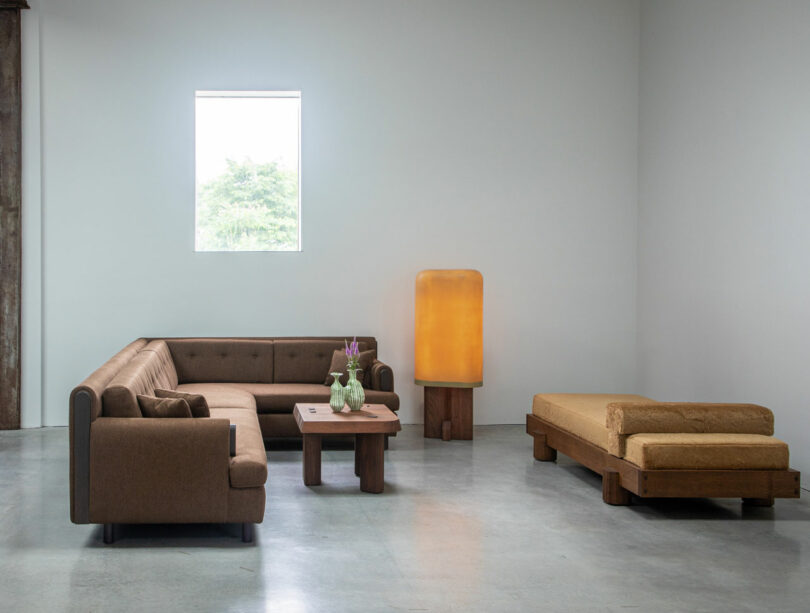
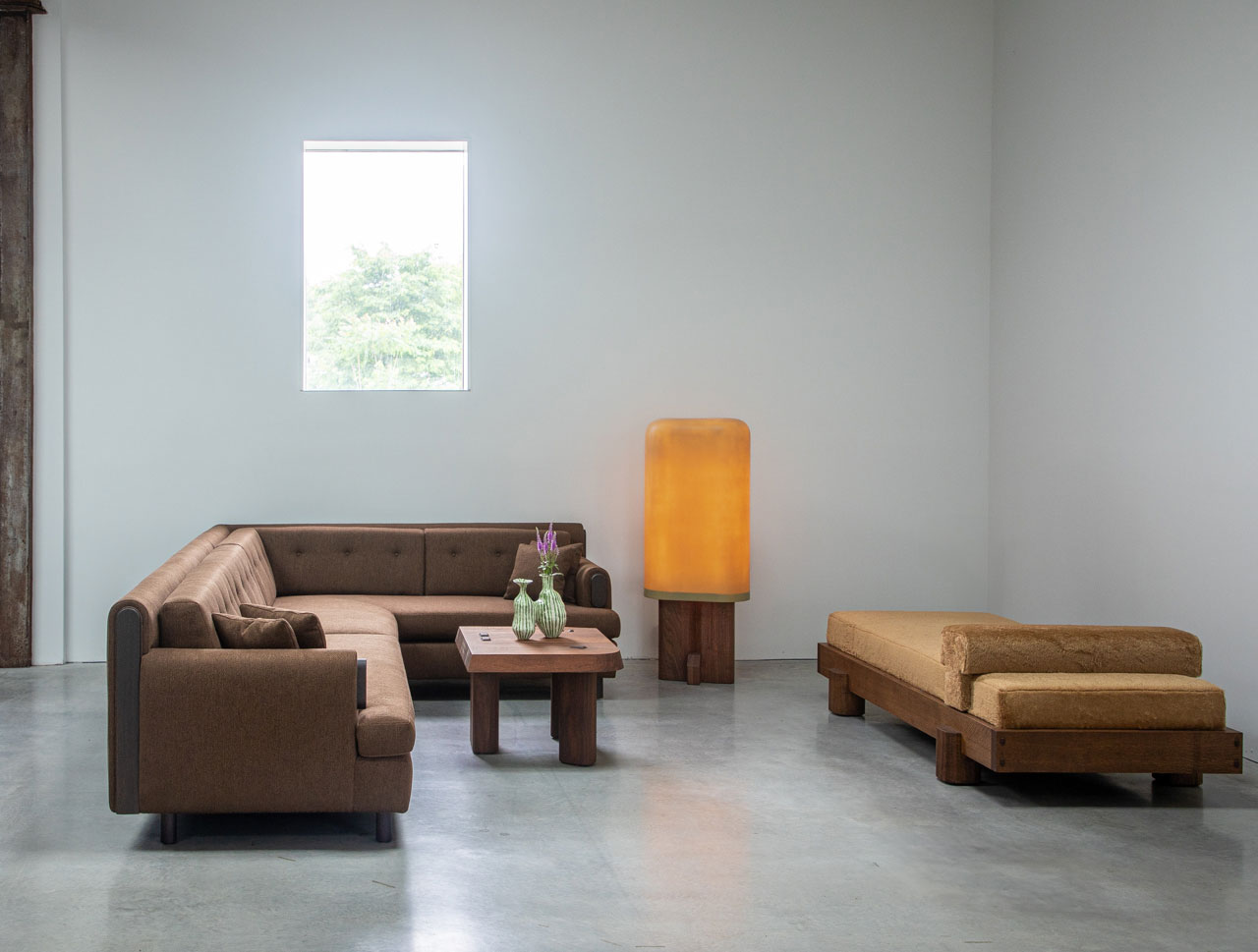
Minimalist living room with a brown sectional sofa, wooden coffee table, large glowing floor lamp, daybed, and a small window on a plain white wall—perfect inspiration for your next Friday Five.

Photo: courtesy of Fern

Sheffield Sectional, Ned Floor Lamp, Clois Daybed
Referencing middle 20th century forms, the Sheffield upholstery collection features exposed wood arm and panel components. The Ned Floor Lamp is our first foray into sculptural lighting that is an extension of the laminated wood pieces we have been exploring. Ned features a built-up hardwood base, a hand cast fiberglass & wood shade, and custom steel armature. And the Clois Daybed is a monumental-sized piece featuring hardwood construction with classic joinery details including wedged and carved wood tenons and faceted leg details. The mattress features a weighted, removable bolster, and a down filled pillow sized to match the bolster.

Holzrausch Extends a Wilhelminian-Era Frankfurt Penthouse

Holzrausch Extends a Wilhelminian-Era Frankfurt Penthouse

Few design conditions are as layered as the inhabited palimpsest – a historic building asked to absorb a contemporary life without surrendering what made it worth preserving in the first place. Penthouse Frankfurt, completed by Munich-based workshop and studio Holzrausch, navigates exactly this tension. The Wilhelminian era left behind a very particular architectural grammar – deep floor plates, generously proportioned rooms, and load-bearing masonry. Rather than smooth over these conditions or treat them as a neutral backdrop, Holzrausch worked the existing fabric into the logic of the intervention itself.

Modern kitchen with wood-paneled walls, a central stainless steel island, light-colored flooring, and large windows overlooking trees. Natural light enters through a circular skylight.

The two-story roof extension that crowns the building is the project’s boldest move, and its most structurally clarifying one. By constructing a new volume above the historic shell, the project distinguishes legibly between what was found and what was made. Inside, Kambala – an African hardwood with a warm amber grain that oxidizes gracefully – runs as full-height panelling across rooms, built-ins, and circulations alike, functioning as a continuous spatial membrane.

View of a modern kitchen with wooden walls, light wooden floor, stainless steel cabinets, and a red bench in the hallway. Natural light enters from a circular skylight above.

Warm-brushed stainless steel meets terrazzo and stained timber within the kitchen. Holzrausch, operating as a single-source supplier with designers, construction planners, and craftspeople in continuous dialogue, was particularly well positioned to resolve these junctions. The end result is coherent precisely because no single element was considered in isolation from the whole.

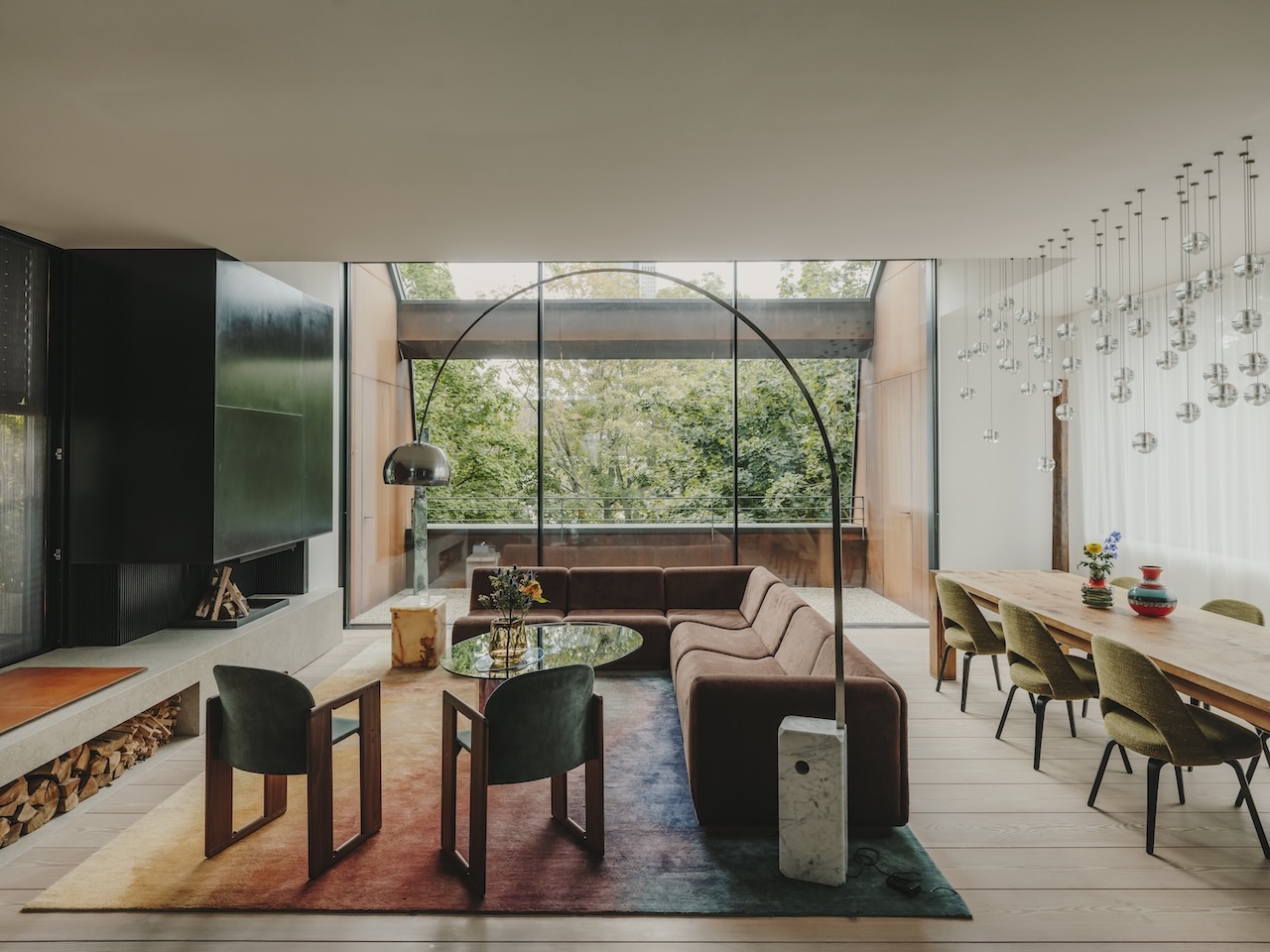
Modern living room with two green velvet chairs, a curved floor lamp, a wall-mounted fireplace, stacked firewood, and large windows overlooking greenery.

The client came with an art collection, of which required a space with walls that do not compete, and circulation that allowed for sustained attention. The calm sequencing of rooms was a direct response to this need, with the Kambala shell providing a visual ground warm enough to humanize the spaces without asserting itself against the works on display. It is a balance that gallery-adjacent residences frequently fail to strike, defaulting either to the clinical neutrality of a white cube or to an exuberant domesticity that overwhelms the collection.

Minimalist staircase with light wood steps and a concrete banister, surrounded by wooden walls and modern artwork; skylight above and bright orange sculpture at the top.

A curved staircase with a smooth, light-colored finish ascends beside a wooden wall featuring a framed abstract artwork in black, white, and gray tones.

Modern dining and kitchen area with wood-paneled walls, minimalist furniture, a large forest art piece, and spherical hanging light fixtures.

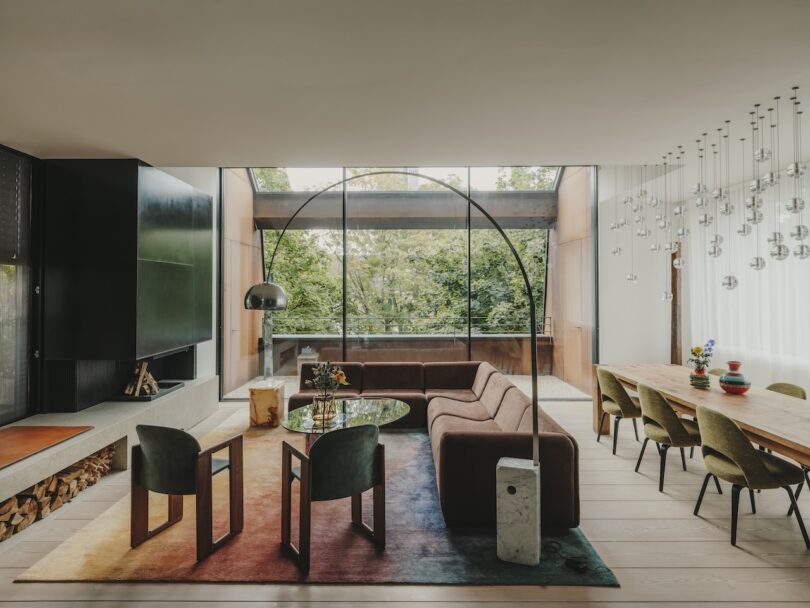
Modern living room with wood-paneled walls, green chairs, a glass coffee table, an arc floor lamp, and contemporary art, adjacent to an open kitchen with a minimalist design.

A modern living room with a dark metal fireplace, stacked firewood, a marble side table with a glass of water, and a brown velvet armchair.

Modern home office with built-in wooden shelves, books, a desk with a chair, and large sliding glass doors opening to a garden patio with greenery outside.

View more information on Holzrausch’s website.

Photography by Salva Lopez.

Butter, Miso, + Mushrooms: Three Books Where Focus Meets Curiosity

Butter, Miso, + Mushrooms: Three Books Where Focus Meets Curiosity

There’s a particular discipline in building an entire book around a single ingredient. It requires curiosity—and the confidence that one subject, examined closely enough, can hold a reader’s attention. This Month, Anna Stockwell’s The Butter Book, Bonnie Chung’s new edition of Miso: From Japanese Classics to Everyday Umami, and Taschen’s The Gourmand’s Mushroom present butter, miso, and mushrooms not just as pantry staples, but as substances with visual presence—explored through recipe techniques, cultural context, and striking close-up “glamour” photography. Each title, in its own way, argues for the ingredient as both material and muse.
An open cookbook shows a recipe for whipped butter with an image of butter on a pedestal; nearby are a butter wrapper, wooden utensils, and a rolling pin on a cutting board, inviting you to enjoy the taste of homemade goodness.

An open cookbook displays a recipe and a photo of a butter board with vegetables and bread, inviting you to experience the taste, with a translucent page labeled "The Butter Book" partially covering the book.

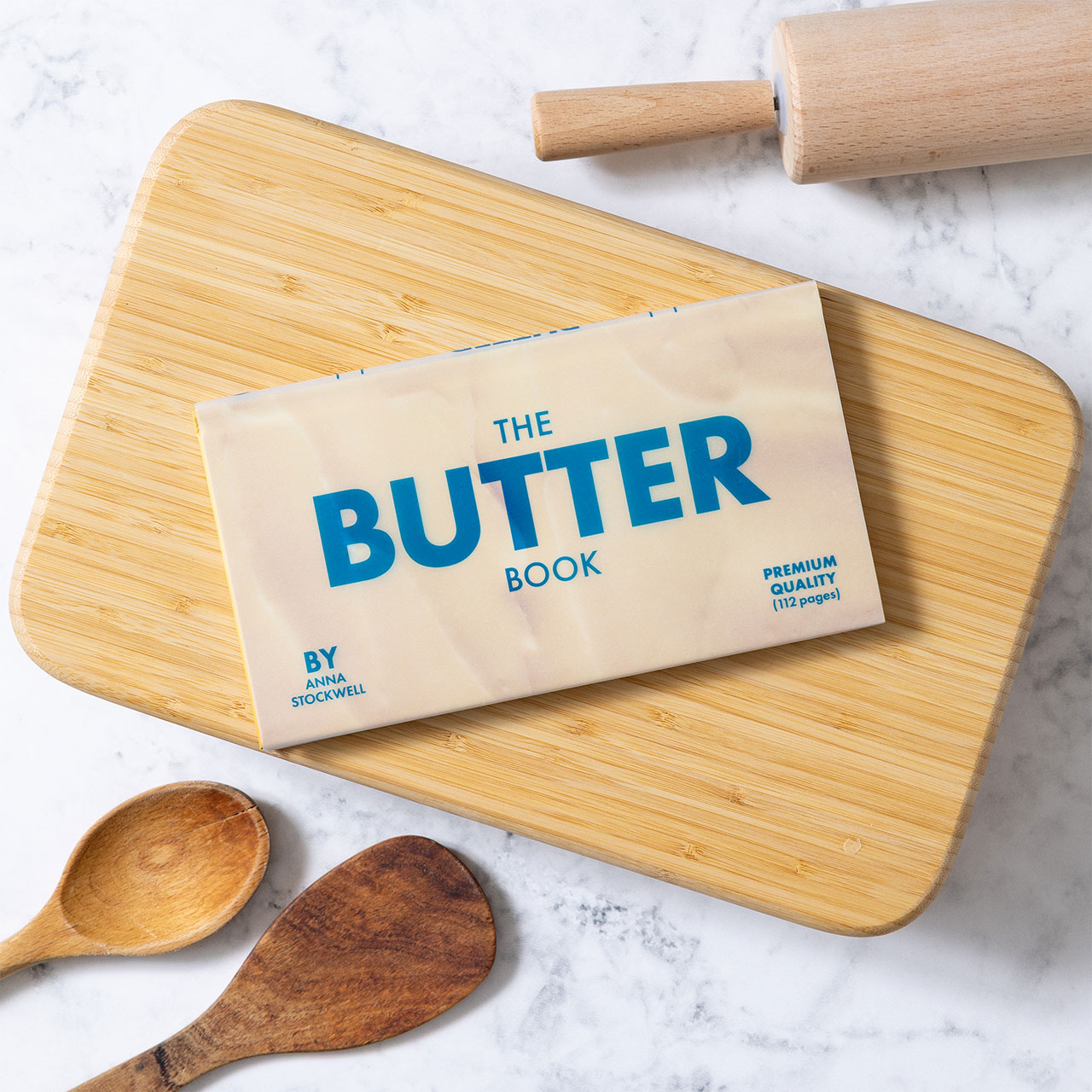
Initially, I was drawn (pun intended) to The Butter Book’s design, a clever trompe l’oeil that mimics a stick of butter. The volume of churned, cream-colored pages arrives wrapped in a vellum book jacket adorned with all-too-familiar blue typography. Anna Stockwell shared that this was Chronicle Books Food & Lifestyle Art Director Lizzie Vaughn’s concept. A veteran of the test kitchens at Bon Appétit and Epicurious, Stockwell writes with the confidence of someone who has browned, clarified, whipped, and emulsified her way through years of recipe development. She reveals how butter can baste scallops into tenderness and gloss a roast chicken until it gleams. From savory puttanesca to hot honey, the pages on compound butters demonstrate modular, creative ways to layer flavor into even the most mundane dish.

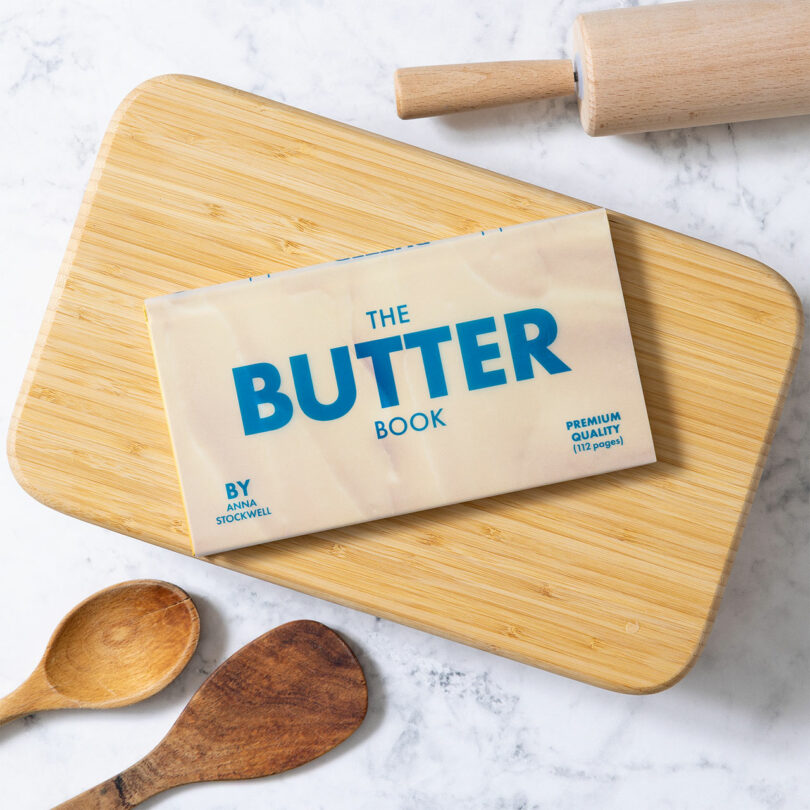
A book titled "The Butter Book," authored by Anna Stockwell, features a cover designed to look like a stick of butter and promises to elevate your taste experience.

Table of contents page for a butter-themed book, listing sections, page numbers, and recipe titles—organized into "Ten Favorite Recipes" and "That Depend on Butter"—all highlighting the irresistible taste of butter.

Beyond recipes, Stockwell explores one of the oldest human-made foods—synonymous with the history of cooking itself—by diving into the world of butter accessories like molds, slicers, and warmers. Though we bonded over a shared disdain for single-use kitchen gadgets, we both admitted a soft spot for the Coquillor, a silver butter dish and curler in one that extrudes a perfect rosette with a gentle press. Inevitably, our conversation turned to today’s butter renaissance—swooped whipped mounds and edible sculptures populating brand launches and trendy restaurant scenes. As all trends stem from something, Stockwell traced the lineage of butter sculpture back to 1536, when chef Bartolomeo Scappi carved Hercules with a lion as a dinner centerpiece in Rome. As butter continues to permeate food, fashion, and interiors—as hue, reference, and indulgent signifier—The Butter Book emerges as a timely, design-forward homage.

A bowl of miso udon carbonara topped with a raw duck egg yolk, shredded cheese, and small pieces of bacon sits on a dark blue surface, promising a rich taste experience alongside the recipe and instructions.

Bonnie Chung’s self-proclaimed magnum opus—and love letter to her favorite ingredient—Miso: From Japanese Classics to Everyday Umami approaches its subject with similar focus, from the perspective of fermentation and balance. This new and expanded edition positions miso, a paste that builds depth with minimal volume, as an essential tool in contemporary cooking. Chung outlines various types and tasting notes, explains how miso is made, and provides guidance for home fermentation alongside profiles of innovative, sustainable producers. The book moves from recognizable dishes, such as miso soup and miso black cod, to more unexpected applications like miso udon carbonara and white miso ice cream with hazelnut praline. Throughout, Chung frames miso not only as a structural ingredient, but as “a chef’s secret.” By adding a spoonful to enrich a tomato sauce, intensify a gravy, or deepen a dessert, she encourages us to see miso not as exotic, but essential. Visually, the book draws on the richness and tonal range of miso for its striking cover—a full-bleed, close-up photograph capturing shades from deep russet to pale ochre, reminiscent of the Grand Canyon at sunset.

Three white books stand upright, each with a large photo on the cover—a fried egg, a lemon with leaves, and a mushroom—capturing the diverse taste of each ingredient. The titles are "Egg," "Lemon," and "Mushroom.

A hardcover book titled "Mushroom," featuring a large mushroom photograph on the front cover, stands upright on a white surface—an inviting look at the taste and beauty of fungi against a plain background.

From the same authors behind Taschen’s iconic Egg and Lemon collections comes the third book in the series, The Gourmand’s Mushroom: A Collection of Stories & Recipes. David Lane and Marina Tweed, founders of the UK-based Gourmand Magazine, explore one of the more mysterious ingredients on Earth, bringing together culinary craft and cultural inquiry. The volume opens with a reflection on impermanence, foraging, and culinary memory by chef and food writer Jeremy Lee. Photography captures caps and gills as sculpture, pattern, and form—a visual feast that situates fungi within art, folklore, science, and design. This in-depth mycological journey honors mushrooms as fleeting marvels and endlessly inventive ingredients. It’s the expansive collection of original recipes, from funghi sott’olio to classic duxelles and Hungarian mushroom pie (gombás lepény), that makes this more than just a chic coffee table book.

Open book showing a cluster of pale yellow mushrooms on the left page and the word "Stories" in large black text on the right, inviting you to discover the taste of new adventures within its pages.

Open cookbook showing a mushroom tempura recipe on the left page and chopsticks holding a tempura mushroom dripping sauce on the right, capturing the irresistible taste of this crispy dish against a white background.

In the end, these books leave you with a hunger rooted as much in curiosity as in appetite. Each, devoted to a single ingredient, creates space for deeper understanding: how it behaves under heat, how it carries culture, and how it shapes the look and feel of a dish. For cooks who approach food through a design lens, the visual and structural qualities of these ingredients extend beyond taste—through butter’s glossy sheen, miso’s dense richness, and mushrooms’ architectural potential. Butter teaches restraint and indulgence in the same breath. Miso reminds us that time is an ingredient we cannot shortcut. Mushrooms insist we look closer at what grows in the shadows. Alone, these ingredients may seem straightforward. Together, however, they feel almost conspiratorial. So yes, I went ahead and made brown butter–miso glazed maitakes for dinner. I suggest you do the same.

An open cookbook displays a mushroom omelette recipe on the left page and a plated mushroom omelette, ready to taste with a fork and knife, on the right page. Open book showing a foreword on the left page and four brown mushrooms with soil and roots attached on the right page, inviting curiosity about their earthy taste, all set against a white background.

Continue reading for more information regarding each monograph and its availability:

The Butter Book
Chronicle Books, March 17, 2026

The Gourmand’s Mushroom. A Collection of Stories & Recipes
TASCHEN – available end of March 2026

Miso: from Japanese Classics to Everyday Umami
(Pavilion Books, Harper Collins in January 2026)
Photography by Yuki Suguira
Food & Prop Styling by Aya Nishimura
Illustrations by Merlin Evans

Powells Headquarters is a Showcase for the Firm and Local Makers

Powell’s Headquarters is a Showcase for the Firm and Local Makers

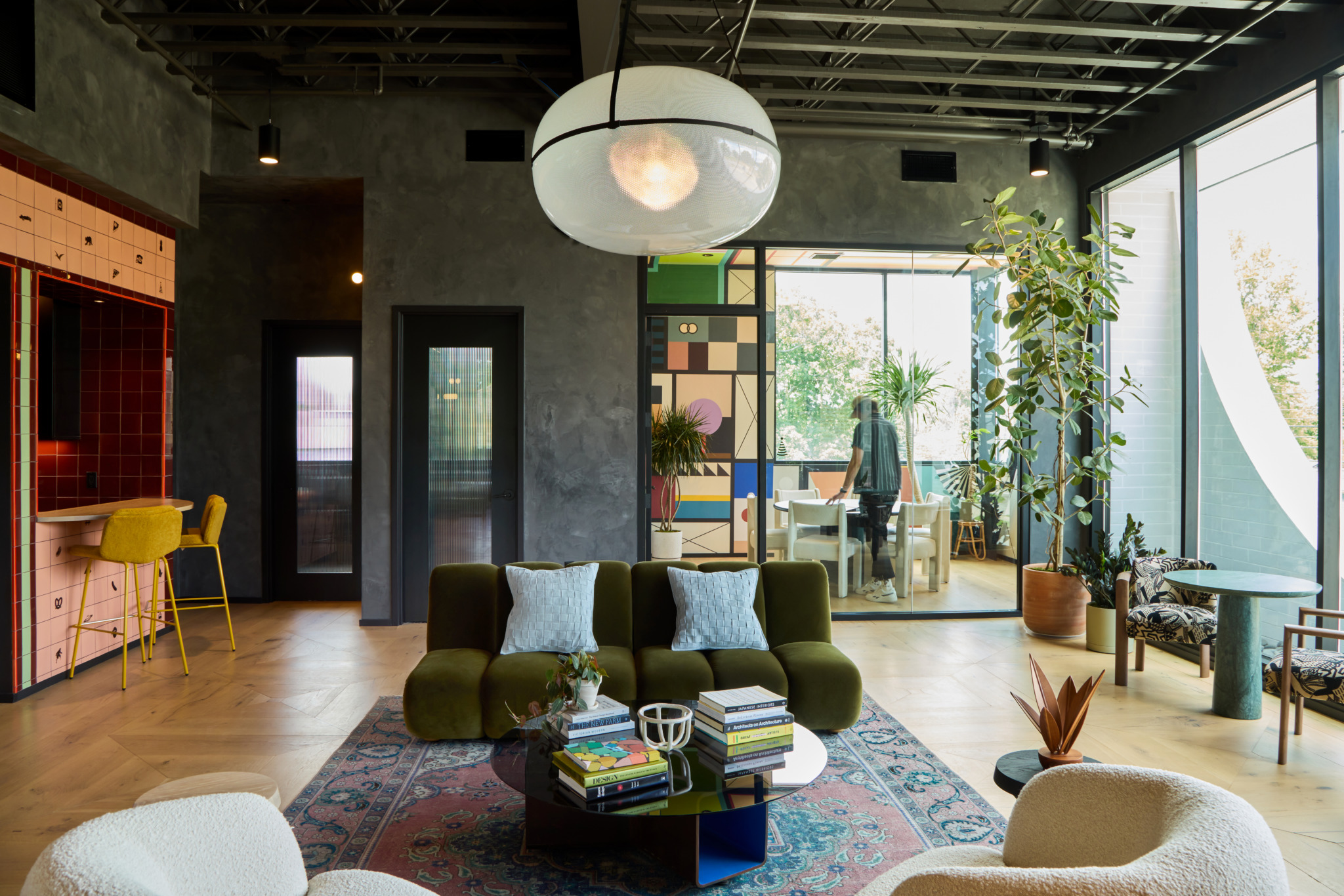
Corporate environments typically reference a brand aesthetic paired with contract furnishings to support staff as they perform their daily tasks. When architects envision their own spaces, they often strive to capture a seamless blend of form and function that mirrors the firm’s signature structures.

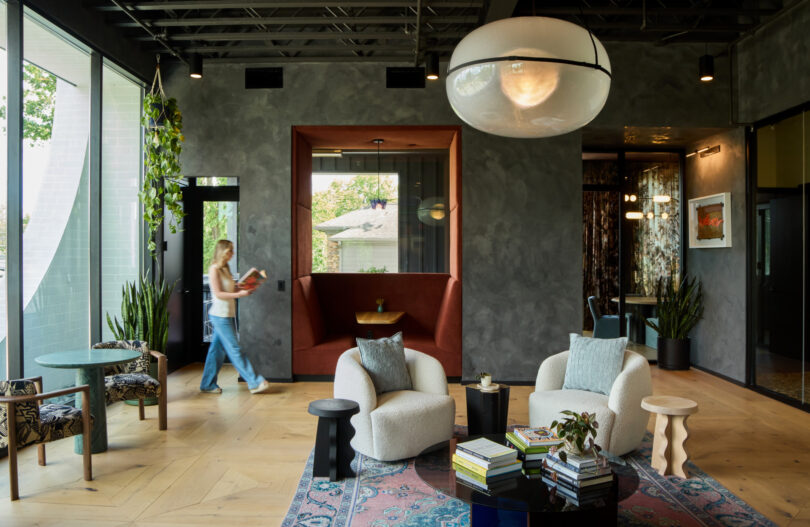
Modern lounge with armchairs, tables, books, plants, and a large Powell overhead light; a person walks by expansive windows, and a built-in seating alcove is visible in the background.

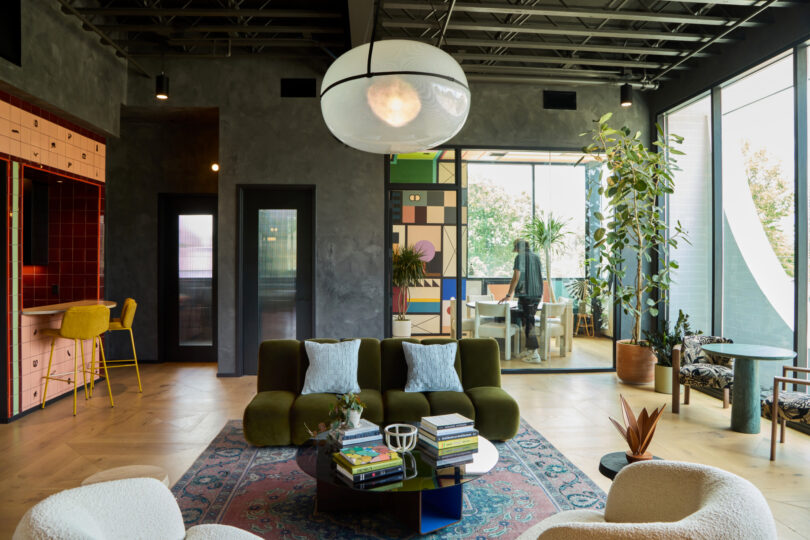
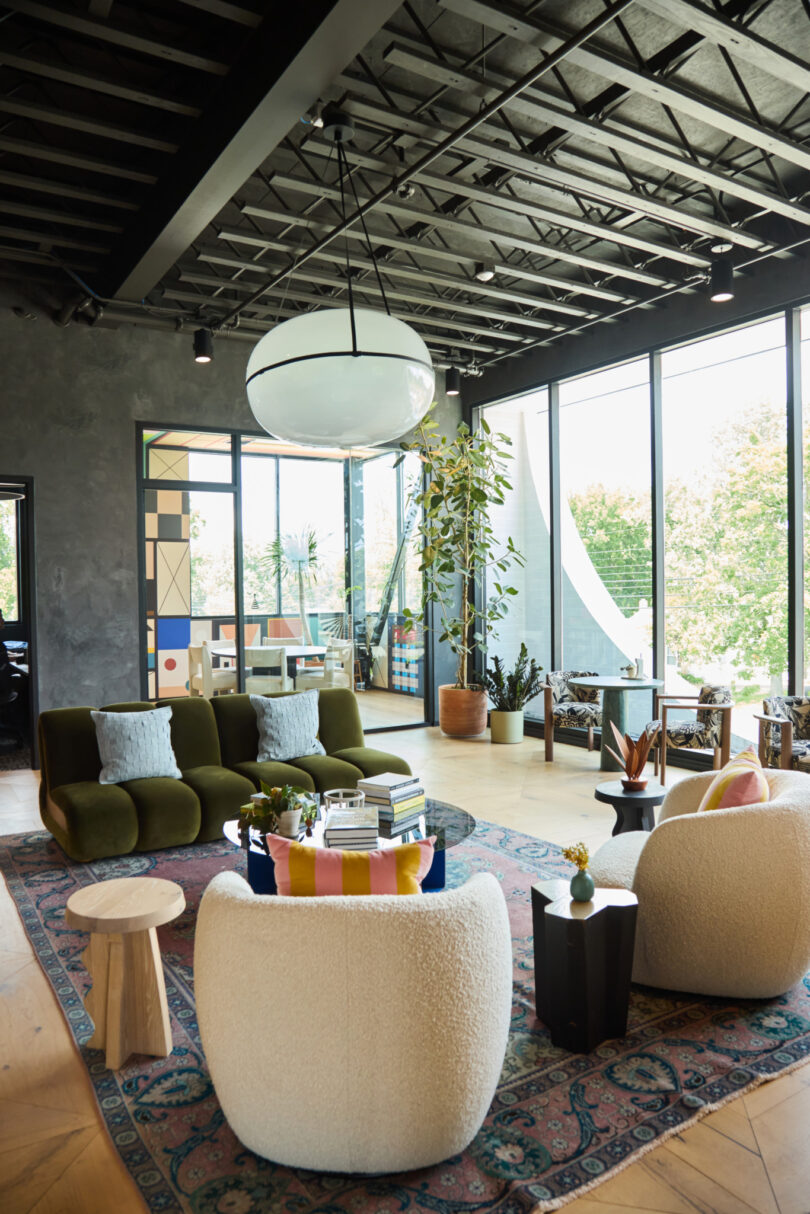
Modern Powell office lounge with large windows, green and white seating, a patterned rug, potted plants, and a circular overhead light fixture.

When the Powell team envisioned their own headquarters, they decided to create a contemporary workspace that doubles as a showcase of their capabilities. “As an architecture, design, and construction firm, we wanted to bring our clients into a space where all of that was fully integrated and to show them what we can do,” says Katie Vance, partner and chief creative officer at Powell.

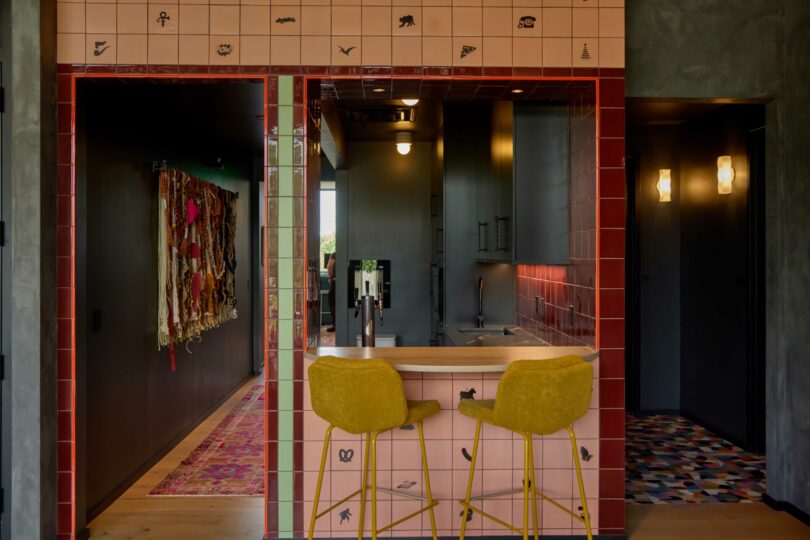
A modern Powell kitchen with a pink tiled breakfast bar, two yellow stools, dark cabinetry, and eclectic wall decor and flooring in the surrounding areas.

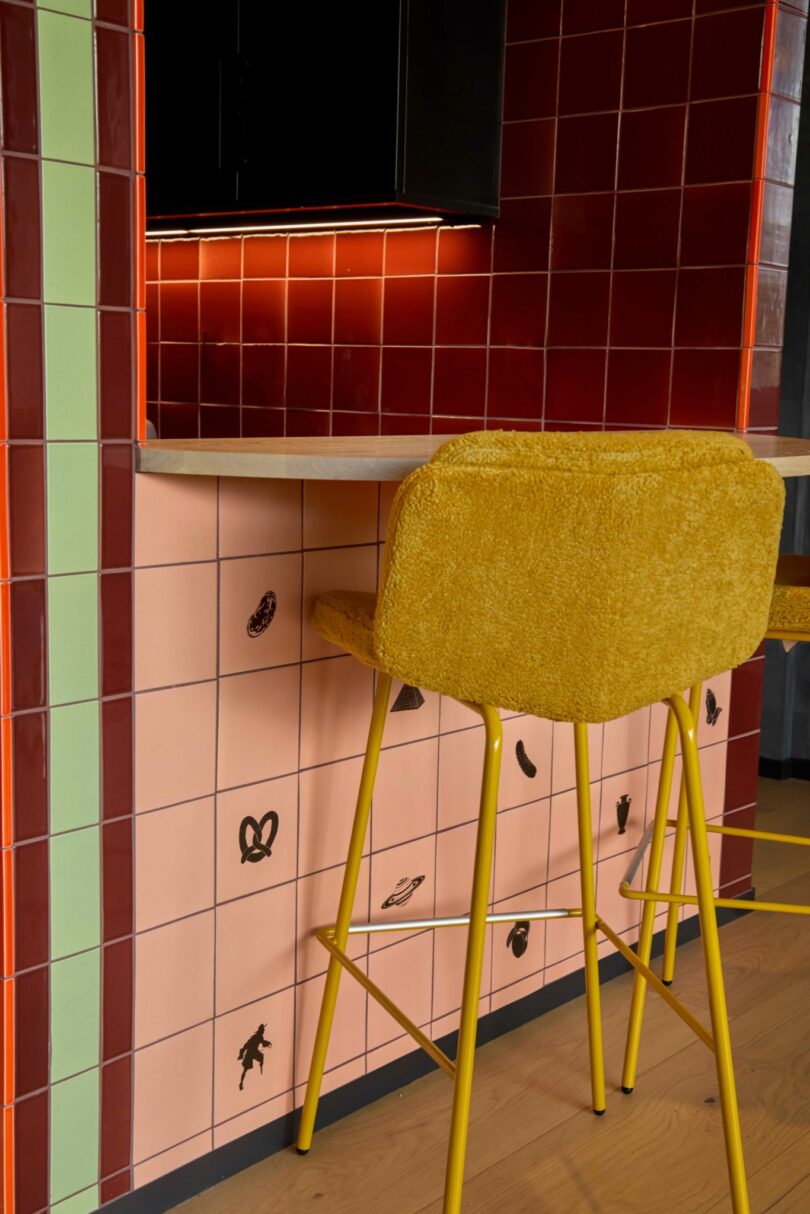
A yellow upholstered Powell barstool sits at a counter, with a tiled wall featuring red, peach, and green tiles, some decorated with black food illustrations.

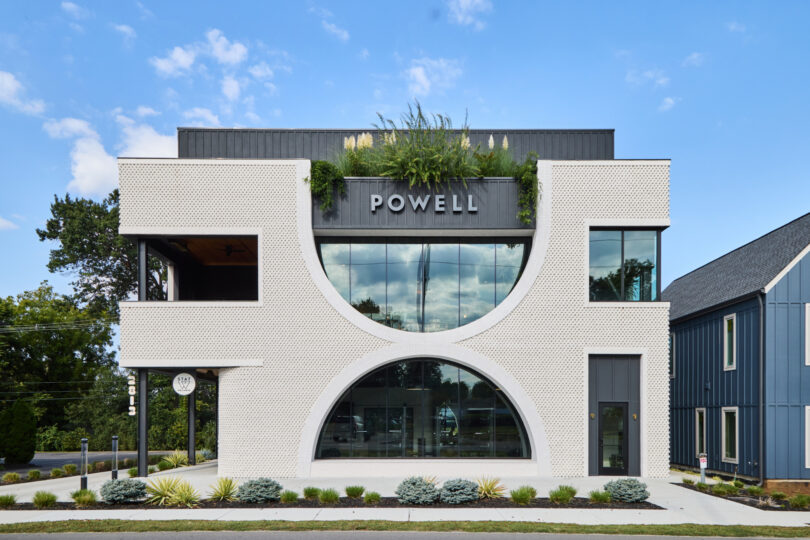
Located in the Berry Hill neighborhood, home of Nashville’s design district, two ordinary parcels were transformed into a three-story story structure that houses Powell’s spaces and those of another tenant, a luxury functional medicine and movement studio.

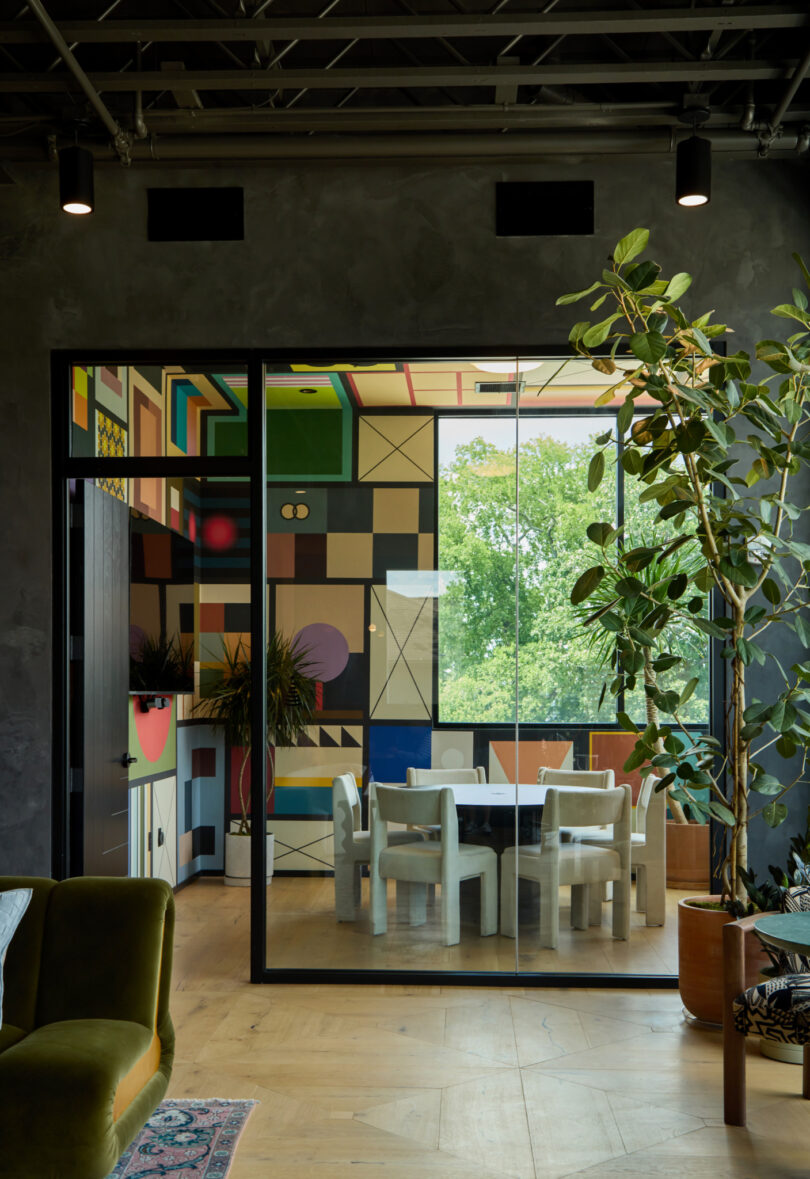
A modern glass-walled Powell meeting room with colorful geometric wall art, white chairs around a table, large windows, and indoor plants.

Fine craftsmanship sets the tone as soon as visitors enter the building through a first-floor lobby, where they are welcomed through an 11-foot custom white oak door. The area opens into a glass entryway punctuated by exposed steel, enlivened by terrazzo tile in shades of peach, black, cream, and hunter green.

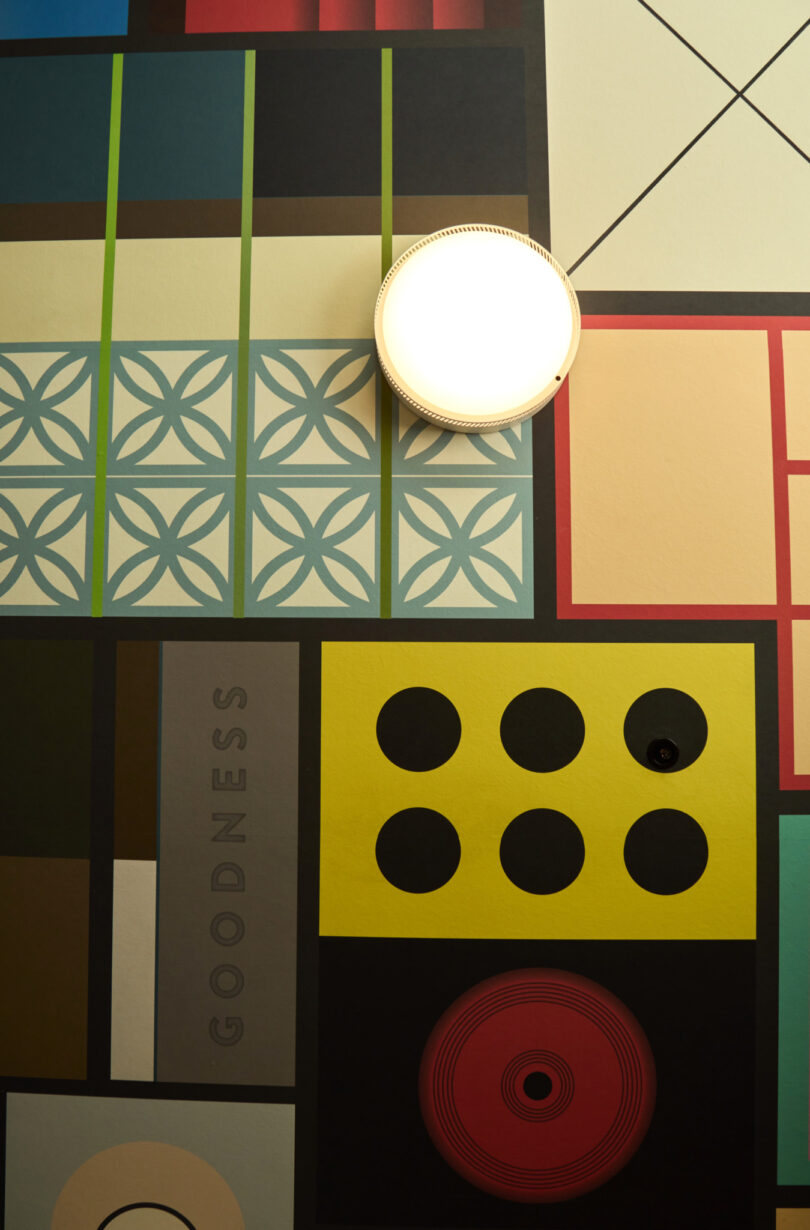
Geometric patterned wall with a variety of colored shapes and a lit round Powell wall sconce at the top center. The word “GOODNESS” is printed vertically on one section.

Powell’s 3,806-square-foot office space is on the second floor. Yet rather than simply emphasize a few interiors with distinct colors and signage, this section is immersive and warm, with bold visual moments layered in. “We have a series of vignettes that you see in hospitality environments, like an amazing lounge or a booth that feels cozy,” notes Luke Tidwell, Powell partner and CEO. “These are the same types of spaces that we create, but in a smaller form.”

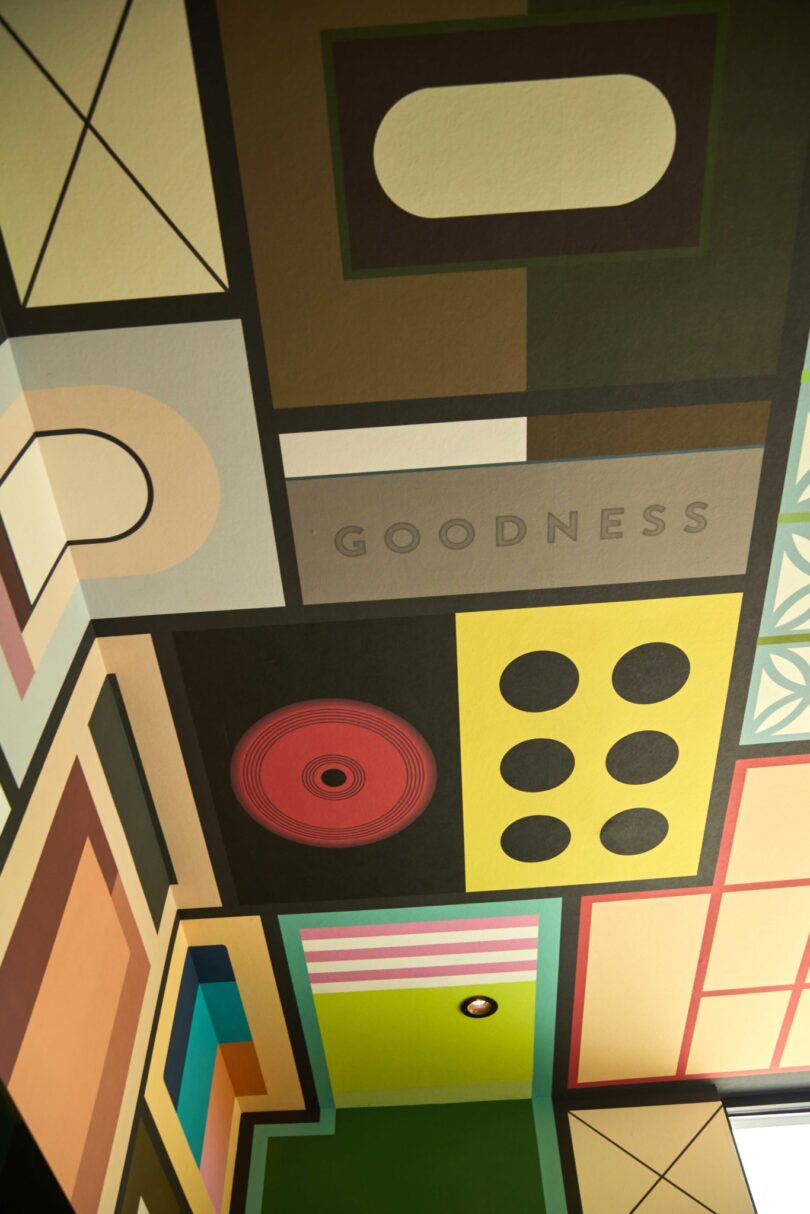
Ceiling mural with geometric shapes, circles, and rectangles in various colors; the word “GOODNESS” is printed in uppercase letters among the designs, reflecting Powell’s vibrant artistic style.

The studio serves as a gallery filled with unique elements produced by 13 local makers, who also frequently collaborate with Powell. In the lounge, comfortable seating is paired with a Pullman-style upholstered booth. A custom bodega-like bar sits across the room. Clad in tile, it features playful design iconography with items that begin with the letter P (for Powell, of course), including pizza, a pirate, and pretzel.

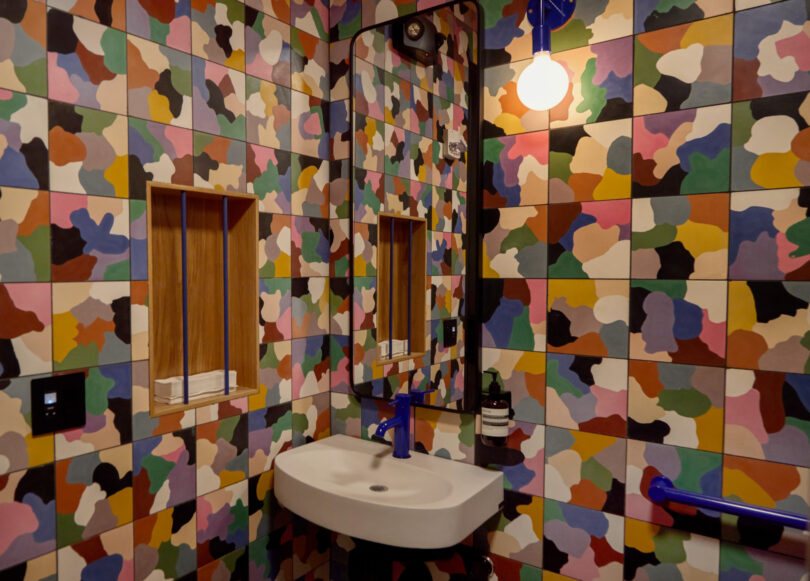
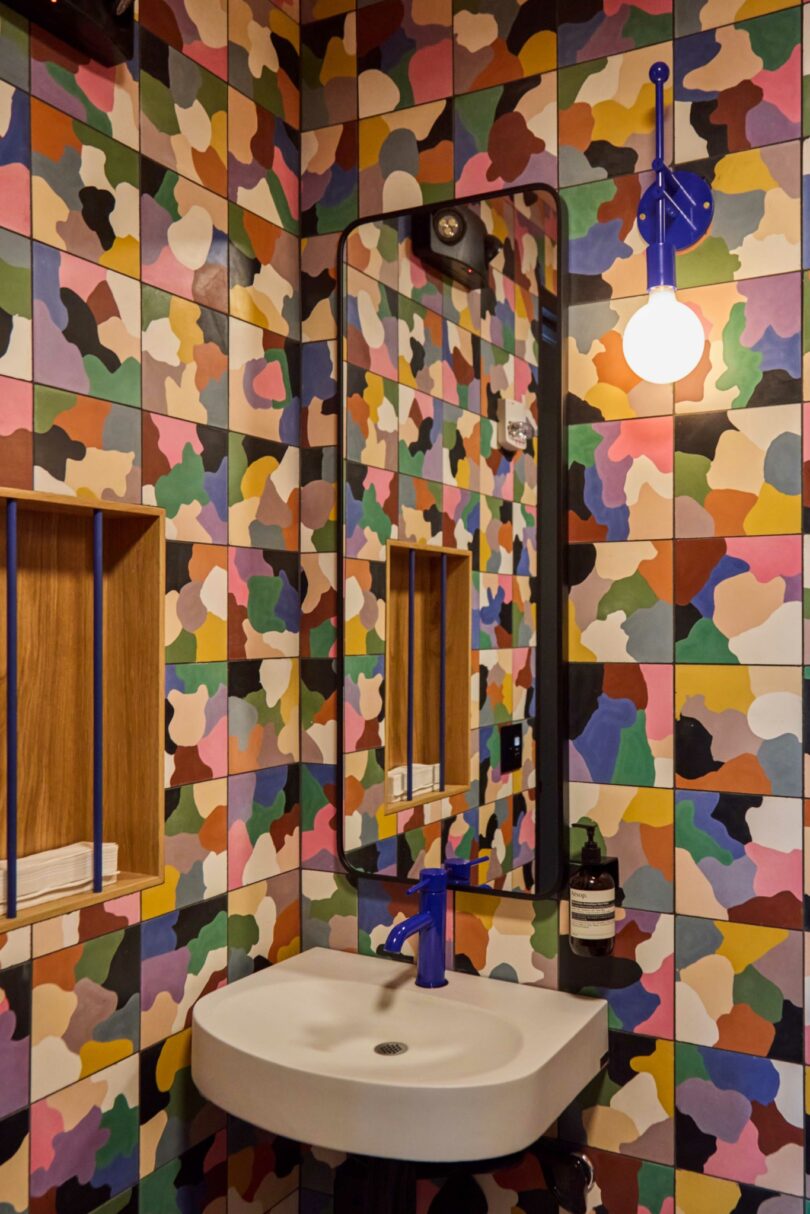
Bathroom with a small sink, mirror, and shelves, surrounded by walls covered in Powell’s multicolored, abstract-patterned tiles.

A small Powell bathroom with multicolored camouflage-patterned tiles, a rectangular mirror, a white sink, blue faucet and light fixture, and a round exposed bulb.

The marquee conference room is decorated with a bespoke wallpaper from New Hat, with hues and details inspired by Powell’s completed projects, each represented in its own rectangle. Greenery adds vibrancy throughout the workplace, while glass walls let light in and maintain a connection to the outdoors.

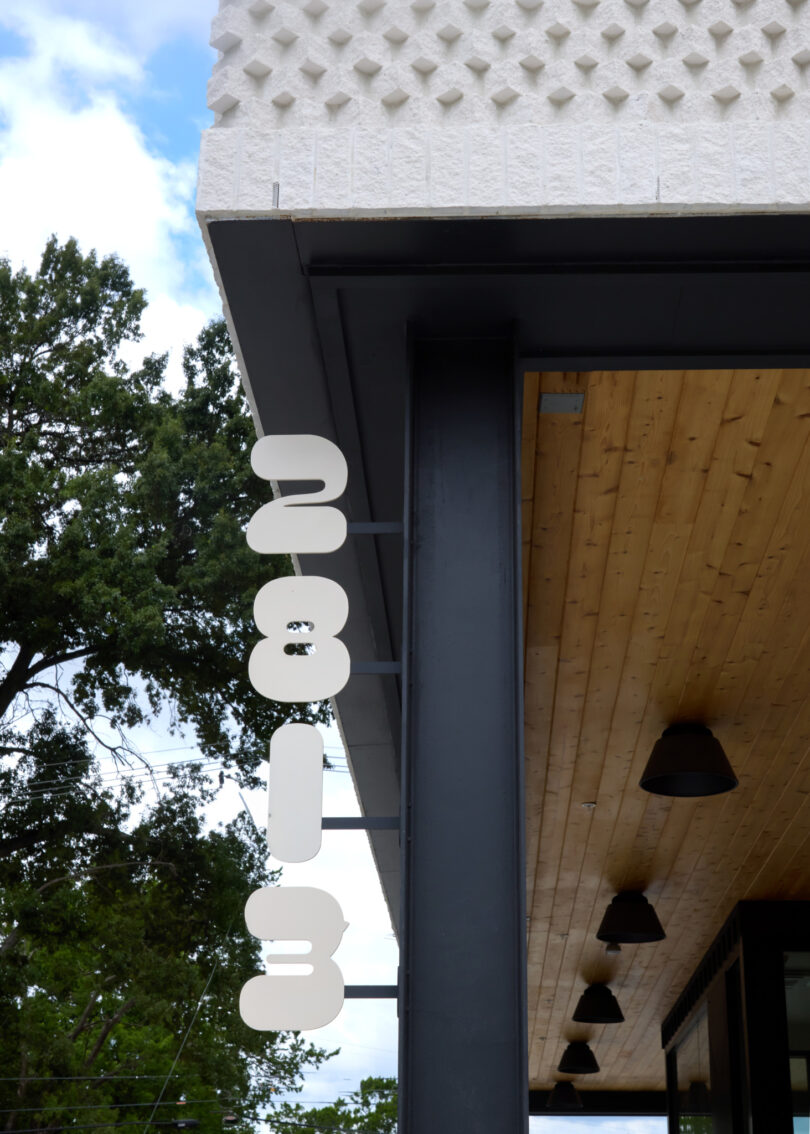
Modern building facade on Powell with large white numbers "2813" mounted vertically on a metal beam; features wood-paneled soffit and trees in the background.

More than a place to work, Powell’s headquarters is a dimensional narrative and a living prototype that will continue to evolve alongside the firm.

Modern three-story Powell building with a geometric white facade, large arched window, prominent "POWELL" sign at the center, and lush greenery adorning the rooftop.

To see other works by the firm, visit powellnashville.com.

Photography courtesy of Emily Dorio.

These New Pieces From FRAMA Showcase the Softer Side of Metals

These New Pieces From FRAMA Showcase the Softer Side of Metals

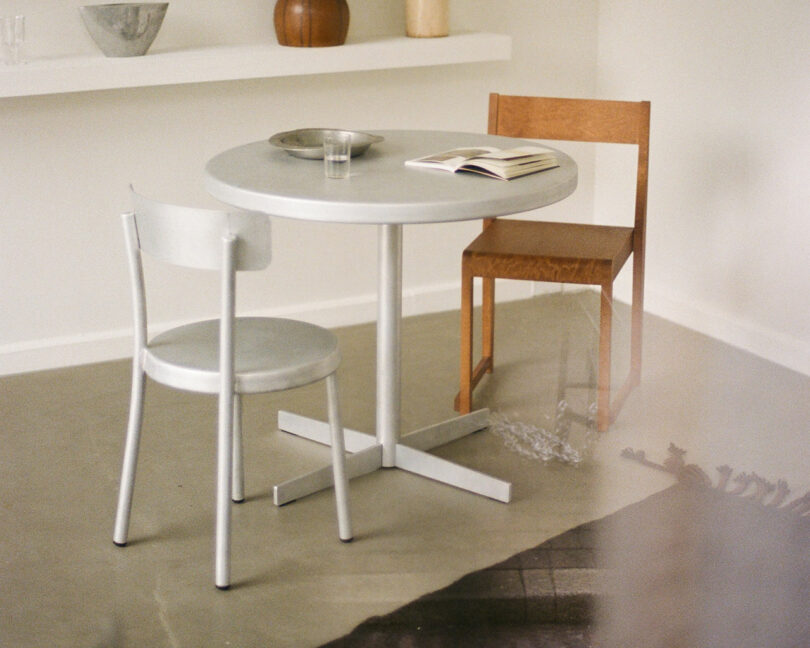
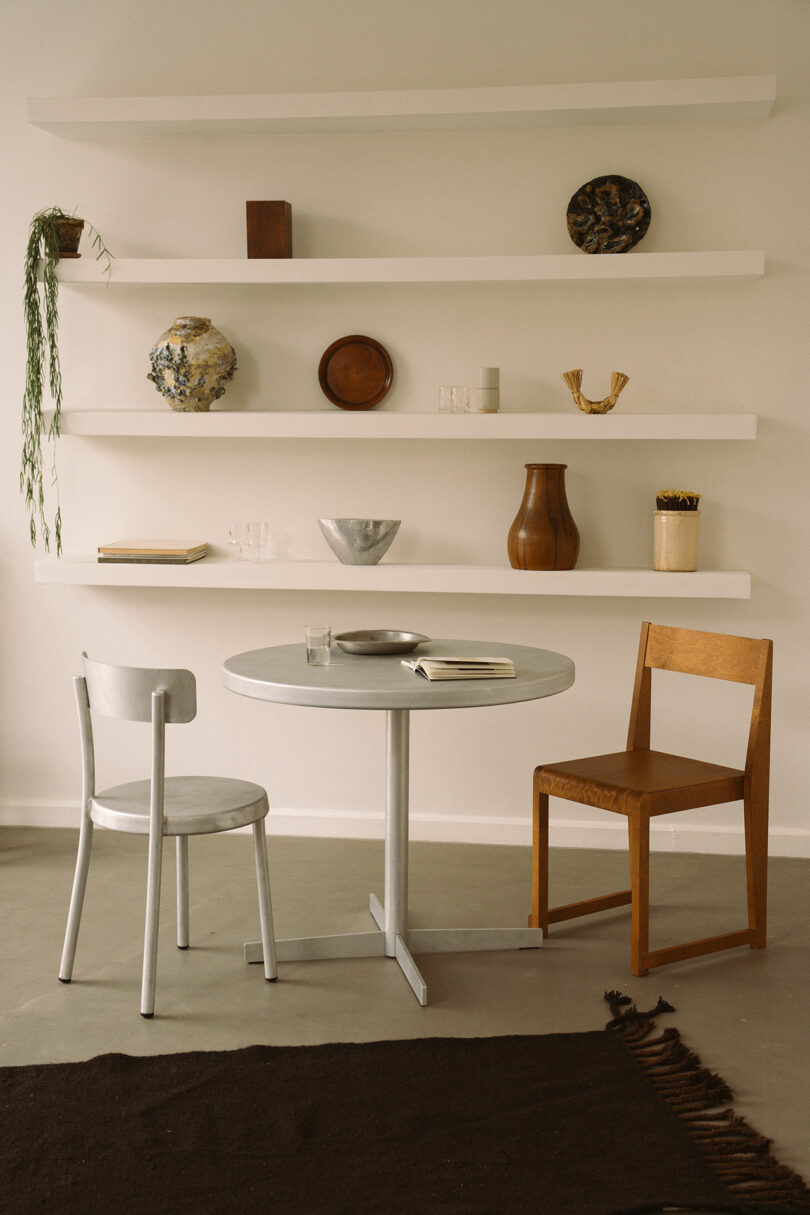
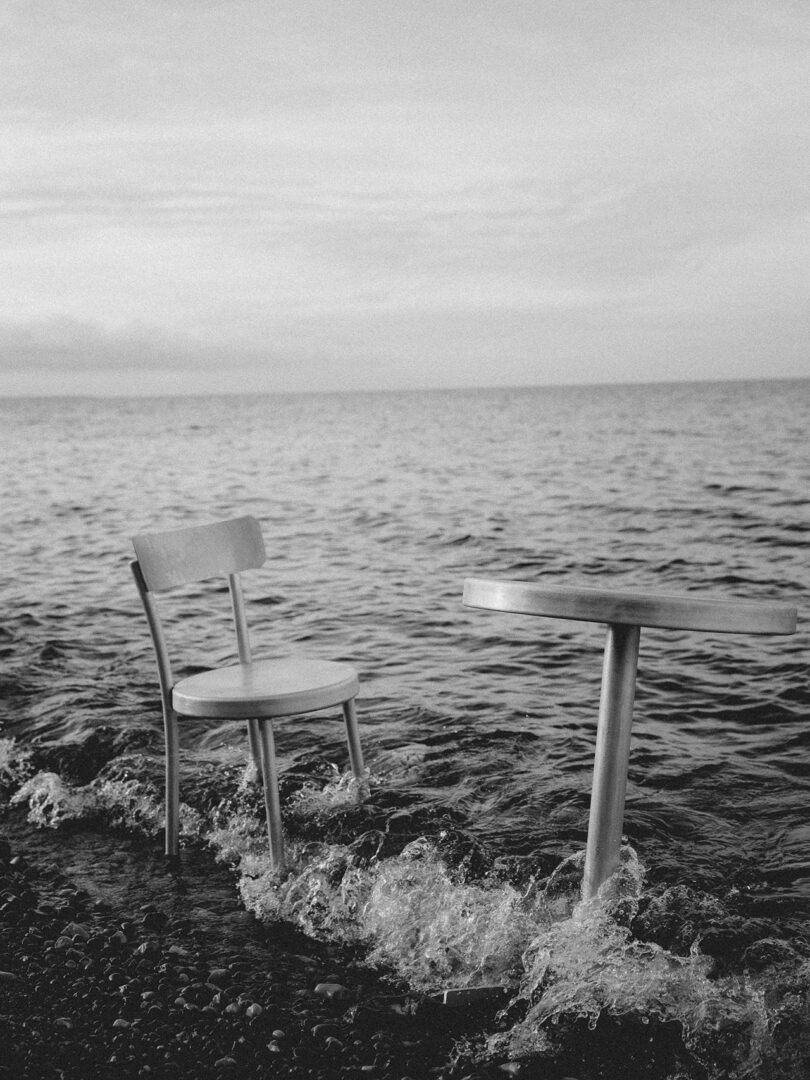
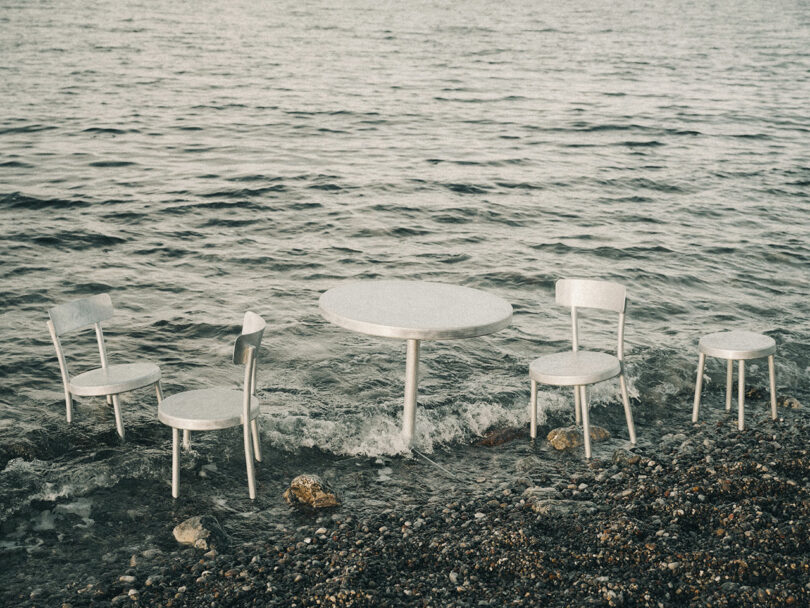
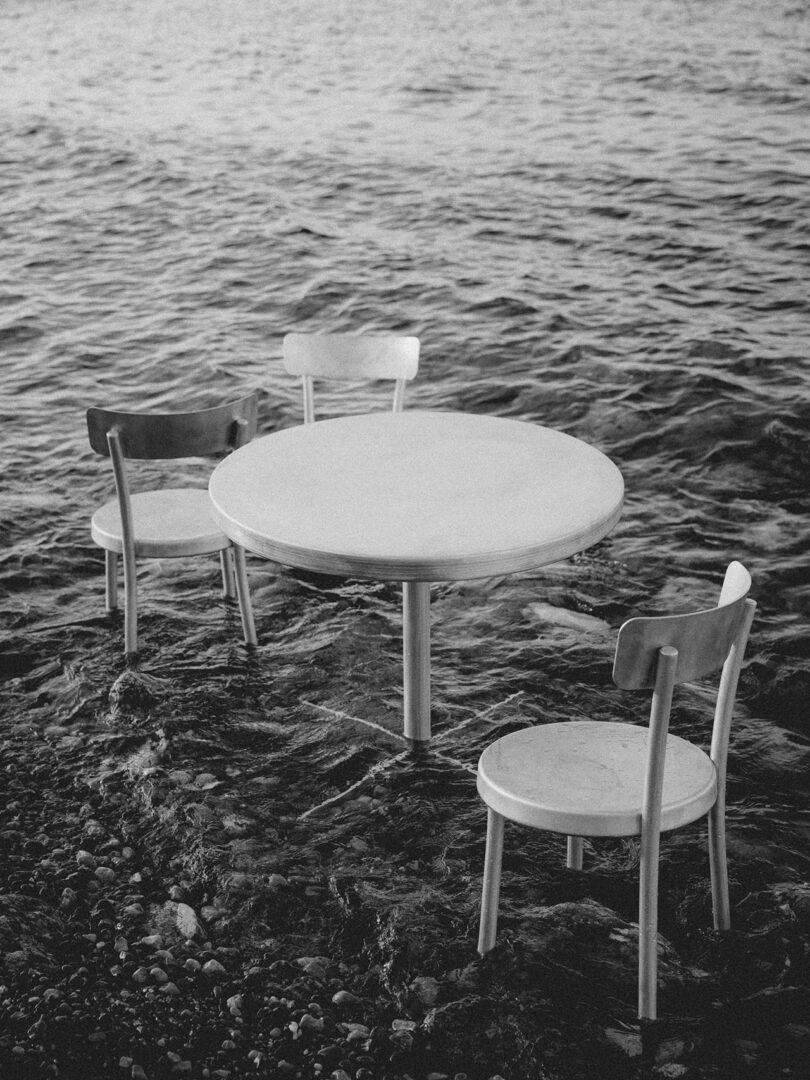
There’s something about the smell of the sea that calls to us. A briny froth caps the waves, signaling the turning of our world. The Tasca Table Large from FRAMA is made to be used anywhere, even outdoors – and even among the waves themselves. A beautifully wrought satin finish takes charge, a subtlety that hearkens to the flow of water itself. Also available in a smaller size, the Tasca Table is ready to host – perfect for two, three, or four.

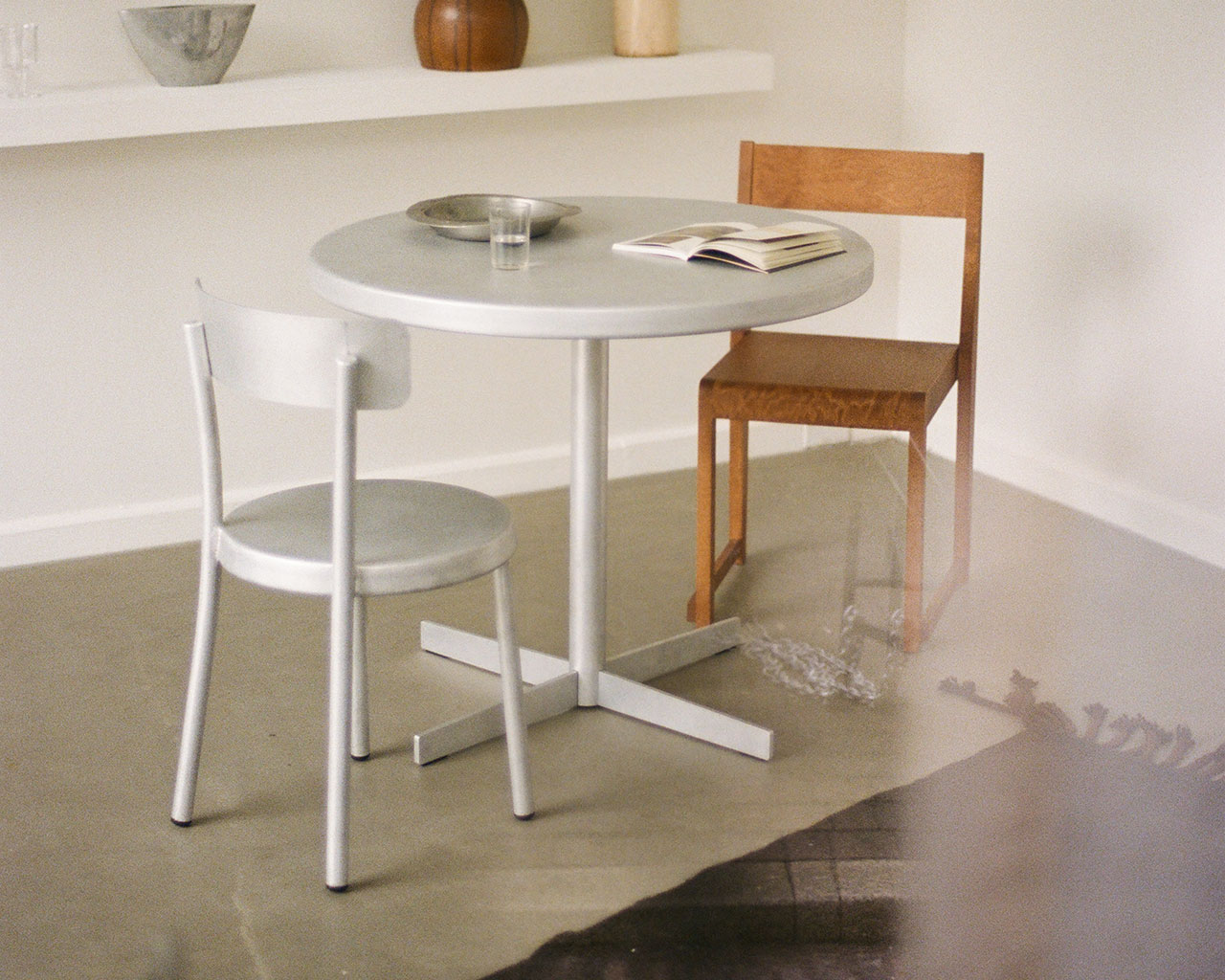
A round Tasca Table FRAMA with two chairs, an open book, and a glass sits in front of white shelves displaying decorative objects, vases, and bowls against a neutral wall.

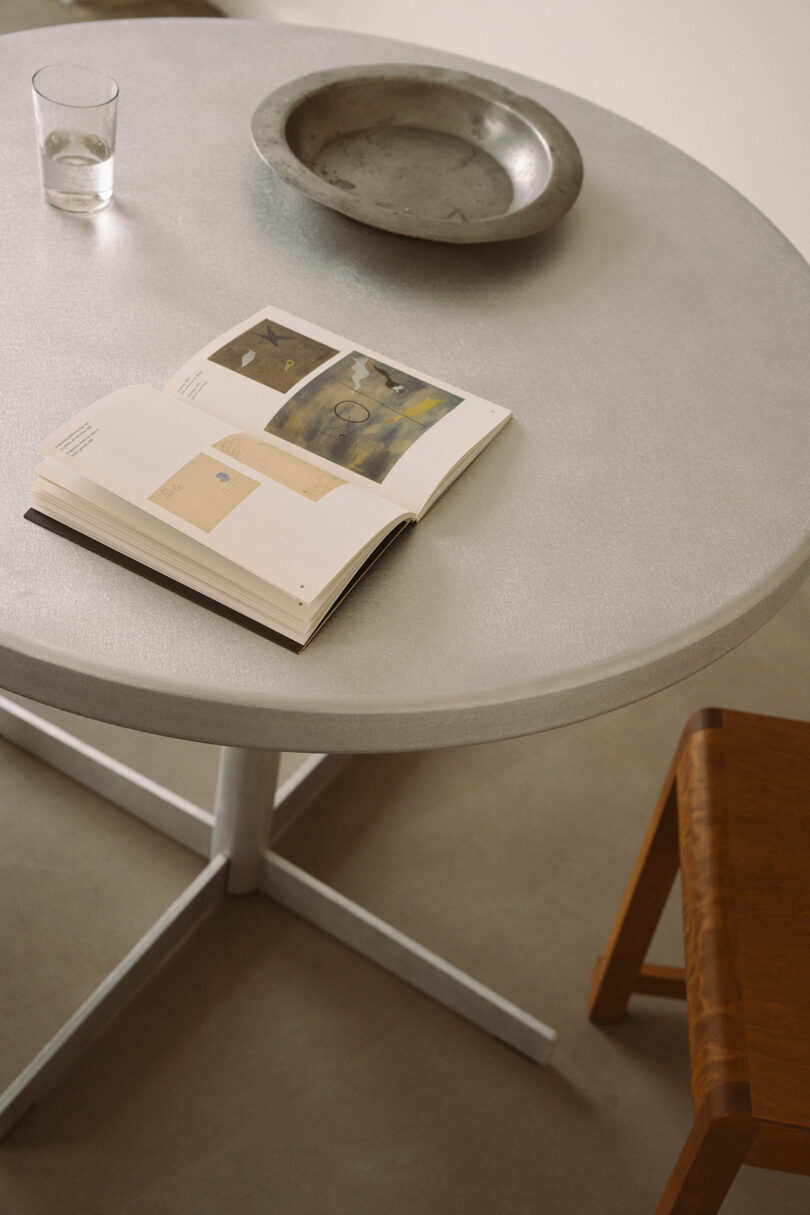
At first, the Tasca Table seems like something you’ve seen before – a solid ‘x’ creating the base, a singular cylindrical leg, and a circular top. In simplicity, technical detail is obfuscated within minutia, for those who look to find it. Subtle but intentional variation emerges within the hand-wrought finish, a graceful patina developing over time. As the aluminum is left bare, signs of wear are natural and welcome, a sign of a life well-loved.

A Tasca Table FRAMA holds an open art book, a glass of water, a metal bowl, and is paired with a wooden chair beside it.

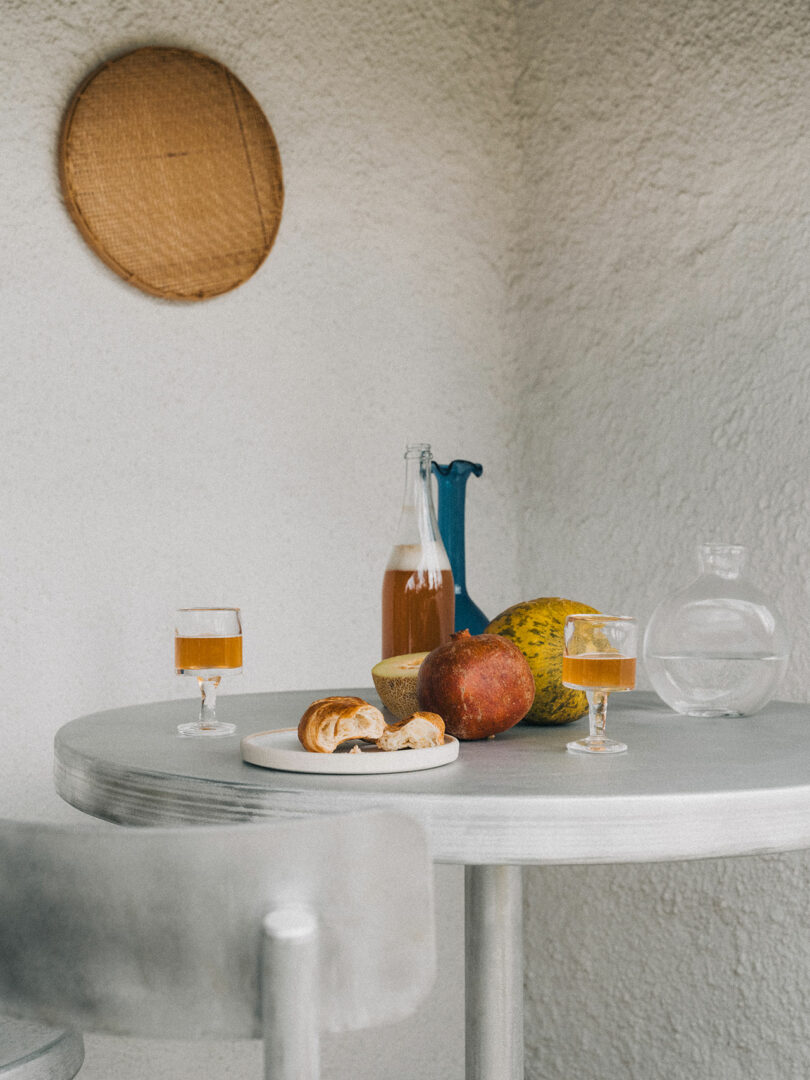
A small round Tasca Table from FRAMA with two glasses of amber liquid, a bottle, a glass pitcher, a plate with pastries, and assorted fruits set against a textured white wall.

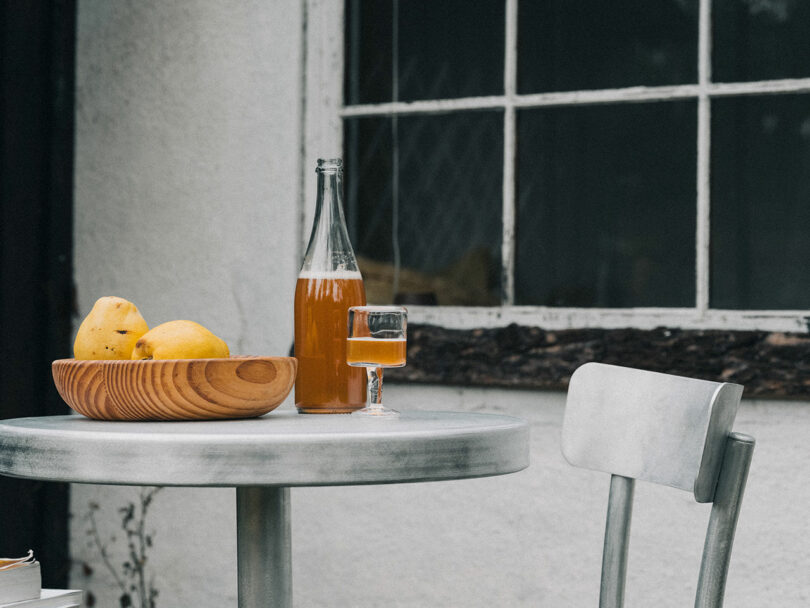
A Tasca Table from FRAMA holds a wooden bowl of pears, a glass bottle of amber liquid, and a filled glass, placed beside a metal chair and a window.

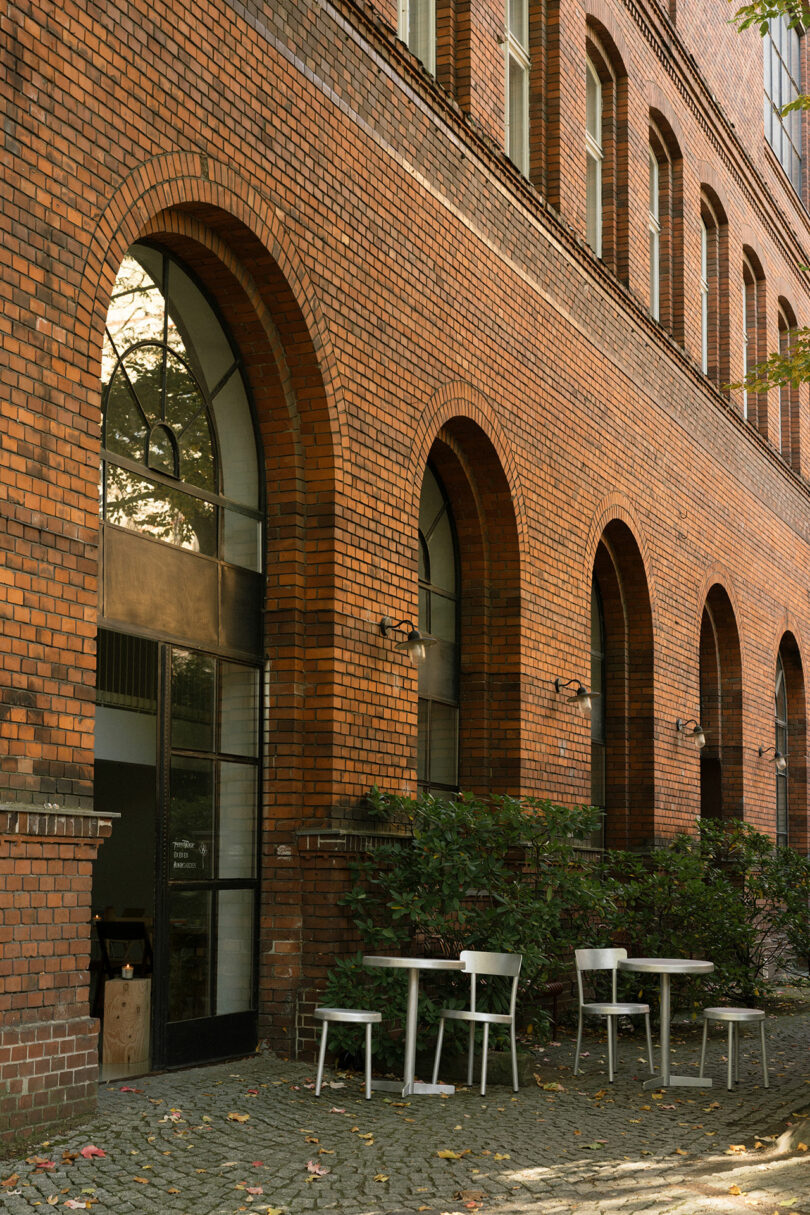
Outdoor tables and chairs, including the Tasca Table FRAMA, are arranged on a cobblestone patio next to a brick building with tall arched windows and some greenery.

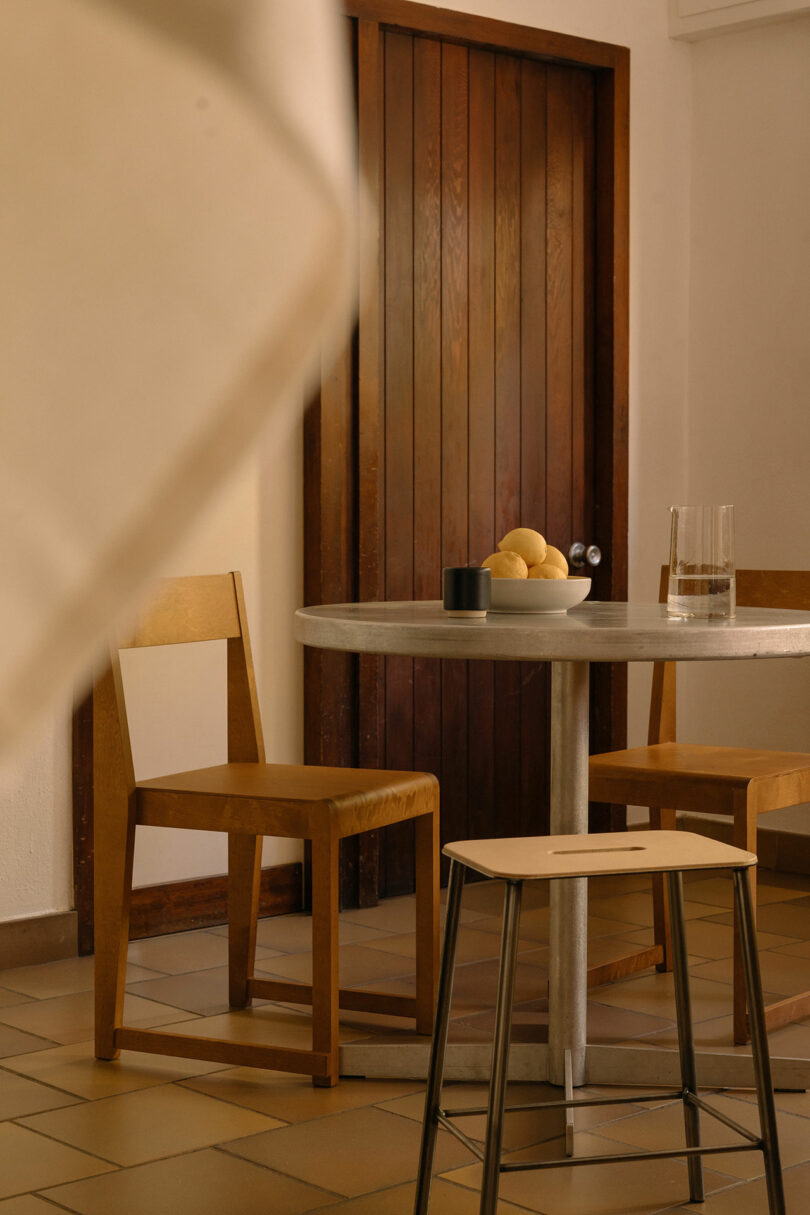
A Tasca Table FRAMA sits between two wooden chairs, topped with a bowl of lemons, a glass of water, and a cup in a room featuring tiled floors and a wooden door.

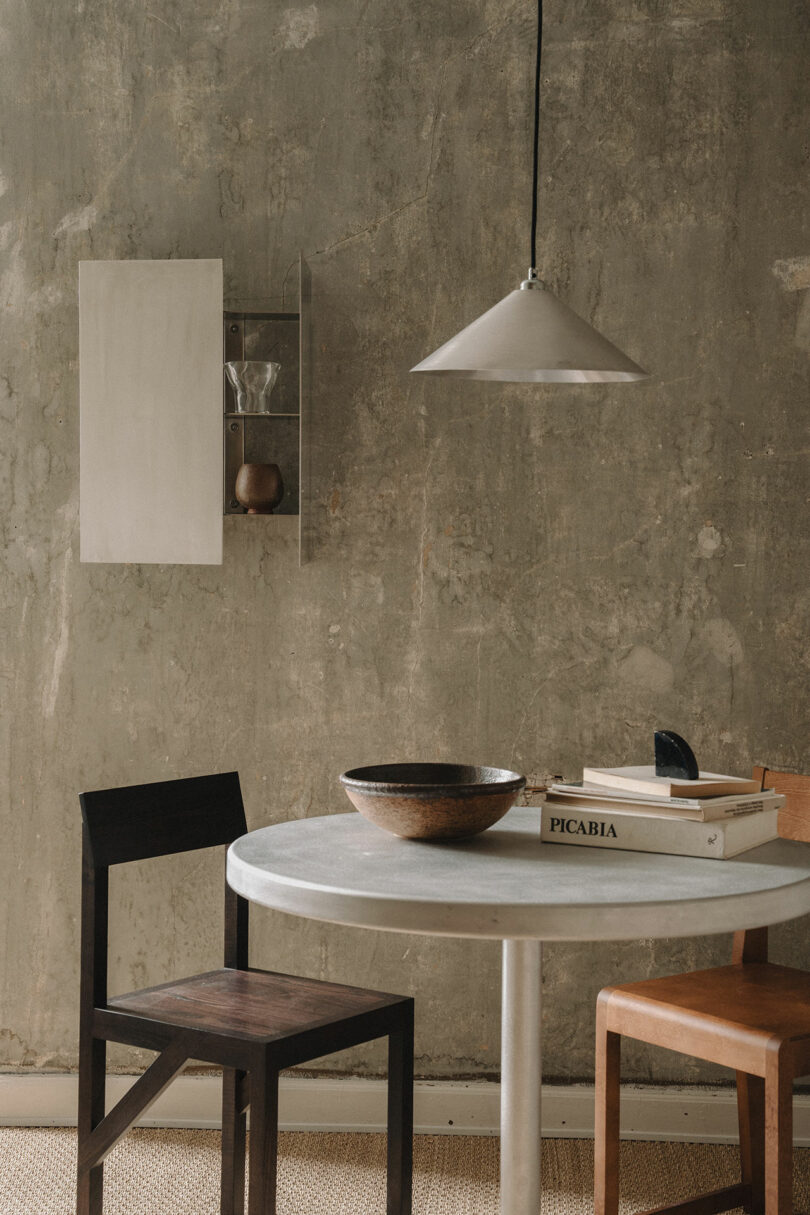
A Tasca Table from FRAMA sits between two chairs, topped with a wooden bowl and books, against a textured concrete wall beneath a hanging pendant light.

A luminosity emerges in soft light, almost seeming to glow from within. As aluminum is strong, light, and endlessly recyclable, it was a natural choice for the team to expand their collection of aluminum pieces, adding a sustainable lens to the project. As we dive into a new era of the anthropocene, it is our duty and privilege as designers to take stock of how we create, and to design within the flow of our natural world, not against it. FRAMA continues to explore this balance – inviting us to take our time, and feel good in doing so.

A wooden chair and a Tasca Table FRAMA stand partially submerged in shallow water at the edge of a rocky shore.

Four metal chairs and a Tasca Table from FRAMA are partially submerged at the edge of a rocky shoreline, with waves from the water reaching the furniture.

A Tasca Table FRAMA with three chairs stands in shallow water at the edge of a rocky shoreline, gentle waves surrounding the legs. Black and white image.

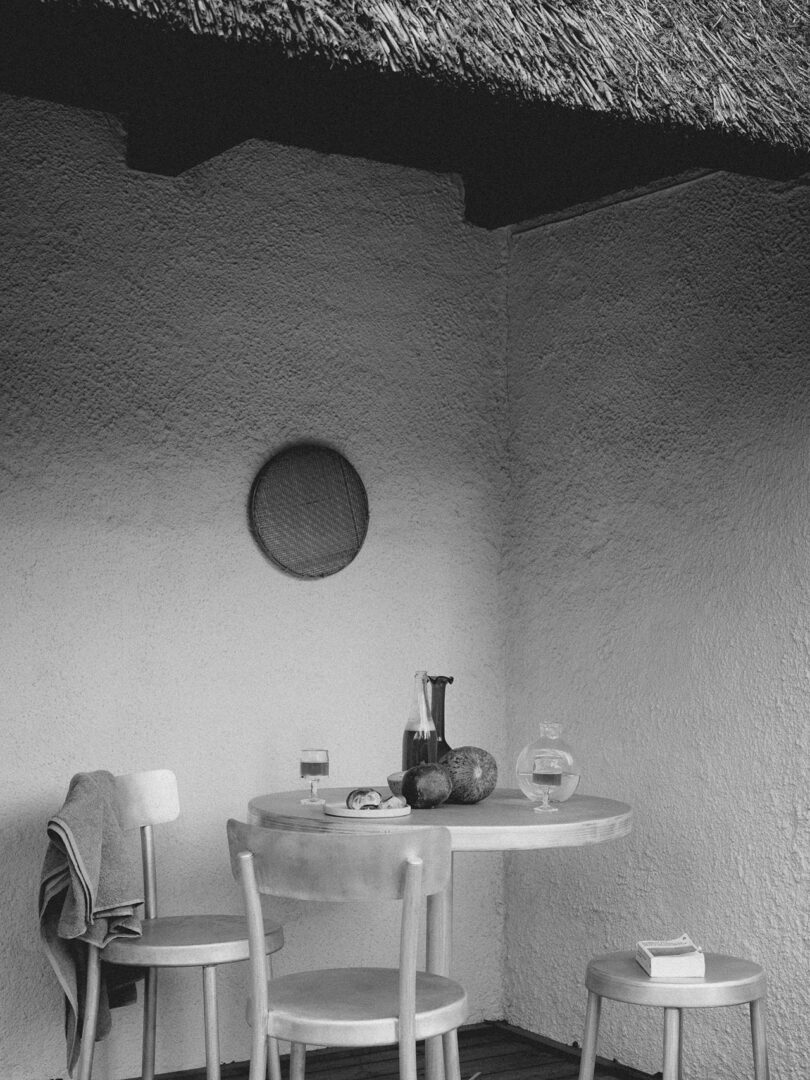
Black and white photo of a small round Tasca Table FRAMA with two chairs on a patio, holding a pitcher, two glasses, a round fruit, and a book; a woven decor hangs on the wall.

Copenhagen-based FRAMA celebrates the intersection between design and experience, encouraging us to celebrate the details, and hopefully be a bit more mindful. Natural materials and simplified geometries help retain integrity within the collection, keeping spaces warm, practical, and honest.

A Tasca Table FRAMA stands round with a plate of food, utensils, a glass of water, and a teapot beside two chairs—one near a stack of books by the window. Black and white photo.

To learn more about the Tasca Table Large from FRAMA, visit framacph.com.

Photography by Paolo Galgani, and courtesy of FRAMA.


Artek and Heath Ceramics New Tile Tables Cleverly Cohere Clay with Wood

Artek and Heath Ceramics’ New Tile Tables Cleverly Cohere Clay with Wood

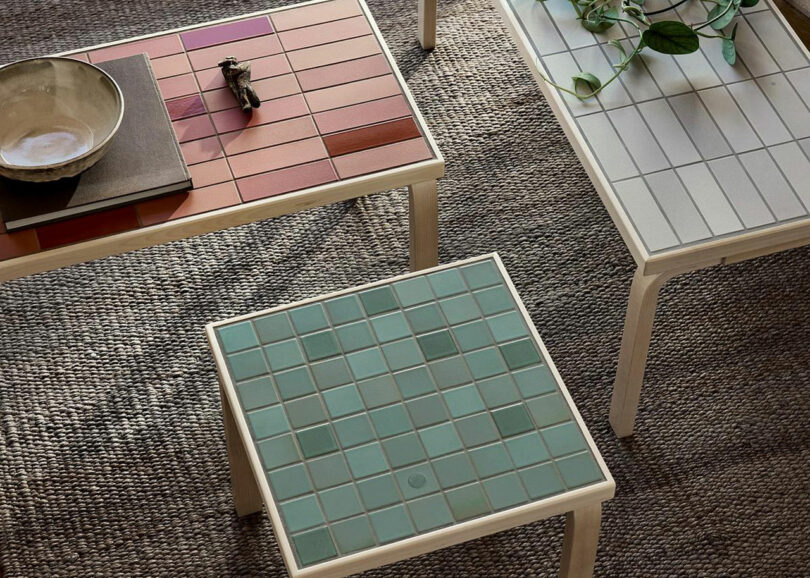
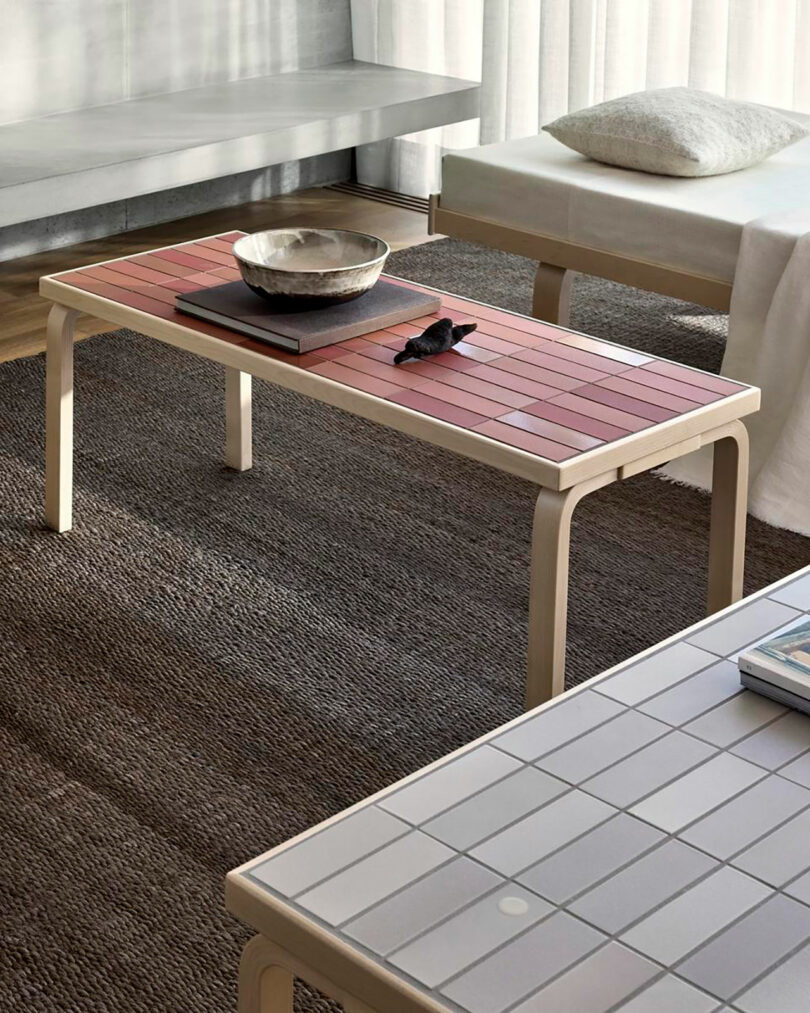
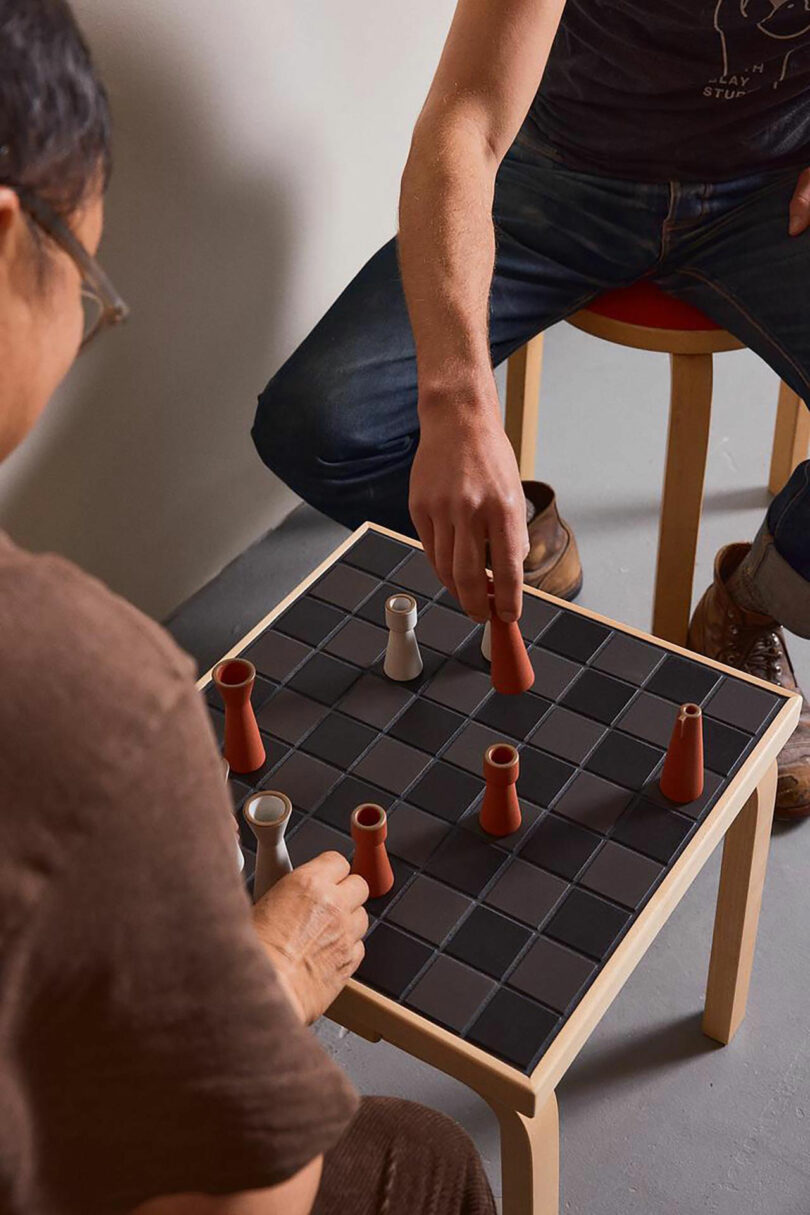
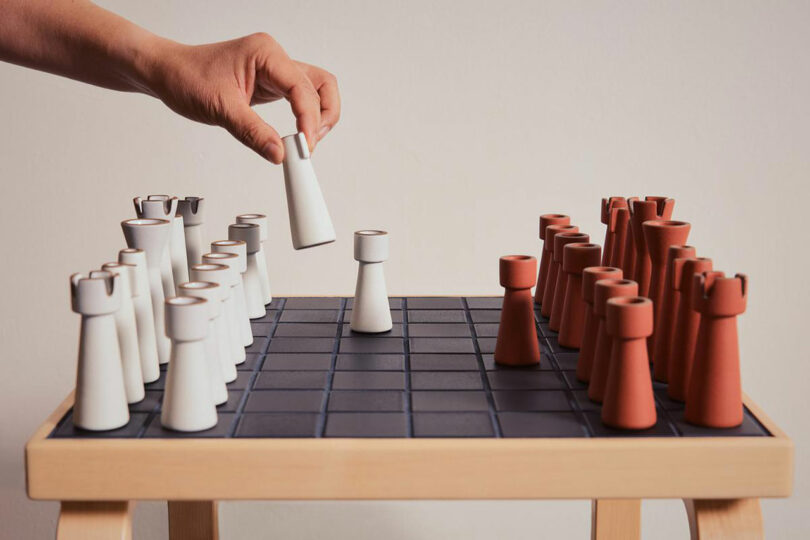
As kindred spirits, the Artek and Heath Ceramics teams have once again come together to combine our respective crafts,” says Marianne Goebl, Artek Managing Director. Designed as a system, the Tile Table collection encourages play and experimentation with color and texture. The results are, we believe, delightful functional companions for the home.” The refreshed offering, a first version of which debuted in 2022, is presented in a trio of signature colorways: green, white, and now terracotta red. The latter aligns well with an industry-wide return to moody hues and Art Deco embellishments. This third edition stands in the intersection between materiality, personality, and honesty – the wood simply treated, the tiles moveable to taste.

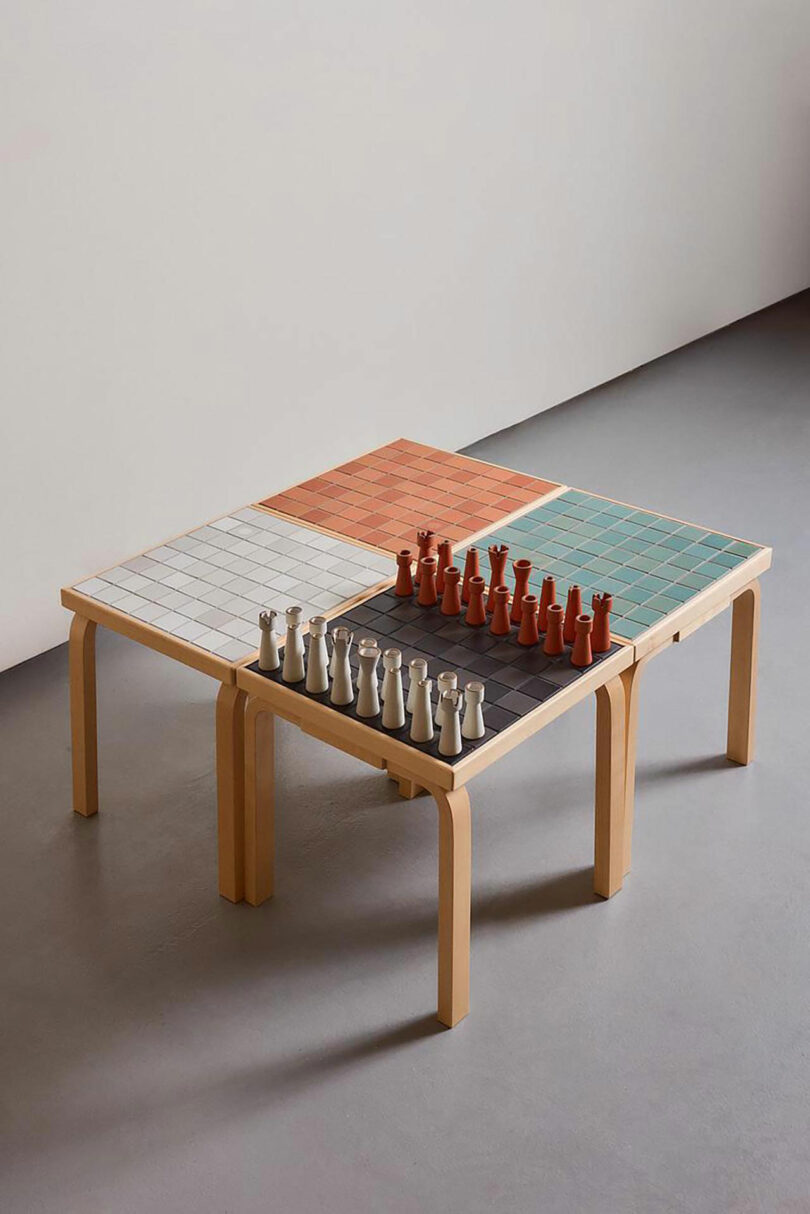
A wooden Artek table with four different colored tiled sections, featuring a chessboard and chess pieces arranged for a game.

This extended proposition – the fusing of historic ceramicist Edith Heath’s deftly proportioned and toned tiles with Alvar Aalto’s Table Square—isn’t just aesthetic. The practical, durable and even hygienic application of fully glazed ceramic tiles as a table finish can’t be overlooked. One has only to consider the especially efficient and cost-effective kitchen countertops of the 1990s, replaced since by equally enduring but significantly more expensive natural stones.   

Three square Artek tables with tiled tops in red, cream, and green stand on a textured rug; one table has a plant and another holds a bowl and decorative object.

A rectangular Artek coffee table with a red tiled top holds a bowl, a book, and a small sculpture. The table stands on a dark rug next to a sofa and another tiled surface in this modern room.

What the joining of these forces ultimately represents is the deft mirroring of values. Both boutique heritage producers rarely diverge from the central principles of beauty, utility, integrity, and longevity. New releases are almost always nuanced reinterpretations of long-appreciated classics that transcend time without necessarily becoming timeless.” These fresh takes tend to hold fast to a long-established, underlying understanding of succinct form-finding and resolute styling that has yet to be surpassed. And any indication of national or regional attribution – what might be characterized as Finnish and Californian design – is hard to decipher. Nods to their distinct natural settings are implicit, at best. These cleverly configured and finished designs are emphatically universal; enticing on both a visceral and visual level.  

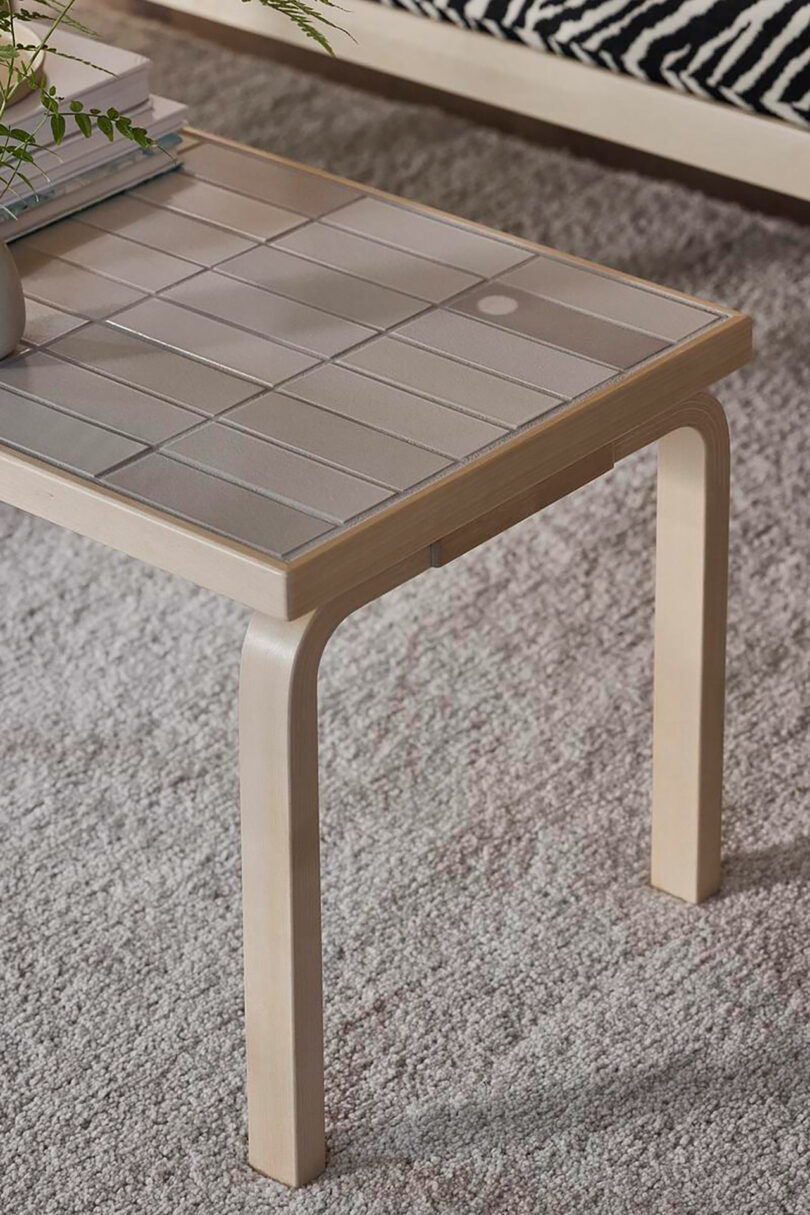
Rectangular Artek table with a tiled surface and light wood legs sits on a gray carpet, with books and a small plant on top.

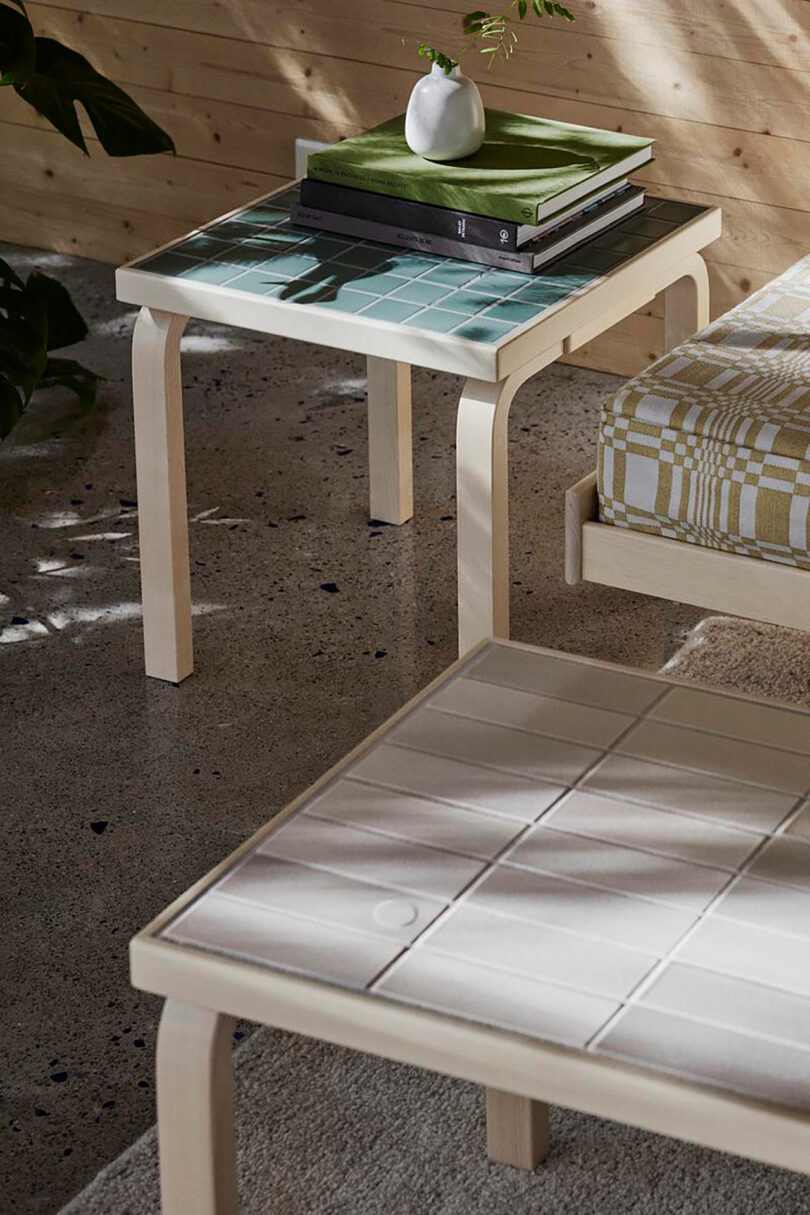
Two light wood Artek tables with tiled tops sit beside a cushioned bench; one table holds books and a small white vase, while sunlight casts gentle shadows across the surfaces.

Where other brand-collabs lean bombastic and gimmicky, this collaboration makes sense. What keeps us coming back to this [project] with Artek is a shared reverence for natural materials—clay, glaze, and wood—and how they respond to use over time,” says Heath Clay Studio Director Tung Chiang. It’s both a creative exchange and a close friendship, rooted in the mutual love for thoughtful making.”  

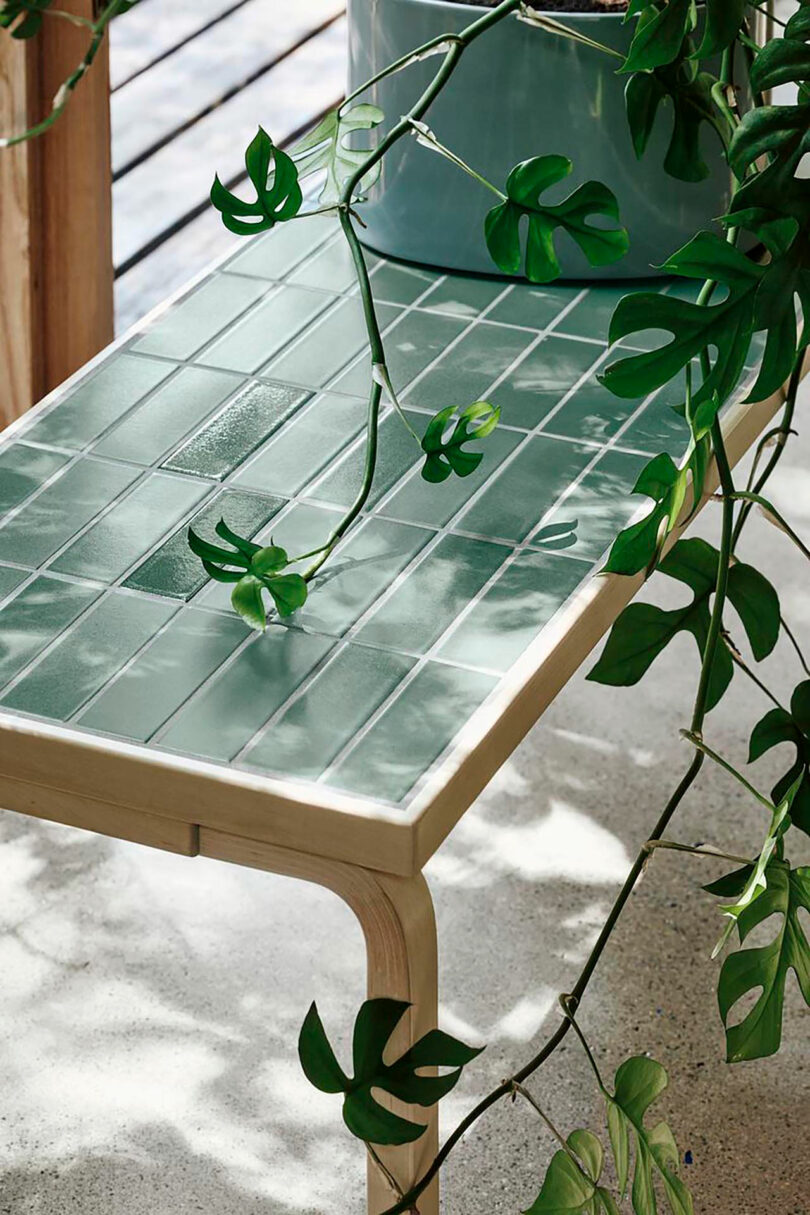
An Artek green tiled table with wooden edges sits next to a potted plant, with leafy vines trailing across its surface in natural light.

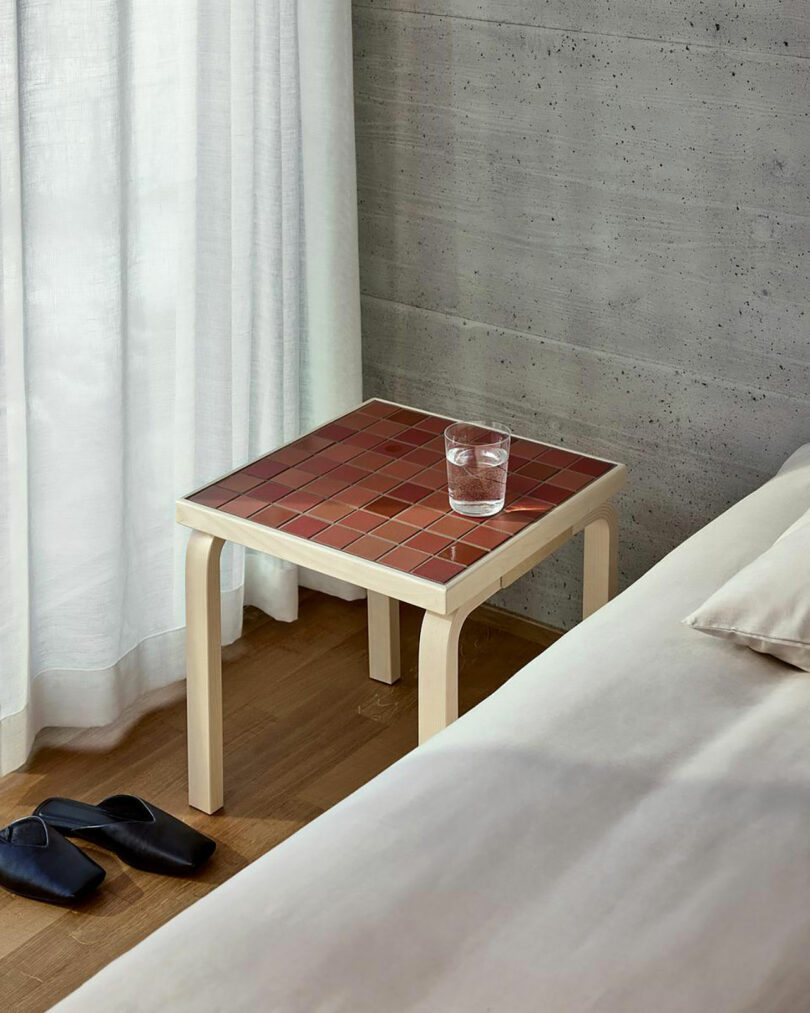
A small Artek bedside table with a red tiled top holds a glass of water; slippers are on the floor next to a bed in a minimalist room.

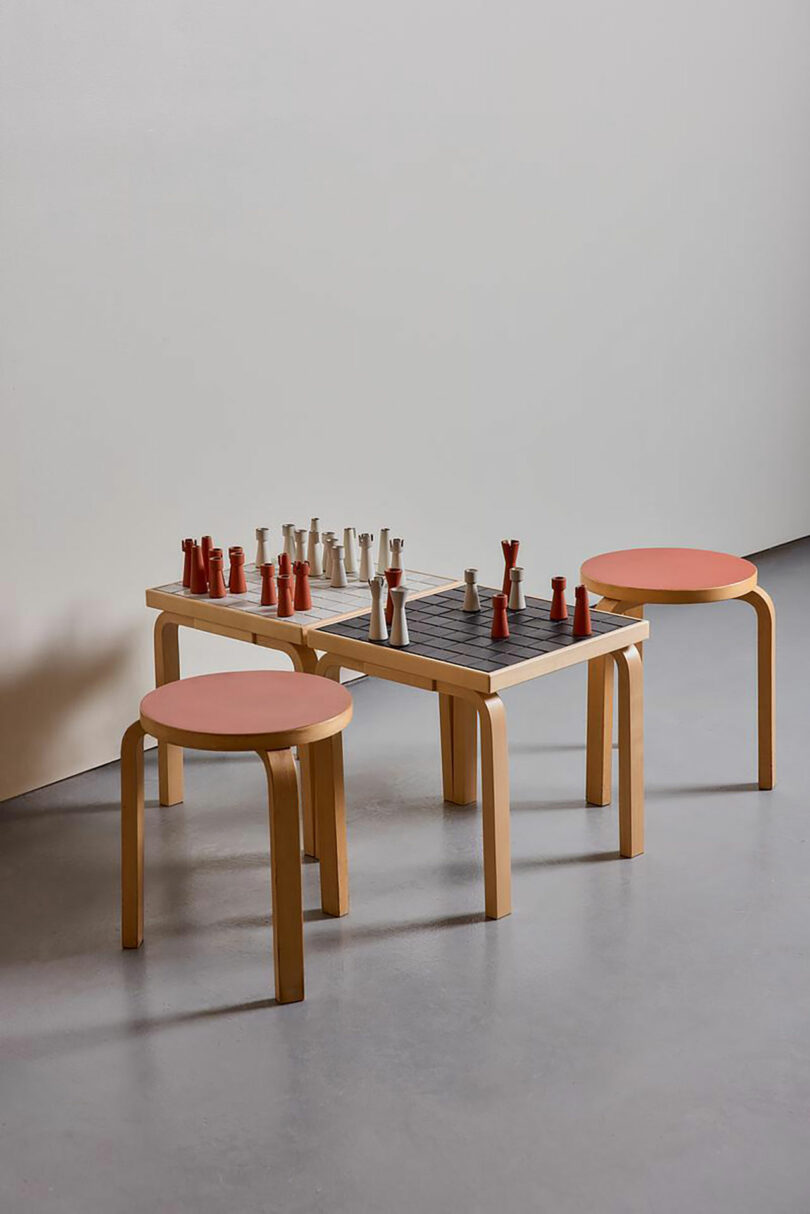
A minimalist chess set on a square wooden table, flanked by two round Artek wooden stools with reddish-orange seats, placed on a smooth grey floor against a plain wall.

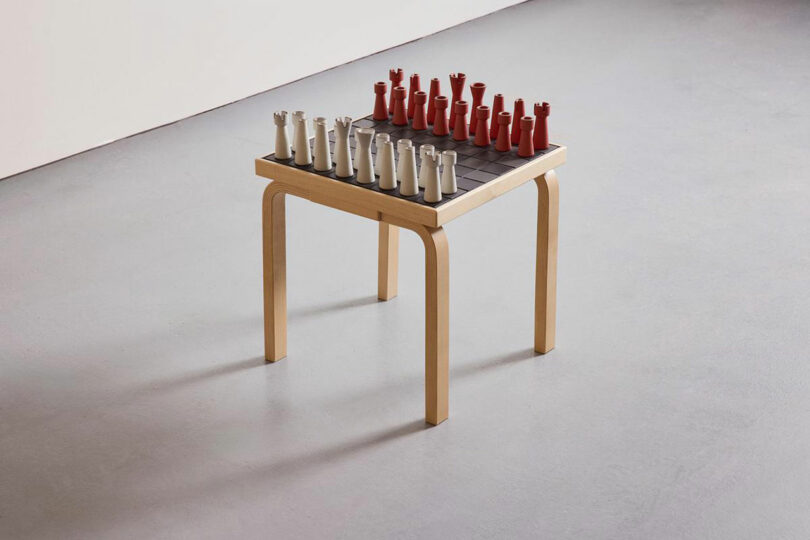
A small Artek wooden table with a built-in chessboard and neatly arranged white and red chess pieces stands on a plain gray floor.

Two people play a board game with black squares and cone-shaped and cylindrical pieces on a small Artek wooden table.

A hand moves a white chess piece on a minimalist Artek chess board adorned with elegant white and brown cone-shaped pieces.

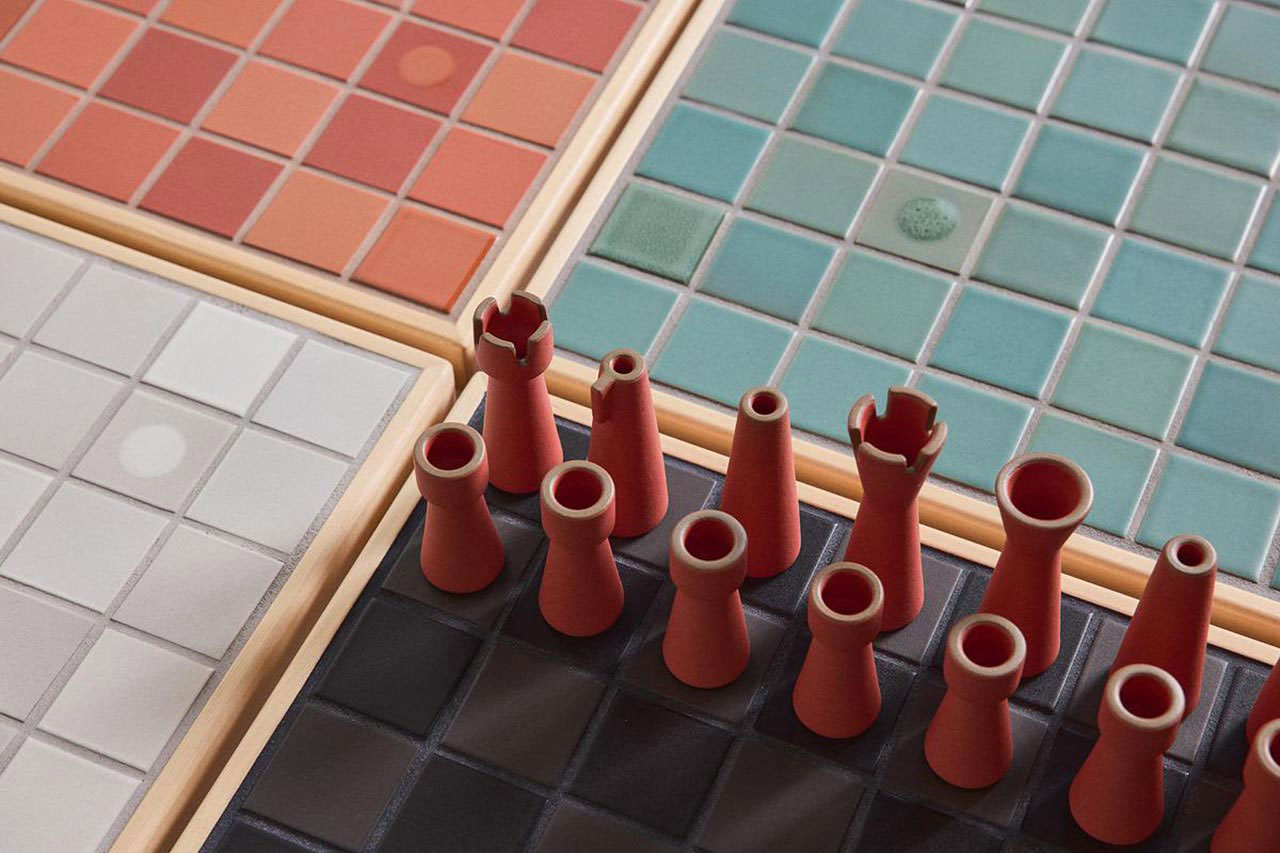
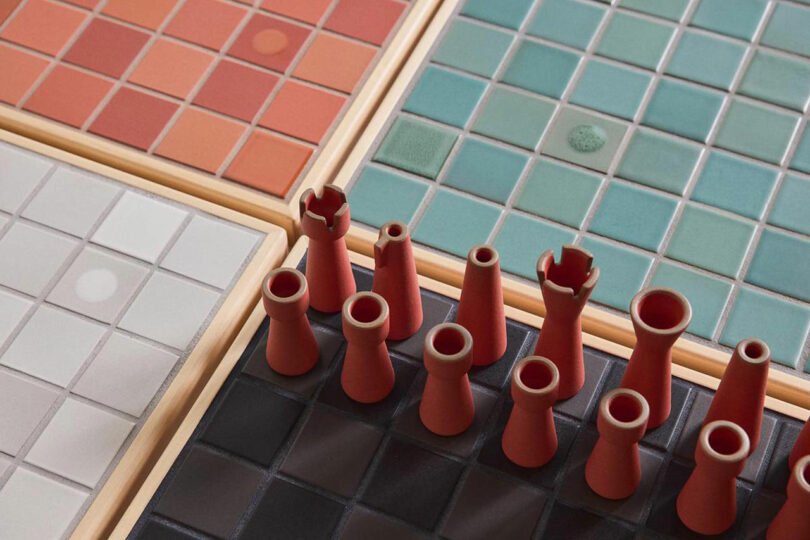
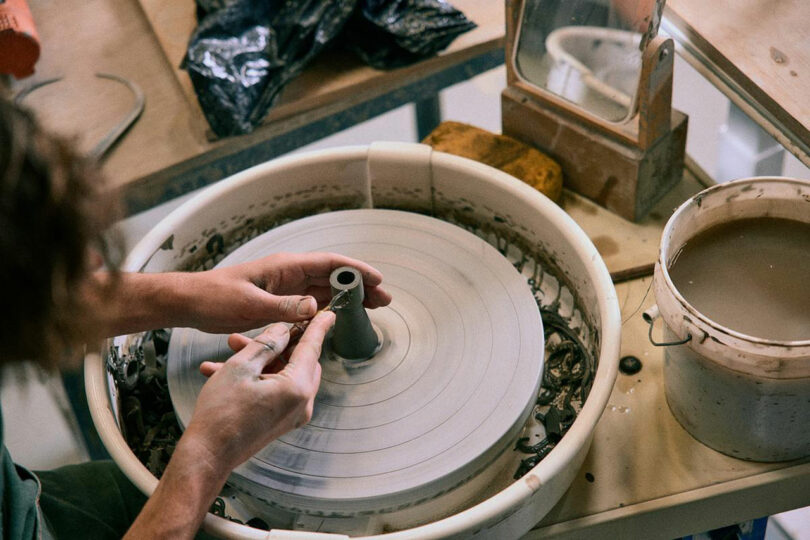
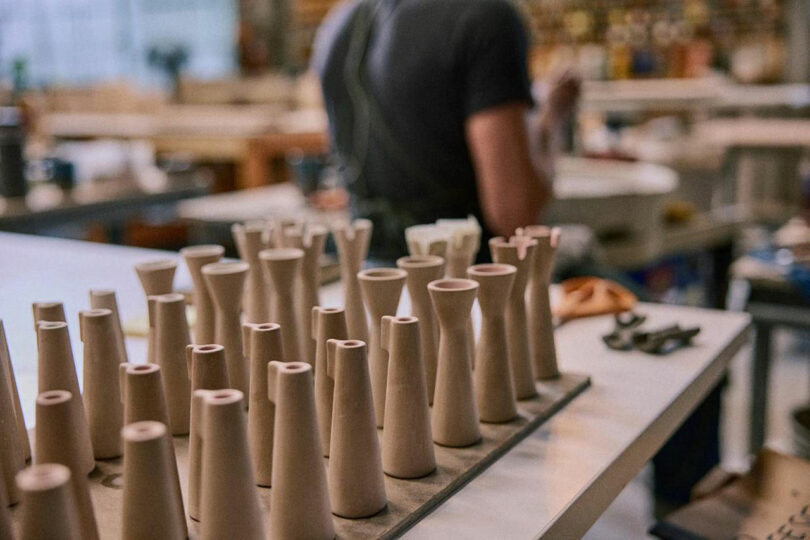
An added bonus: the Artek + Heath Chess Table. Though the brand identifies this clever application as a call back to Max Ernst chess table at Villa Mairea—designed by Aino and Alvar Aalto, this ingeniously unexpected second application seems to have naturally emerged from the coherence of tile and table typologies—an impromptu game board with segmented tiles doubling as chessboard files. To mark the moment, hand-thrown and hand-glazed ceramic chess pieces were imagined according to the previously outlined philosophy. The possibilities of pattern configuration and unexpected function are ostensibly, endless.  

A person shapes a small clay object on a pottery wheel, using their hands and a tool, with Artek pottery materials and water nearby.

A person shapes wet clay on a pottery wheel, using their hands and a tool to form a narrow, cylindrical vase inspired by the minimalist design of Artek.

A row of unfinished ceramic vases sits on a worktable in a pottery studio, echoing the minimalist style of Artek, with a person working in the blurred background.

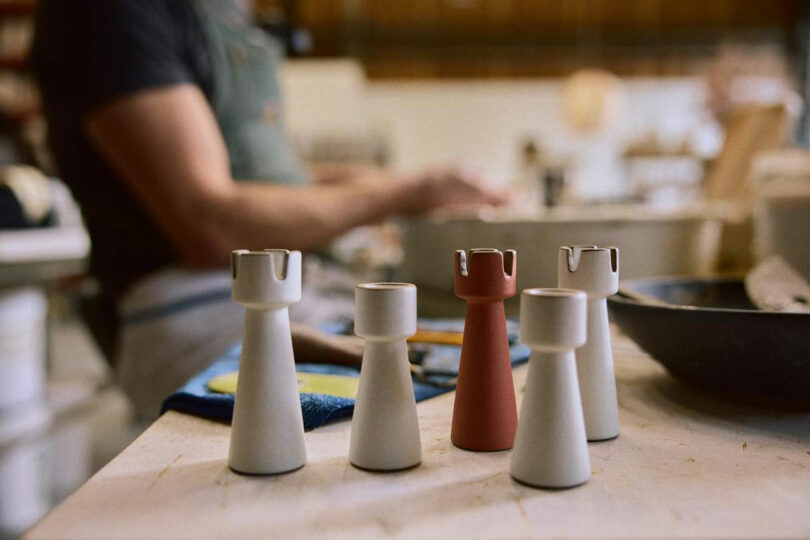
Five rook chess pieces, four white and one red, are arranged on a table at Artek, with a person working in the blurred background.

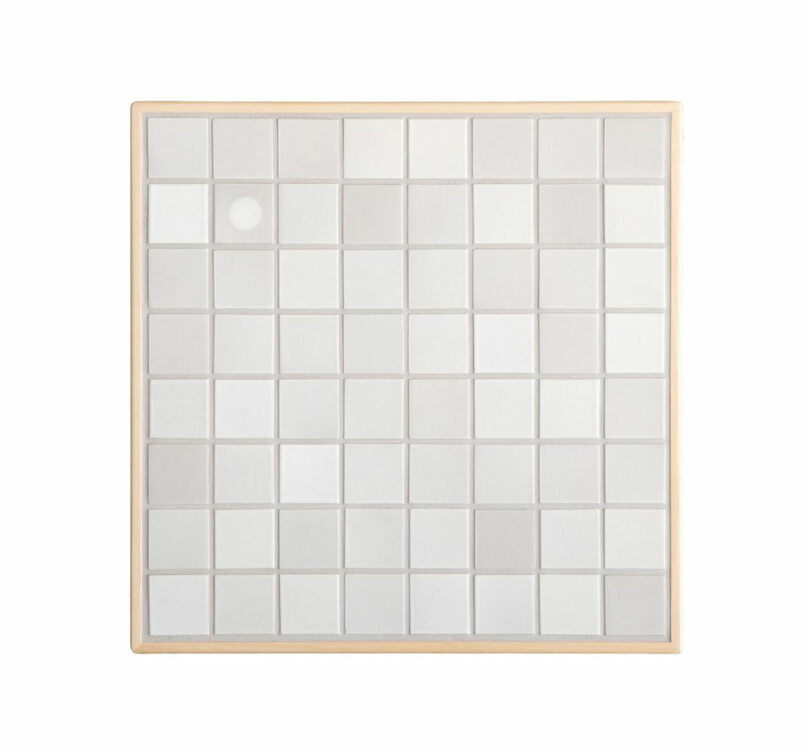
A square grid of 81 frosted glass tiles with a single solid white tile near the top left, framed by a light wooden border in the signature Artek style.

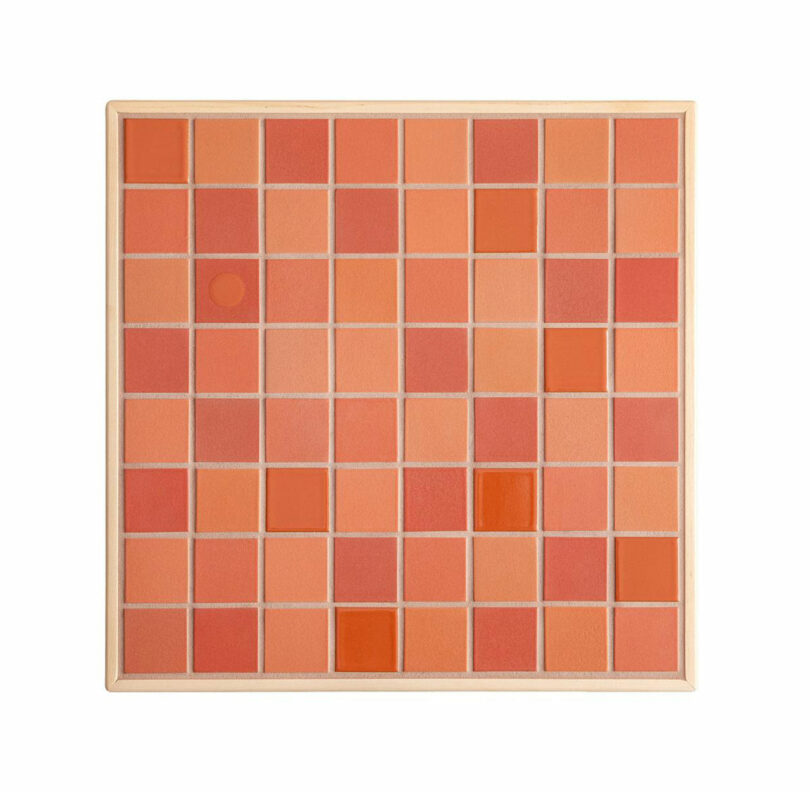
A square grid of red and orange tiles with various shades, framed in a light wooden border inspired by Artek’s iconic design aesthetic.

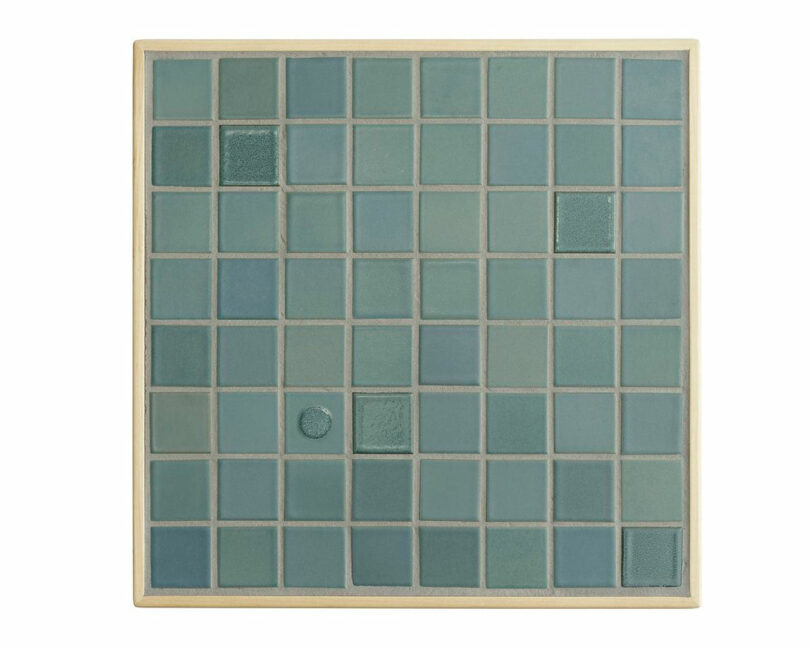
A square grid of blue-green tiles with subtle texture variations, framed by a light wood Artek border. Some tiles have different finishes or patterns.

To learn more about the brands involved in this spirited collaboration, visit artek.fi and heathceramics.com.

Photography by Derek Yarra and courtesy of Heath Ceramics.

Satinines Oficina Milanese Balances Memory and Modernity, Rigor with Intimacy

Satinine’s Oficina Milanese Balances Memory and Modernity, Rigor with Intimacy

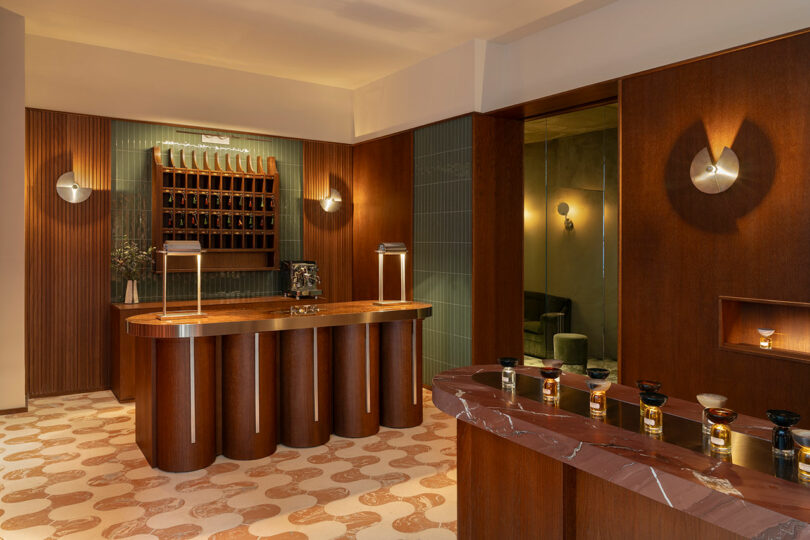
Smell is the sense most closely associated with memory, our olfactory systems nestled right next to the hippocampus. A whiff of cologne on a crowded subway car or an unmistakable trace of a beloved baked good in a nearby shop can instantly transport us to a different time and place. Since 1883, Italian perfumery Satinine has studied the art of scent, and now presents its newest space, Oficina Milanese, designed by Mara Bragagnolo, which treats memory through scent as something spatial, tactile, and alive.

Storefront with a glass door and a sign reading "SATININE" above the entrance; warm lighting and a wooden interior are visible inside.

A modern interpretation of the traditional portineria, or concierge, the stately doors open onto a distinctly Milanese sequence of spaces, each facet mirroring the culture of the city beyond. Bragagnolo positions hospitality as a principle of architecture, drawing from the entrance halls of historic buildings—thresholds where the act of arrival becomes ceremonial. Here, that gesture unfolds across a series of distinct yet connected environments: a reception-like portineria that reframes exchange as ritual, a more intimate sensory room for discovering fragrances in quiet seclusion, and a curatorial space designed for rotation, collaboration, and dialogue with art and design.

A modern perfume shop interior with a marble counter, various perfume bottles displayed, wood paneling, green tiled walls, and a vintage-style poster above shelves.

Integrity is essential to understanding the longevity of a perfume house established nearly 150 years ago. Throughout, the lighting, stonework, tile, and millwork are not only locally sourced but shaped through close collaboration with Milanese artisans, reinforcing a supply chain rooted in proximity and care. Every furnishing element—from the oak boiserie to the custom lighting fixtures—was made by hand, carrying forward a lineage of craft that feels vehemently relevant rather than nostalgic.

A modern perfume boutique interior with wooden shelves, display tables holding perfume bottles, and vintage-style posters on the walls.

The care and attention to detail evident throughout the space, combined with the provenance of the hands that created it, marks Oficina Milanese as distinctly respectful of its surroundings. It underscores a larger truth: that Milan’s identity is inseparable from its material culture, and that authenticity is not declared but built, surface by surface.

A modern interior with a glossy wood counter, patterned floor, green tiled wall, and a green room with a sofa, ottoman, and wall sconce in the background.

As scent is emotional, so too are the details featured in the space. Lombard terracotta tiles, laid according to traditional techniques, ground the interior in regional history, while glossy ceramic tiles arranged vertically nod to the facades of Milanese apartment buildings. Cathedral glass partitions diffuse light with a quiet luminosity, recalling the thresholds of historic entryways. Against this, oak paneling introduces warmth, set in deliberate contrast to cardinal marble, burl wood, and satin-finished steel. The sensorial experience gently oscillates between softness and precision.

A modern lounge with green walls, carpet, velvet sofa, round ottoman, metal side tables, round glass coffee table, and floor-to-ceiling drapes under recessed lighting.

The lighting, developed in collaboration with lighting designer Martina Frattura, bathes the space in a muted, diffused glow that boasts a silky, enveloping “satin” effect in subtle reference to the brand itself. It is less about illumination than atmosphere, softening edges and extending time within the room.

Art Deco sensibilities meet a color drench in the lounge area, where sage velvet wraps the room in a kind of quiet opulence. Round forms paired with slender metallic verticals introduce height and rhythm, while curtains provide a sense of retreat from the city’s constant movement.

Reception desk with a glossy wood surface, two metal lamps, green tile wall, and a partition with multicolored frosted glass panels, with patterned floor tiles.

A sliding door with colored glass panes seals the space from view when necessary, a nod to the stained glass windows that punctuate Milan’s churches. Directly to the left, a burlwood bar inlaid with the brand’s name encapsulates the project’s ethos. Highly polished and meticulously crafted, it transforms the expected gesture of welcome into something more enduring—an invitation to linger. Flanked by twin chrome lamps, their reflective surfaces catch and refract the surrounding materials, embedding the space in a subtle play of light and texture.

A polished wooden bar counter with the word "Satinine" engraved on the surface, accompanied by three curved wooden bar stools.

As Satinine looks toward the future, it does so not in defiance of the past, but through a careful continuation of it where craftsmanship becomes a contemporary language, and simple gestures, repeated with intention, become ritual.

To learn more about Satinine’s Oficina Milanese or designer Mara Bragagnolo, visit satinine.com and marabragagnolo.com, respectively.

Photography by Tiziano Ercoli & Riccardo Giancola.

Kohler Brand KLAFS Debuts the Worlds First Retractable Sauna

Kohler Brand KLAFS Debuts the World’s First Retractable Sauna

Dynamically programmed bathhouses and saunas have cropped up across major metropolises. These alternative third spaces are far better for one’s health than the proverbial bar. People are drinking less and instead, getting in a good sweat to allay the pains of the day. But what if these third spaces were able to collapse back into our first spaces—our homes—quite literally? Home sauna products are a dime a dozen these days but most require considerable amounts of square footage to be installed, the measure of which most urban dwellers can only dream of attaining at some point in their lives.

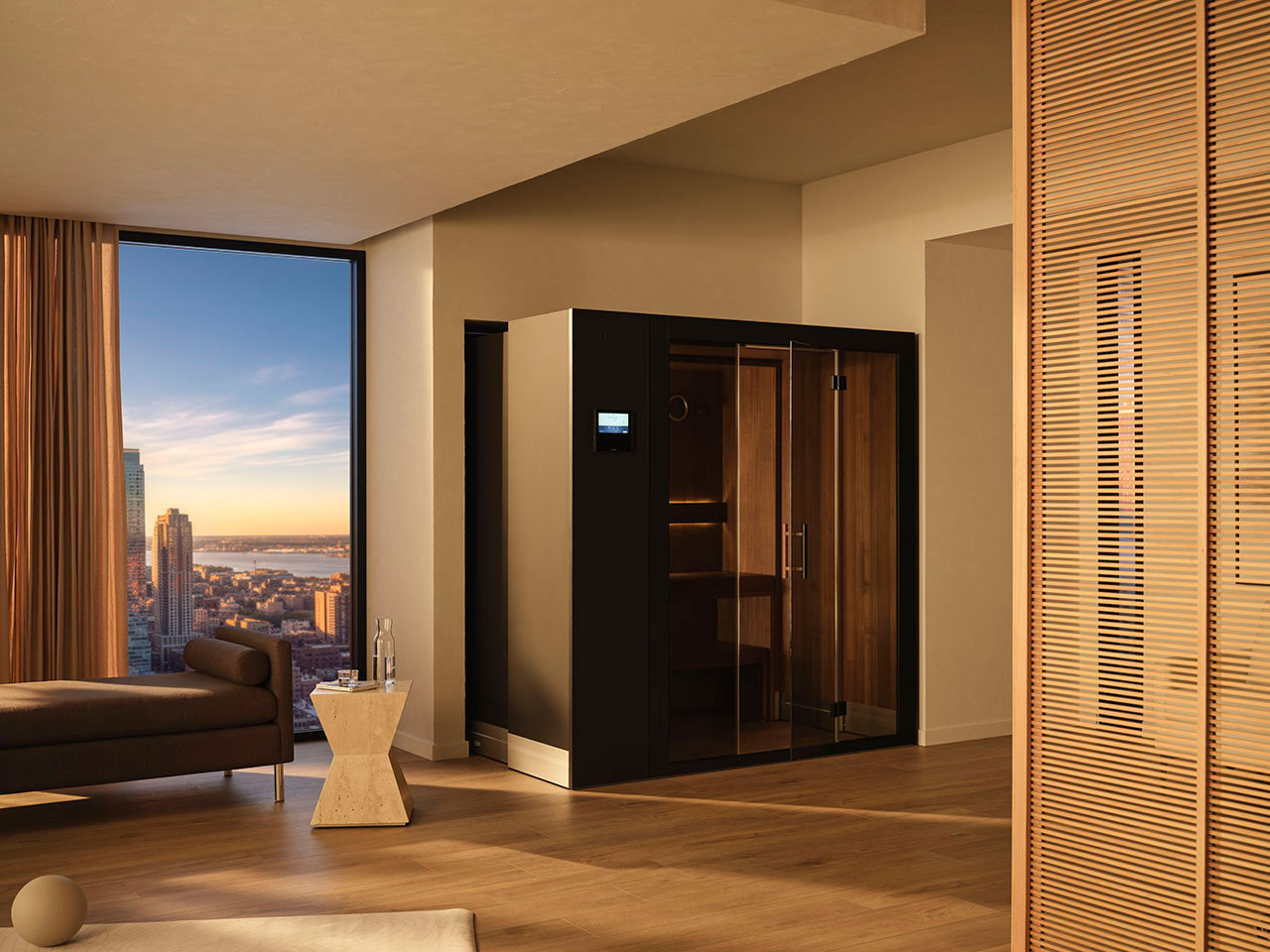
A modern living space with a large window showing a city view, featuring a black home sauna, a lounge chair, and wooden accents.

Modern living room with floor-to-ceiling window, city skyline view, wooden flooring, a lounge chair, small side table, built-in shelves, and a black sauna installed against the wall.

Making the prospect of domestic wellness far more accessible to those residing in infinitesimal abodes, long established German brand KLAFS—a subsidiary of American bathroom fixture giant Kohler—just unveiled to the US market its fully retractable S1 sauna. Attuned to the equally acute push to imbue these primary environments with modular, adaptable solutions, the system compresses into itself not just two, but three, fold. Impressively, it does so without skimping on performance or style.

Modern apartment interior with a wooden sauna unit, floor-to-ceiling window showing a city skyline at sunset, and minimal furniture including a sofa and small side table.

A person walks through a modern living room with wood flooring, large windows showing a cityscape, and a built-in sauna with glass doors.

Retractable kitchens and beds that descend from the ceiling are becoming more commonplace in progressively compact apartments stacked on top of each other in increasingly populated urban centers. Why shouldn’t a sauna do the same?

A person’s hand adjusts a touchscreen control panel displaying sauna settings on a device labeled “Klafs.”.

A person adjusts settings on a digital control panel mounted on a dark wall, with information displayed on the screen.

Emerging from what would be the proportions of a standard bookshelf or bar cabinet, the flexible system expands into an enclosure fully equipped to support the schvitzing needs of three people. It does so, automatically, at the touch of a button.

A woman in a green sports bra and briefs sits on a wooden bench inside a sauna, resting her elbow on her knee with her eyes closed. A round thermometer is on the wall.

The S1 is enabled with KLAFS proprietary SANARIUM control, offering five distinct climate experiences allowing its users to custom calibrate ambiance, humidity, and heat up to 210° Fahrenheit. The design is as sleek as it is versatile; able to fade into the background of interiors outfitted in various styles. Exterior finishes include matte black and walnut, both complemented by a walnut interior for a sophisticated yet inviting aesthetic. The S1 is available in three sizes—small, medium, and large—accommodating 2 to 3 users.

A modern indoor sauna with glass doors is situated in a minimalist room with wooden floors and large windows overlooking a cityscape at sunset.

“For nearly a century, KLAFS has pushed the boundaries of sauna design, and the S1 represents our most transformative innovation for the wellness industry yet,” says KLAFS CEO Phillip Rock. “We’re thrilled to introduce a luxury wellness experience that makes sauna ownership attainable for people who may not have considered it possible due to limited space in their homes. By combining advanced engineering with thoughtful, space efficient design, we’ve created a sauna solution that elevates wellness in any home.”

Woman in athletic wear sits on a yoga mat indoors, performing a seated arm stretch. Warm sunlight enters the room, with a sofa and cityscape visible in the background.

To learn more about the latest wellness technology from the brand, visit klafsusa.com.

Photography courtesy of KLAFS.

Philippe Nigros JOSEPH Armchair for Wittmann Honors Josef Hoffmann Without Imitation

Philippe Nigro’s JOSEPH Armchair for Wittmann Honors Josef Hoffmann Without Imitation

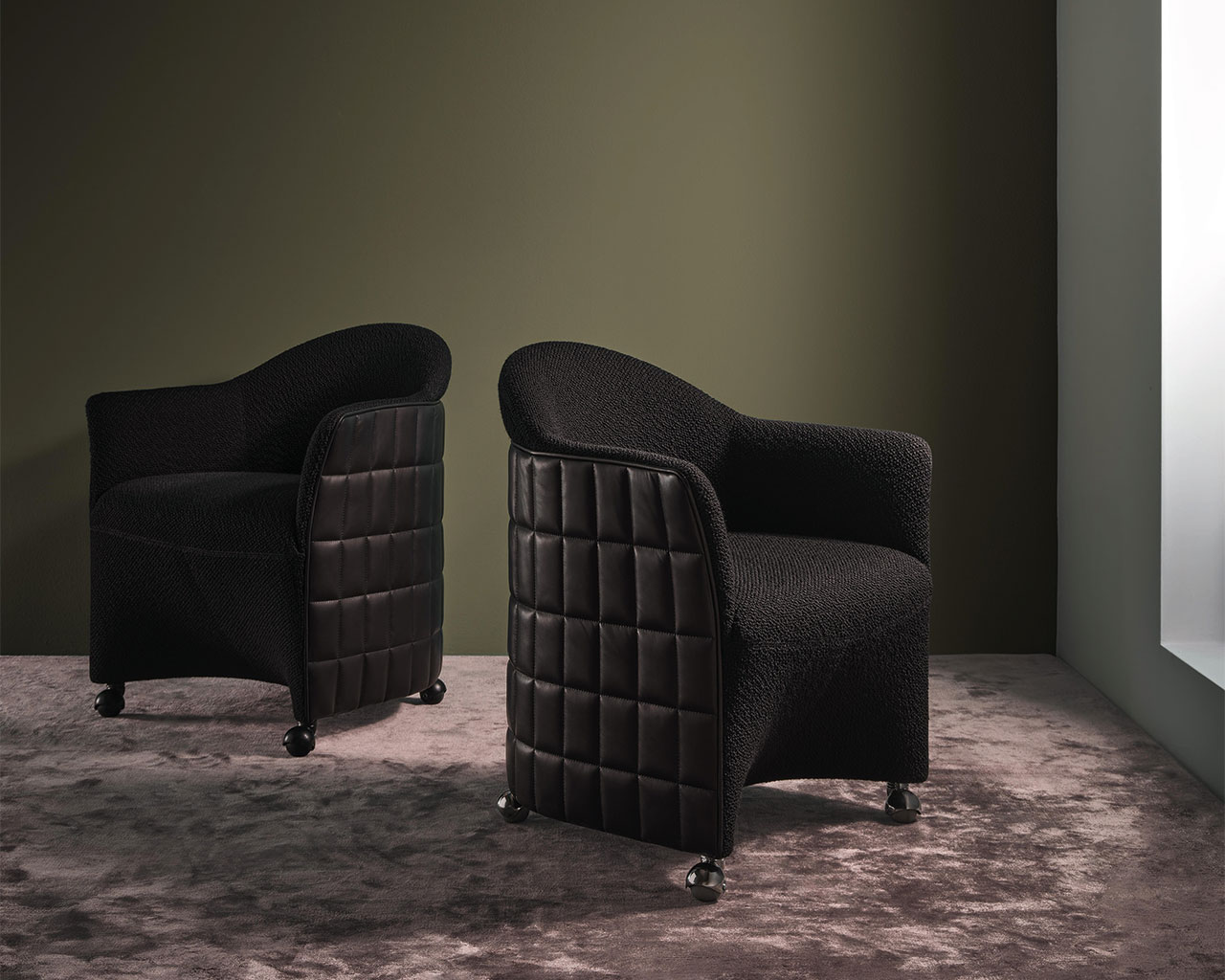
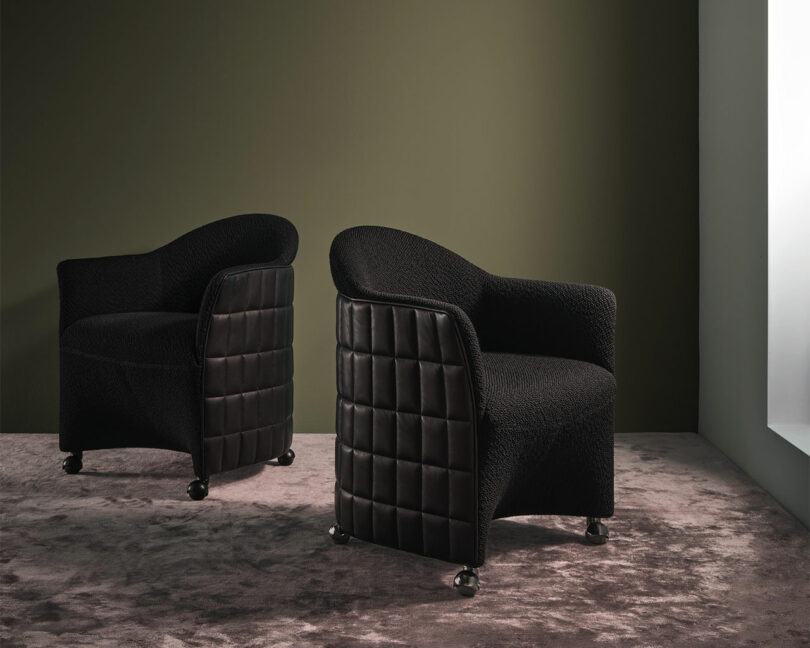
Designing in the shadow of a master requires a particular kind of restraint and discipline––not deference so literal that it becomes mimicry, nor ambition so forceful that it erases lineage altogether. It demands something quieter, more exacting. With JOSEPH, his first Wittmann collaboration, French designer Philippe Nigro finds that balance, creating an armchair that reads as a contemporary work shaped by the discipline, geometry, and craft tenets that defined Josef Hoffmann’s original pieces.

A modern black Wittmann armchair with a quilted side design sits on a gray carpet against a dark green wall in a minimalist room with natural light.

At Wittmann’s Lower Austrian manufactory, this lineage is not theoretical, it is practiced. For generations, the company has built its identity around the idea that furniture is composed rather than assembled, each piece passing through the hands of specialists who understand material as both constraint and opportunity. JOSEPH emerges from this environment as the result of many: woodworkers, metal fabricators, seamstresses, and upholsterers working in concert, refining a form until construction, comfort, and clarity align.

A tan, quilted Wittmann armchair sits on a gray carpet in a minimalist room with a dark green wall and a large window letting in natural light.

Nigro’s reference to Hoffmann is deliberately indirect. Rather than quoting the ornamental tendencies of Viennese Art Nouveau, JOSEPH channels its underlying logic—precision, proportion, and a commitment to legibility. Hoffmann’s barrel armchairs, with their enveloping curvature, and the rigorously gridded Kubus chair both quietly echo here: the former in JOSEPH’s continuous, wrapping silhouette, the latter in its quilted outer shell, where geometry becomes structure rather than surface decoration.

Two tan, quilted Wittmann chairs sit on a textured gray rug against an olive green wall, with round pink wall decor mounted above them.

That exterior is perhaps the chair’s most immediate expression of craft. A grid of meticulously upholstered squares wraps the back and arms, each seam placed with millimetric accuracy. It is an unforgiving detail—any deviation becomes instantly visible—requiring not just experience, but a kind of anticipatory thinking from the upholsterer. The interior, by contrast, softens. Smooth upholstery lines the seat and backrest, creating a subtle inversion: precision outwardly expressed, comfort inwardly reserved.

A tan Wittmann upholstered chair with a quilted back sits next to a round marble table; abstract artwork hangs on a beige wall above mauve carpet. Lemons are on the table.

This duality—structure and softness—extends through every layer of the chair. Beneath the surface, a complex assembly of pocket springs and multi-layered foam is calibrated to support a posture that sits somewhere between upright and relaxed. JOSEPH is intentionally hybridized: neither strictly a dining chair nor a lounge piece, but a form that accommodates both modes of sitting. The slightly inclined backrest and carefully balanced proportions allow it to shift contexts, from residential interiors to workspaces, without losing its composure.

A Wittmann tan upholstered chair with a quilted backrest sits next to a round marble table with a glass bowl of lemons, on a soft mauve carpet in a modern interior setting.

Materially, the chair operates as a site of negotiation. Wittmann’s expertise with upholstery allows for combinations of leather and fabric across interior and exterior surfaces, each pairing requiring careful calibration in cutting, tension, and visual weight. No two materials behave alike; elasticity, thickness, and grain all influence how a seam holds or a curve resolves. The result is beyond aesthetic, demonstrating JOSEPH’s ability to harmonize difference into a single, coherent object.

A black textured Wittmann armchair with a quilted leather exterior sits on a mauve carpet next to a round stone table in a modern room with beige walls.

Despite its clean execution, the construction still carries the imprint of human handwork. The curved metal detail at the backrest is welded in-house, “amid flying sparks,” rather than standardized, which allows each chair to be subtly adjusted as needed. The wooden base, shaped through tensioned straps, introduces both structural resilience and ergonomic nuance. In summation, each chair a discrete resolution of similar sets of challenges.

A tan leather Wittmann armchair with a curved backrest and armrests, viewed from the front against a white background.

And, in a final gesture that brings authorship back into the workshop, each finished piece bears a small plaque signed by the upholsterer responsible for its making. In this way, JOSEPH resists the anonymity of contemporary production or an object to be optimized for replication. Wittmann frames this approach as sustainability not through material innovation alone, but through longevity: furniture designed to endure, to be used, repaired, and ultimately passed on.

Tan leather Wittmann armchair with a curved backrest and quilted stitching on the exterior side panel, shown on a white background.

Tan upholstered armchair by Wittmann with a quilted grid pattern on the back and sides, shown from a side angle against a white background.

To shop this and other products from the storied brand, visit wittmann.at.

Photography by Lea Sonderegger courtesy of Wittmann.

The Shop by Gantri Pays Homage to Set and Setting

The Shop by Gantri Pays Homage to Set and Setting

Color is a powerful thing. Emotional and expansive, the most compelling hues can’t help but define our homes, clothes, and objects by washing every facet of our being in their brilliance and personality. Championing this creative tenet is Gantri, the now decade-old lighting company who fundamentally changed how many creatives and designers conceptualize with light.

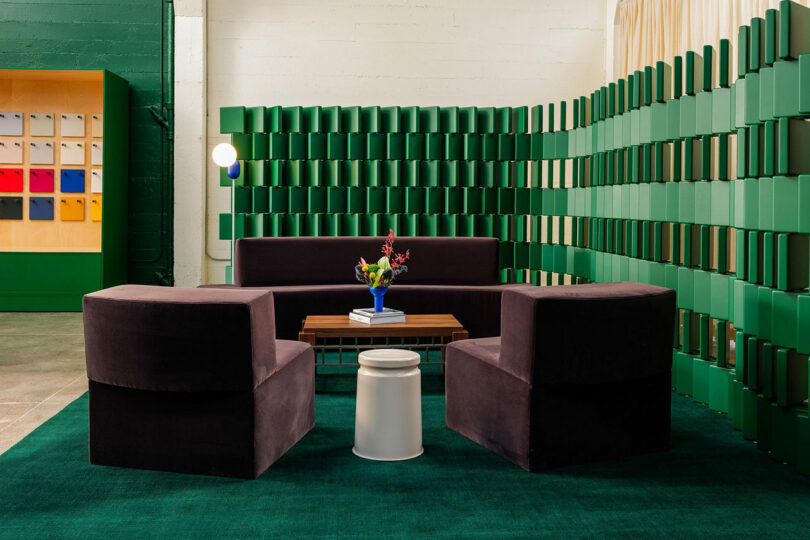
Modern lounge with dark sofas, a wooden coffee table, a blue vase with flowers, books, and a geometric green partition wall; floor lamp with a round white shade in the background.

Designs from familiar faces in the industry, including Madeline Isakson, Louis Filosa, and Viviana Degrandi, are 3D printed, assembled, and shipped out quick––rapid response time just one benefit to the system established here. Extending their influence into the brick-and-mortar world for the first time, Gantri is proud to present The Shop, a space to welcome community and commerce, but most importantly, color.

A blue vase with colorful flowers sits on a curved metallic table in front of a textured green wall.

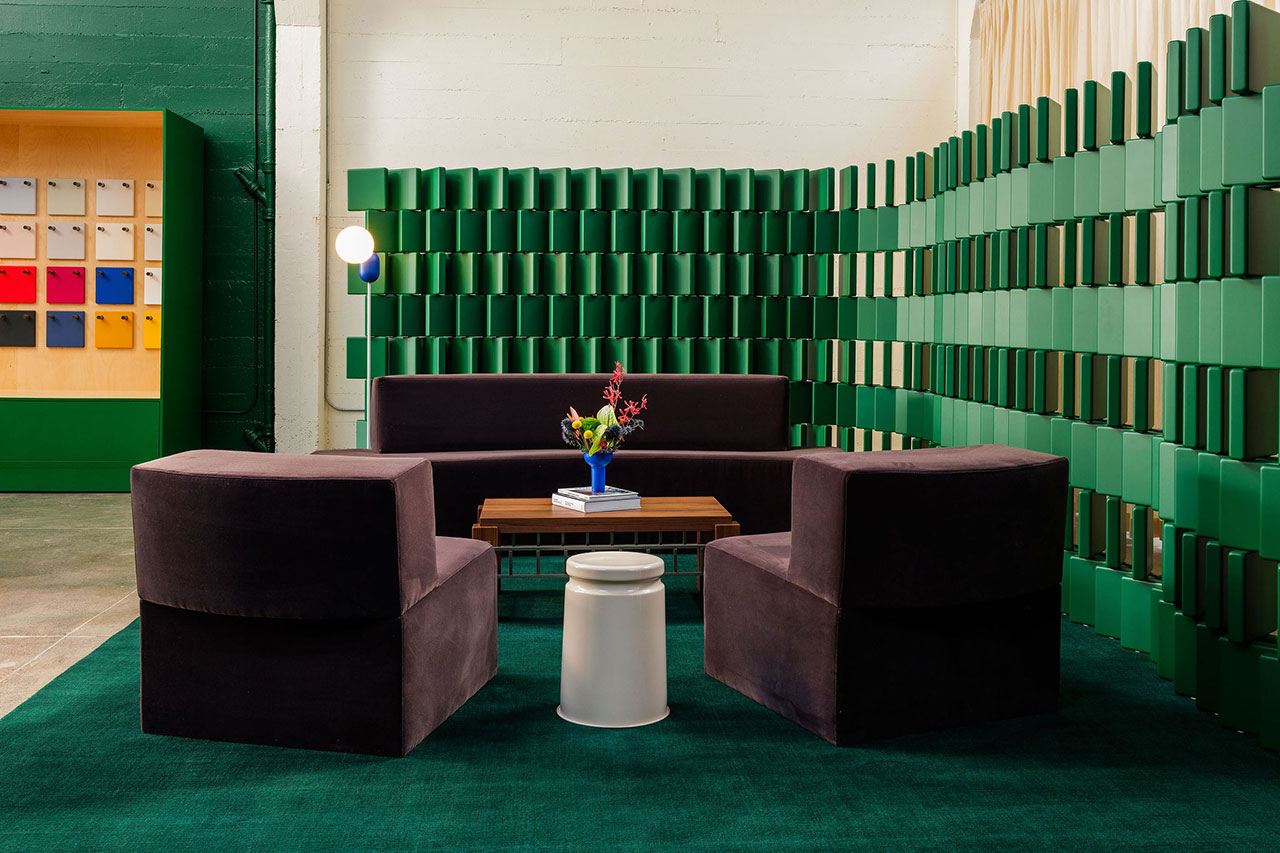
A 1920’s autobody shop in the heart of the Mission District is the set and setting for the new creative hub. Sectioned into thirds, the first facet of The Shop serves as a showroom and community space, with color cards, spaces to rest, and a unique method of room division lacquered in the signature Gantri green. Tiles sit balanced upon one another, perpendicular to their neighbors below. This creates an almost scale-like appearance, undulating tones of green picking up light in slightly different amounts, creating a serpentine feel when viewed from afar.

Two dark brown lounge chairs face each other with a small wooden table and a vase of flowers between them, set against a green paneled wall and green carpet, with two round wall lamps.

The center of the shop serves as a flexible hub, to be utilized for whatever is most pressing at that moment. This gives the team space to host events, meetings, or breakout sessions, while still maintaining the polish of a showroom.

A modern meeting room with a wooden table, eight black chairs, a blue vase with flowers, and color sample displays on green and wood-paneled walls.

In the third quadrant, the team works the magic that has brought international acclaim––and more than a few copycats––throughout ten years in business. Functionally the engine room of the operation, material research, prototyping, and refinement all happen here under one roof. The streamlining of a process that once was so technically arduous and required a large amount of background knowledge is quite elegant, even more so when paired with the clean design Gantri is known for.

Three green display cases with wooden interiors showcase various modern table and pendant lamps, illuminated against an industrial setting with exposed ductwork and ceiling lights.

A showroom, community hub, design studio, and materials lab all in one, the space is simultaneously a stunning achievement of how ubiquitous the Gantri model has become, and inspires a strong future in the decades to come. They take being a part of their neighborhood seriously, and plan to call 10th Street home for the near and far future.

Three pendant lights with different geometric shades hang inside a wooden display box, set against a background of dark green curtains.

To learn more about The Shop, visit gantri.com.

Photography by Krescent Carasso.

Beyond the Screen: Apple Studio Display and the Future of Creative Workflows

Beyond the Screen: Apple Studio Display and the Future of Creative Workflows

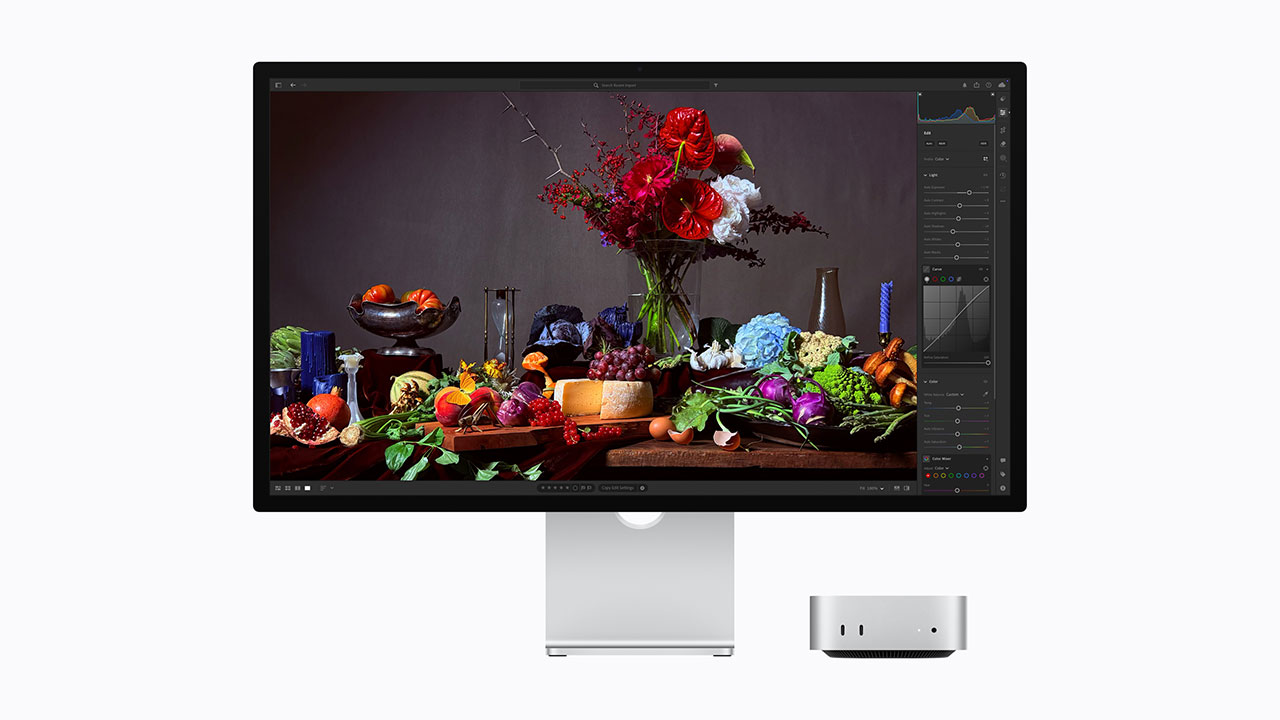
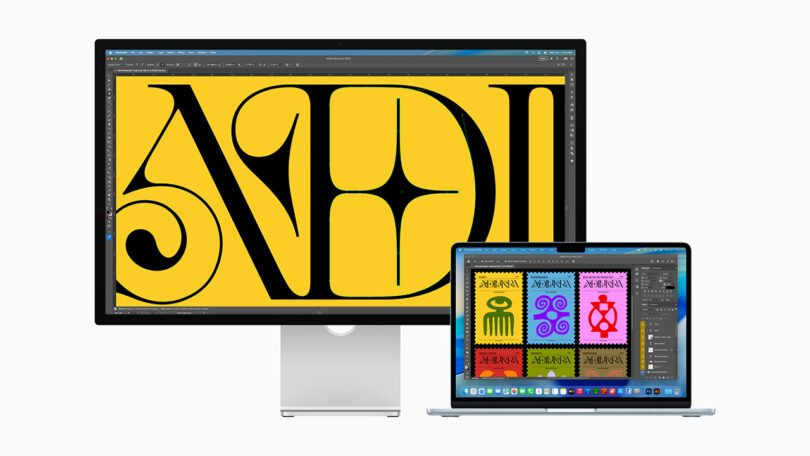
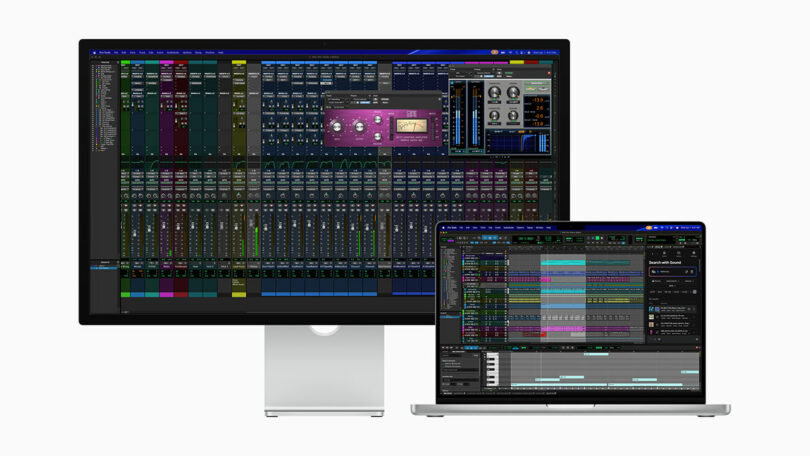
Much to my chagrin, a frenzy of screens increasingly defines my human existence. They seem to multiply, migrate, and mutate over time—expanding beyond passive surfaces into active participants in how I see, speak, and make. Through every iteration, my stalwart ally remains the original 2011 Thunderbolt Display from Apple. And with the introduction of a newly expanded Studio Display family, the brand leans further into its carefully considered evolution, positioning the screen as the central site of creative exchange, where desktop real estate, aspect ratios, and hybridized media shape how we see, process, and retain an onslaught of information.

Two desktop monitors with silver stands display colorful abstract digital artwork on their screens against a plain white background.

Studio Display and Studio Display XDR

A desktop monitor and a laptop display colorful graphic designs, with the monitor showing large stylized letters and the laptop displaying four colorful symbols.

Studio Display

At the entry point, the updated Studio Display reframes the desktop monitor as an integrated communications hub. A 27-inch 5K Retina panel—packing more than 14 million pixels—anchors the experience, offering a precise prescription of equipment variables calibrated for clarity and continuity. Here, user attention, retention, and responsiveness are embedded outcomes, supported by high pixel density, balanced brightness, and a color profile tuned for legibility as much as vibrancy.

A computer monitor and a laptop displaying digital audio workstation software with multiple tracks, audio plugins, and mixing controls visible on both screens.

Studio Display

A person stands in front of a wooden slat wall with guitars and percussion instruments, speaking on a video call displayed on a computer monitor.

Studio Display XDR

Performance, too, is measured in human terms. The potential for eye fatigue or strain hangs in a delicate balance between the density of displayed text, the quality of graphics rendered, and the rhythms of scrolling. Apple’s 5K resolution, 600 nits of brightness, and P3 color gamut work in concert to maintain that equilibrium, allowing for extended time-on-task without compromising comfort or comprehension.

A computer monitor displays an orange and red graphic design project with large yellow text reading "Passiflora" and images of purple passion flowers.

Studio Display XDR

A computer monitor displays a video editing software interface, showing a scene of a person running in the rain on a sports field, with various editing tools and timelines visible.

Studio Display XDR

The addition of a 12MP Center Stage camera with Desk View further shifts the screen from a one-way display into a multi-directional interface that acknowledges how often we are now both viewer and participant. Studio-quality microphones and a six-speaker system with Spatial Audio extend this condition, transforming the display into a site of presence.The addition of a 12MP Center Stage camera with Desk View further shifts the screen from a one-way display into a multi-directional interface that acknowledges how often we are now both viewer and participant. Studio-quality microphones and a six-speaker system with Spatial Audio extend this condition, transforming the display into a site of presence.

A computer monitor displays video editing software with two green-tinted video frames of a car and smoke, timeline, color controls, and node graph visible on the screen.

Studio Display XDR

A computer monitor displays a photo editing software with an image of a person in a shiny jacket standing in front of a colorful, powdery background.

Studio Display XDR

Connectivity follows suit. With Thunderbolt 5, the Studio Display becomes infrastructural—capable of daisy-chaining up to four displays or supporting high-speed peripherals through a single cable that also delivers up to 96W of charging power. What emerges is a workspace no longer constrained to a single screen but distributed across a continuous visual field that can be modulated across multiple surfaces.

A computer monitor displays an image editing program showing a portrait of a person wearing gold fringe and pearl accessories against a red and blue background.

Studio Display XDR

A computer monitor displays 3D modeling software with an abstract, organic digital sculpture featuring metallic and yellow textures.

Studio Display XDR

If Studio Display expands the everyday screen, the all-new Studio Display XDR recalibrates what a professional interface can be. Built around a 27-inch 5K Retina XDR panel with a mini-LED backlight and over 2,000 local dimming zones, it reaches up to 2000 nits of peak HDR brightness with a 1,000,000:1 contrast ratio—producing ultra-bright and ultra-crisp images, respectively.

A computer monitor displays multiple brain scan images, including colored and grayscale cross-sectional views from different angles.

Studio Display XDR

Close-up of a silver computer showing four ports on the back, including two Thunderbolt ports, one USB-C port, and one headphone jack.

Studio Display XDR Ports

The implications for attention and accuracy only intensify. A 120Hz refresh rate with Adaptive Sync ensures that motion remains fluid and responsive, reducing visual friction and cognitive lag. Expanded color support positions the display as a true reference surface, where even subtle shifts in tone or contrast can be read with precision. Whether navigating dense timelines in video editing, parsing complex datasets, or rendering immersive environments, the screen becomes an instrument calibrated for sustained focus and interpretive clarity.

Rear and side views of a silver Apple desktop computer, showing its stand, ports, and Apple logo against a plain background.

Studio Display XDR Stand

Rear view of an Apple monitor showing the Apple logo, VESA mount adapter, ports, and a central circular cutout.

Studio Display Mount Adaptor

Across both models, Apple’s approach is consistent: the screen is no longer just where content appears—it is where workflows converge. Camera, audio, connectivity, and computation are folded into a single plane, transforming the display into a responsive environment attuned to the nuances of human perception and productivity as technology continues to proliferate.

To discover more of the brand’s latest launches or to shop the Studio Displays, visit apple.com.

Photography courtesy of Apple.

This Camping Gear Conjures Nostalgia to Meet the Moment

This Camping Gear Conjures Nostalgia to Meet the Moment

The allure of venturing into the great outdoors for a few days will never cease. When the going gets tough and the challenges of the world seem insurmountable, a trip deep into the reaches of unspoiled nature is almost always the right antidote. Camping, however, doesn’t mean one has to entirely rid themselves of acculturated conveniences. It doesn’t mean they should completely replicate or exceed the creature comforts of home with elaborate glamping accoutrements either. The middle road can be exactly what the doctor ordered. But for it to work, the right equipment is essential. These carefully calibrated tools, furnishings even, should get the job done well and only when that’s achieved, sport a bit of stylistic flourish or incorporate technological advancements.

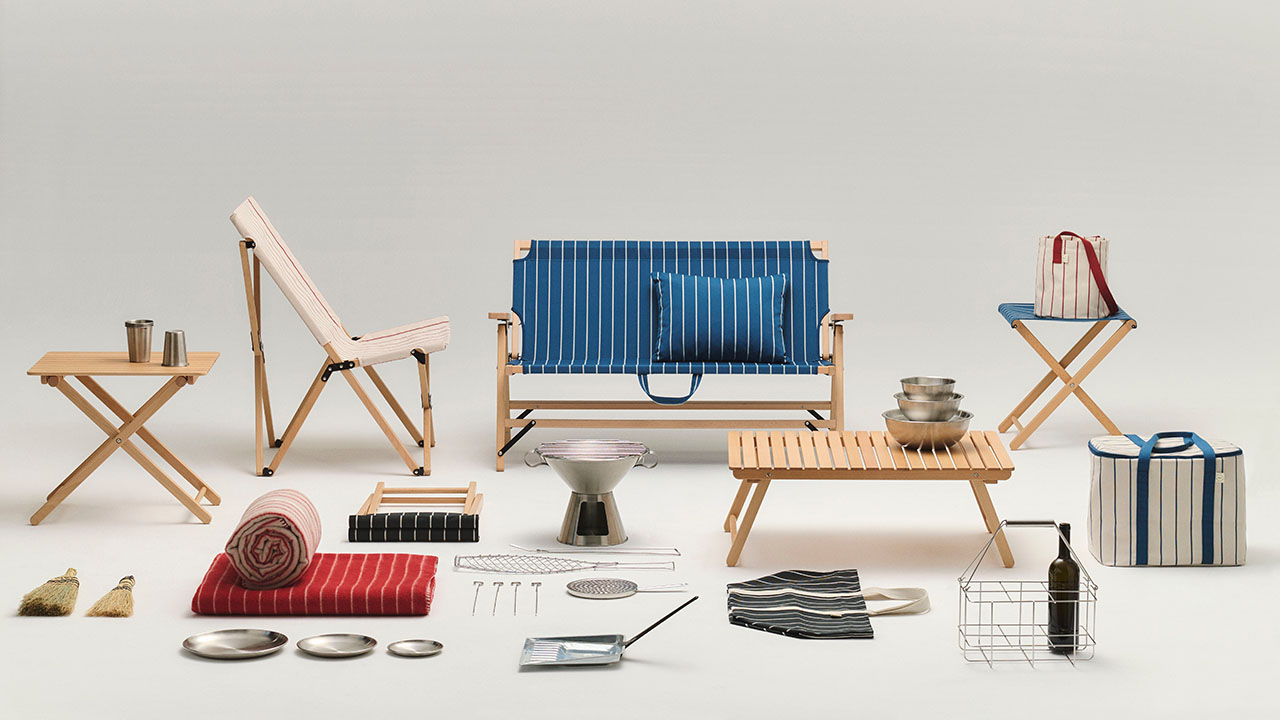
A collection of stainless steel barbecue utensils, grills, bowls, plates, skewers, tongs, and a wine holder arranged on a white background.

A set of stainless steel kitchen and grilling tools, utensils, bowls, and cookware arranged neatly on a plain white background.

Famous for his “supper normal” re-calibration of everyday furniture, lighting, and device typologies, British designer Jasper Morrison has just launched an outdoor product collection with Danish brand HAY that facilitates the median. The simple implementation of colorful strip patterns on incorporated upholstery and the gleaming iridescence of the laid bare metal used accomplishes the second task, not as an added layer of superfluous aesthetic intervention, but as an incidental byproduct of the new, if just slightly, anomalous forms; responding to an intensive, if just slight, reassessment of function conducive to present day need.

A metal tin, a plate with a spoon, fork, and apricot, stacked metal bowls with a pear, and a folded white cloth with red stripes on a white surface.

Funny enough, the aesthetic outcome of this process emerged as nostalgic. Bypassing the pitfalls of overly engineered gear with too many bells and whistles lead to the rediscovery of shapes and mechanics that have and will continue to transcend time. The aim here for Morrison, however, wasn’t to create artifacts with so-called timeless appeal, nor objects with fleeting novelty, but rather designs that carry a degree of familiarity and relatable emotional resonance. Sustainable strategy—the deft implementation of durable water-lacquered beech wood and stainless steel—didn’t need to be explicit, shouted out loud. Ease of use and perceptible simplicity sounds louder.

Three stainless steel mixing bowls stacked on a white surface, with the top bowl filled with green peppers and one pepper lying beside the bowls.

“For us, Jasper is a master of everyday objects,” said Mette Hay, co-founder of HAY. “He has an incredible ability to make the ordinary feel essential, a perspective that closely aligns with our approach to design, where usefulness and longevity are central.”

A plate with a large heirloom tomato, a plate with a wedge of cheese on parchment, and a small plate with two slices of bread and a butter knife on a white surface.

The comprehensive range is as suited for a few days prospecting in the wilderness as for a beach day, afternoon picnic, or evening backyard hang. Included are folding armchairs and love seats that can be quickly stored away. They’re far more refined and essentialized than the unsightly, collapsible metal pole camping chairs sold at the local camping store. It makes the prospect of spontaneously heading out far more appealing and tenable.

A metal plate with an apricot, a tin can, and nested stainless steel bowls with a pear on a blue striped cloth on a white table.

Alongside the more structural Canopy and Folding Tables are the Cooler, Bottle, and Picnic Bags. Formed like two intersection cones, the BBQ and Firepit products are as straightforward in their function as they are satisfying in their countered shape. The adjoining Plates, Pans, Grills, Tongs, Forks, and Skewers round-out the proposition. Bringing in that nostalgic feel are the Brooms and Dust Pan.

Three metal plates are arranged vertically: the top plate has a slice of bread, the middle has a head of radicchio, and the bottom has a green tomato with a fork and knife.

A metal dustpan and a straw broom hanging side by side on a metal rod against a plain background.

Three metal bowls sit on a wooden slatted surface, containing artichokes, lemons, and a covered bowl, with rocks visible in the background.

Two metal cups, one holding a lemon with a leaf, are beside a stack of cups. In front are two glass bottles, one filled with clear liquid and one with pale yellow liquid.

Four metal skewers with hooks hang from a rod; the skewers hold a red pepper, green peppers, and a king oyster mushroom, against a plain white background.

Six metal barbecue tools, including skewers, skewered forks, a grill basket, and a round grill grate, hang from hooks on a metal bar against a plain light background.

Two stainless steel grills, one small and one large, are stacked vertically. Both have a conical base and a circular grilling surface with metal handles on the smaller grill.

A single slice of bread sits on a spatula over a metal grill, which is placed on a stainless steel, cone-shaped barbecue grill.

Five dark glass bottles in a metal wire carrier with a handle, placed on a white surface against a light background.

Five dark glass bottles in a metal wire carrier with a handle, placed on a white surface against a light background.

A metal carrier holding three dark wine bottles and a metal cup is placed on a rocky, pebble-covered surface.

A metal table with bowls of artichokes and lemons, a bottle opener, and a circular clip holder, set on a wooden surface with rocks below.

A wooden picnic table with metal cups and a metal carrier holding four bottles of wine, set on rocky terrain beside a flowing stream.

A portable metal grill with food including scallions, lemon halves, and what appears to be fish, set on a rocky riverbank near the water.

A metal plate with a cooked octopus tentacle, grilled lemon half, and parsley on a wooden table, next to a metal cup, a bowl of lemons, and a red striped cloth.

A portable metal grill with an open flame sits on a rocky surface surrounded by light-colored stones.

The collection is now available at both MoMA Design Store and through Design Within Reach. To shop, visit store.moma.org and dwr.com, respectively.

Photography courtesy of HAY.

Lore Bath House is a New Kind of Neighborhood Agora for Downtown Manhattan

Lore Bath House is a New Kind of Neighborhood Agora for Downtown Manhattan

Cities like New York are densely packed in an effort to maximize every available square foot—people literally stacked on top of one another. While a calendar crammed full of engagements—or simply fighting through the grocery store at 6 p.m.—can feel taxing, depleting one’s social battery, isolation and complete anonymity are also very real conditions in this context.

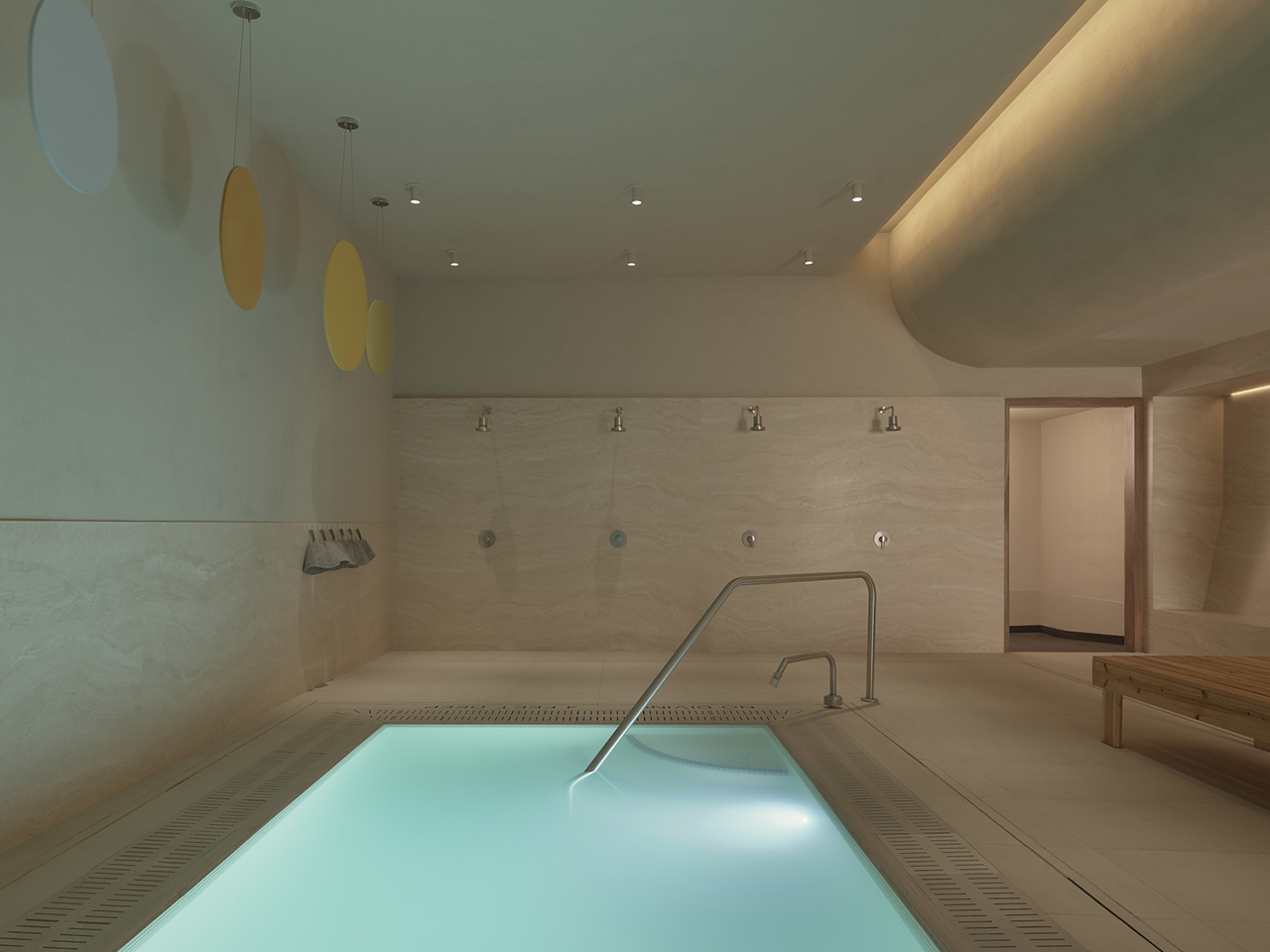
Minimalist indoor pool area with soft beige walls, a wooden bench, wall hooks with towels, a potted plant, and a door leading to a darker room.

Photo: Sean Davidson

Through the monotony of constantly going to work and returning home, one can get lost in the thick of it. Third spaces are essential for breaking the cycle. They facilitate more meaningful, less superficial and fleeting interactions. For too long, this type of “escape” has simply been the bar around the corner; not merely a place to drink but also have impromptu—if more subconsciously planned than most will admit—exchanges with those outside of one’s professional and social circles. The health implications are problematic, to say the least.

Modern wooden sauna room with tiered bench seating, natural light entering through a window, and stone flooring.

Photo: Sean Davidson

Positioned as a new type of neighborhood gathering place—akin to the thriving supper clubs of a bygone era—Lore Bath House is not just another urban sauna but a facility made to more smoothly facilitate community. That isn’t to say that introverts or the newly defined, hybrid ambivert are barred from visiting. The option to converse with others is simply there. Lore’s expansive shared sauna spaces—both dry heat and infrared—and oversized cold plunge pool are far less modulated, confined, and formulaic than other comparable venues in New York.

Curved brick bench with beige cushion features built-in planter filled with ferns; three small wall lights above against a plain beige wall.

Photo: Sean Davidson

It’s also nowhere near as cultish or “fully participatory” as some. The aim, of course, is to forge a base of regulars; those members that come to sweat as part of their weekly, even daily, routine. It’s a healthier alternative to the bar, coffee shop, and even, that loneliest of places, the gym.

Modern locker room area featuring light wood lockers, a marble countertop with three sinks and mirrors, and neutral-colored walls and flooring.

Photo: Sean Davidson

For founders James O’Reilly—formerly of NeueHouse and Life Time—and Adam Elzer—the force behind Everyday Hospitality—such a proposition is not just outwardly but also inwardly facing; an act of kindness bestowed on oneself.

Minimalist bathroom with dark textured walls, a wooden countertop, stone sink, and modern fixtures, illuminated by recessed lighting.

Photo: Sean Davidson

“We were drawn to this practice for the social elements, but stayed for the health and felt benefits,” O’Reilly says. “While it’s been around for millennia, science now confirms what tradition always knew: regular sauna and cold-water immersion sessions enrich health. The key isn’t longer sessions but greater frequency.

A stairwell with textured walls leads down to a brick wall, which features a large illuminated photograph of flowering branches.

Photo: Sean Davidson

Behind a nondescript facade flanking Broadway as it climbs up through the bustling pocket neighborhood of NoHo, Lore unfolds as a 6,200-square-foot facility. Upon entering, members descend two separate staircases, one for women and the other for men, only to discover long, well-appointed changing and shower rooms. They re-emerge on either side and are fully immersed in the monumental sauna and cold plunge chamber. Along the way, they’re guided by a gradually evolving, sensorially cued palette of colors, materials, and textures. White warm travertine encircles the pool, the sauna is wrapped in dark, chocolate toned, alder wood. The bold yet gentled transitioned scheme evokes the sharp contrast of putting one’s body through thel extremes of “hot and cold.”

A dimly lit sauna interior features red lights, a wooden bench with a towel, and a ladle resting on top.

Photo: Aly Kula

Two gray and white felt hats labeled "lore" are displayed on a wooden shelf, partially obscured by green plant leaves in the foreground.

Photo: Aly Kula

A wooden table holds a potted plant and a small candle labeled "lore," set in front of a brick-patterned wall and bench.

Photo: Aly Kula

A cream-colored metal cup labeled "lore" sits on a wooden table, with a green plant partially visible in the foreground and a cushioned bench in the background.

Photo: Aly Kula

A small glass vase with green and white plants and a cream-colored cup labeled "lore" sit on a wooden table; a tiled wall and leafy plant are in the background.

Photo: Aly Kula

To learn more about the new space, visit lorebathingclub.com.

Photography by Sean Davidson and Aly Kula as noted.

Sixpenny Launches its Wild Air Print With a Bold Showroom Redesign

Sixpenny Launches its Wild Air Print With a Bold Showroom Redesign

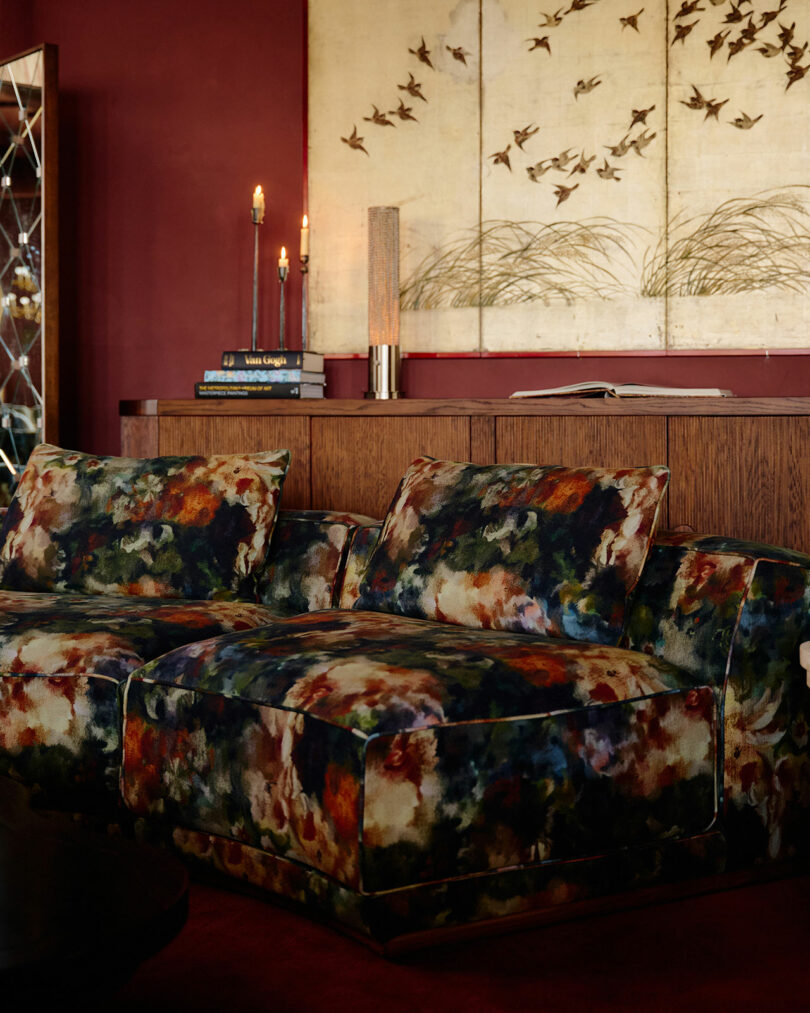
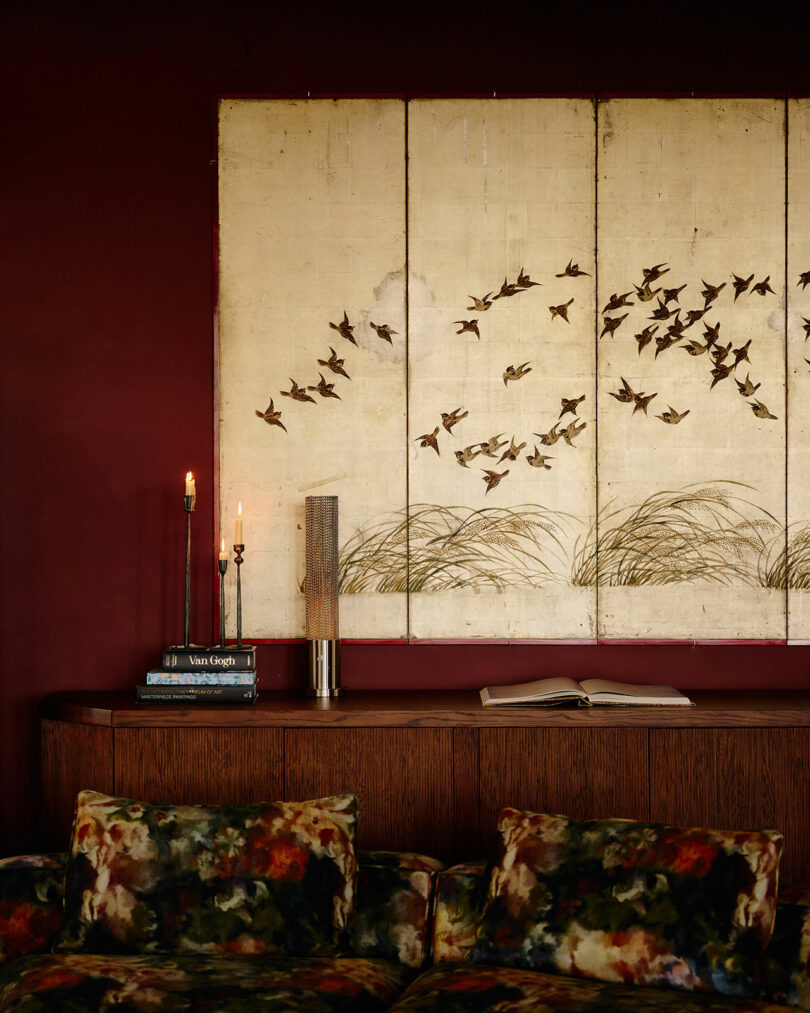
Untethered by bombastic claims of trend adherence or disingenuous refutes thereof, Brooklyn furniture brand Sixpenny does things differently. For the maverick producer, it isn’t even a question of substance over style but an unyielding concession that the objects we surround ourselves with in our ever-multivalent homes will inevitably wear down; imprint the passage of time and use. Its proposition: create especially comfortable furnishings with carefully sourced top quality materials in timeless compositions. Sixpenny’s differentiator: a favorable price point for what are ostensibly heirloom pieces.

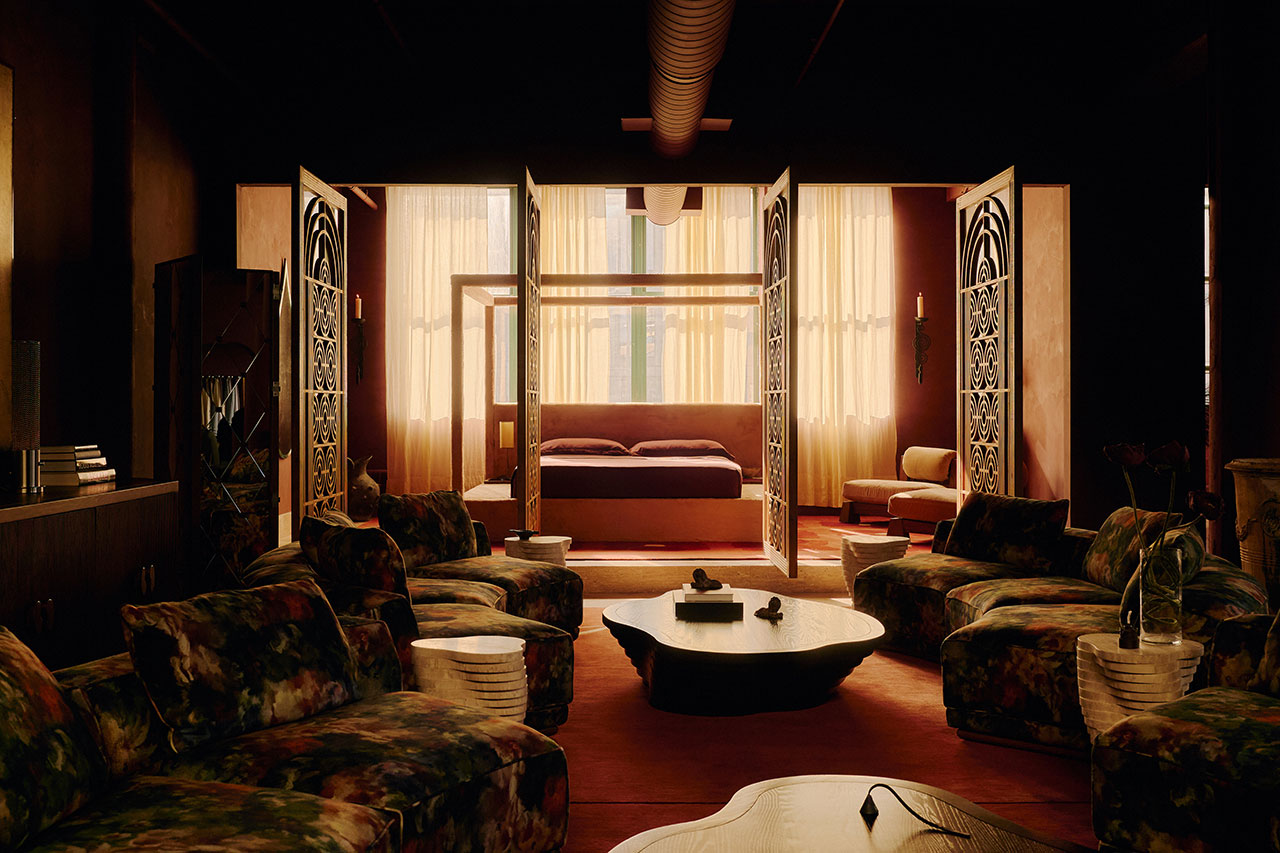
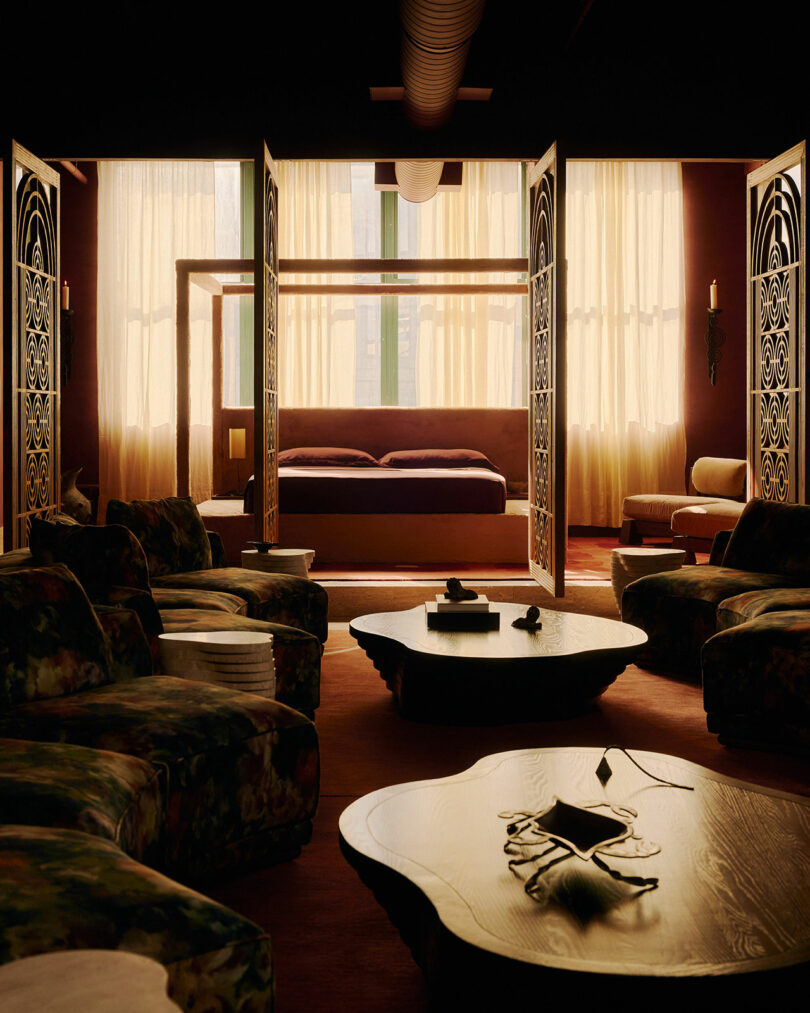
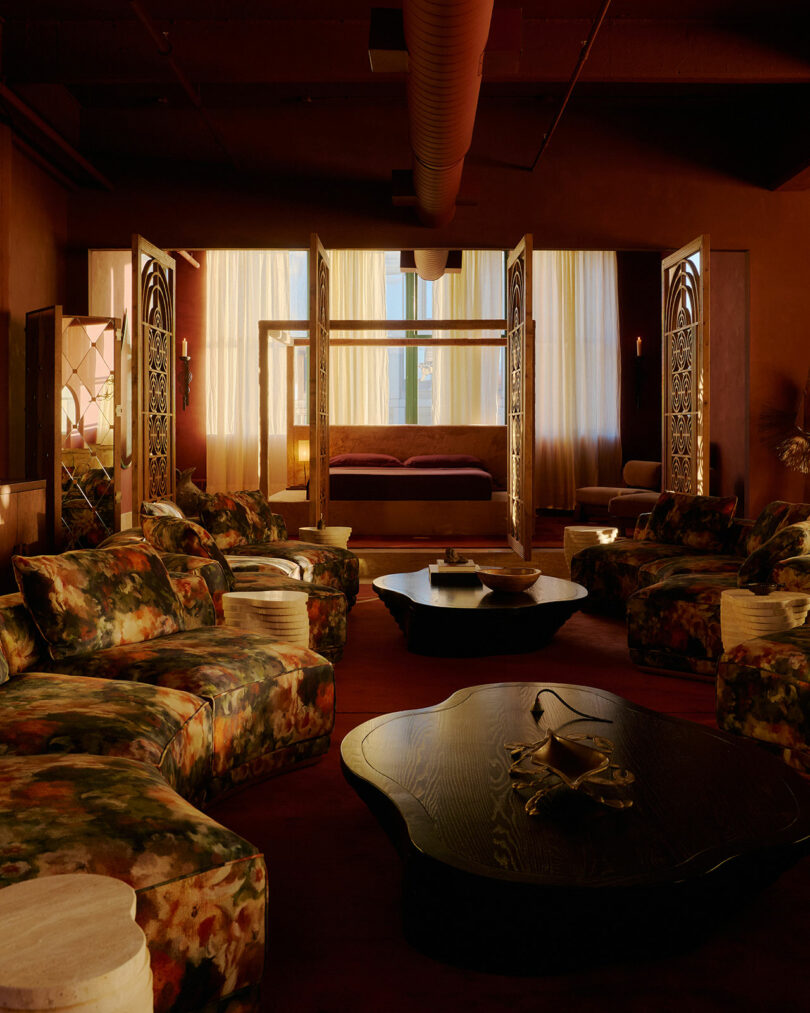
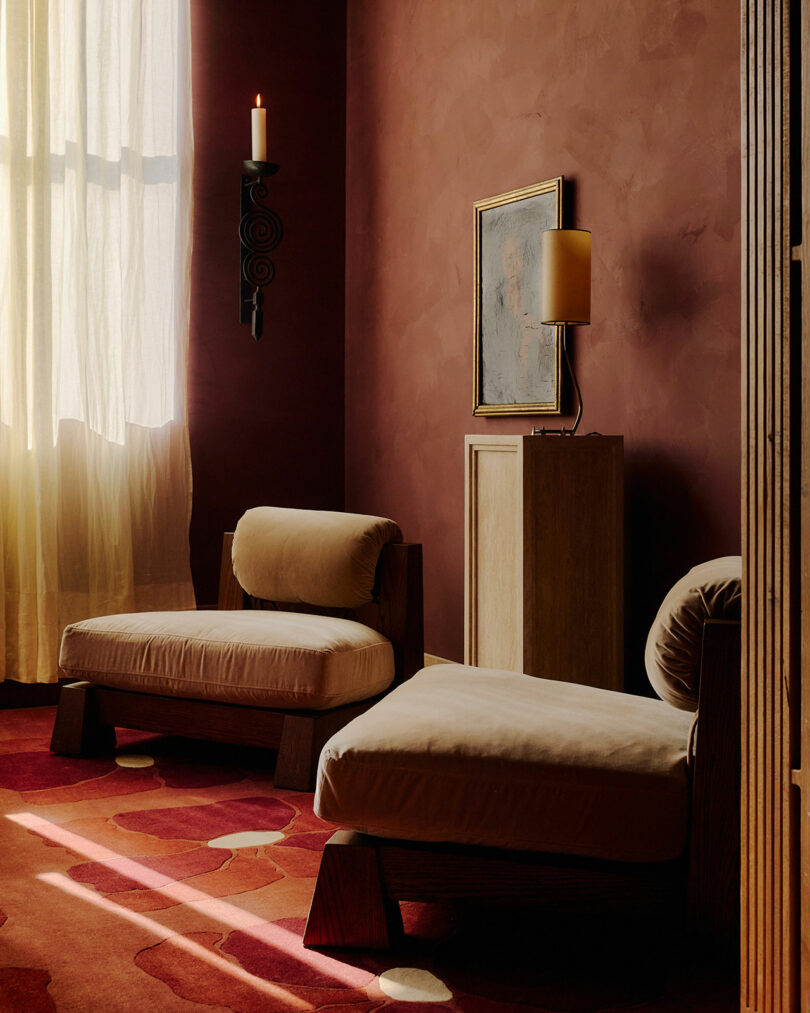
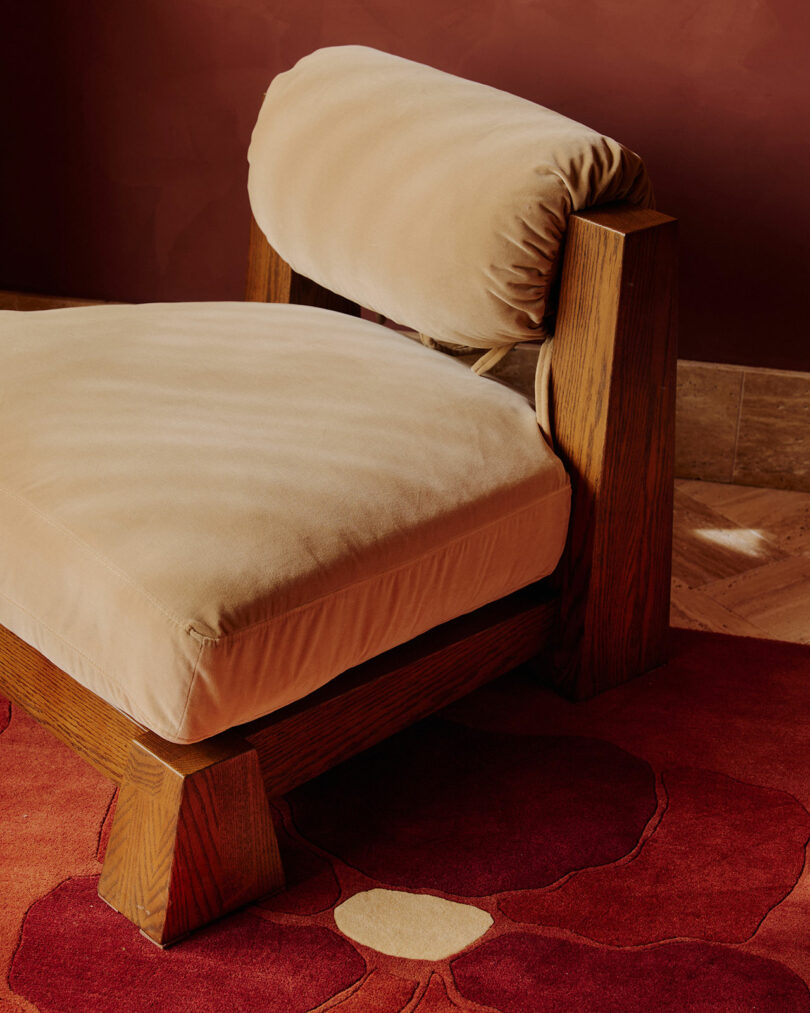
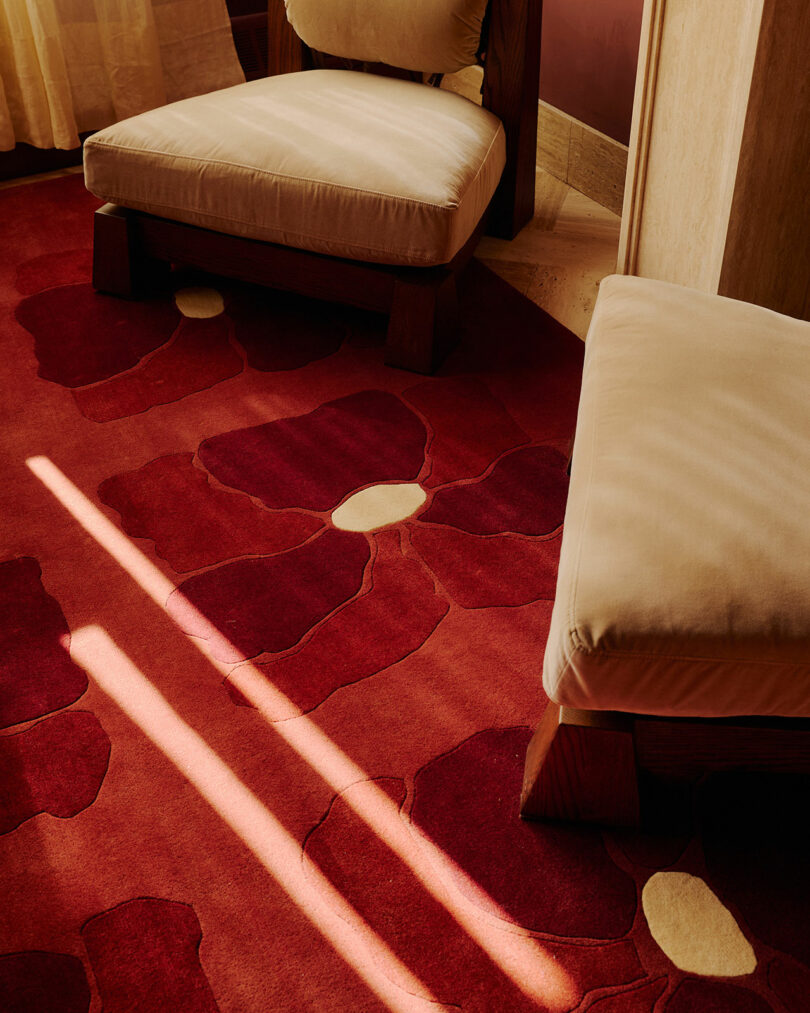
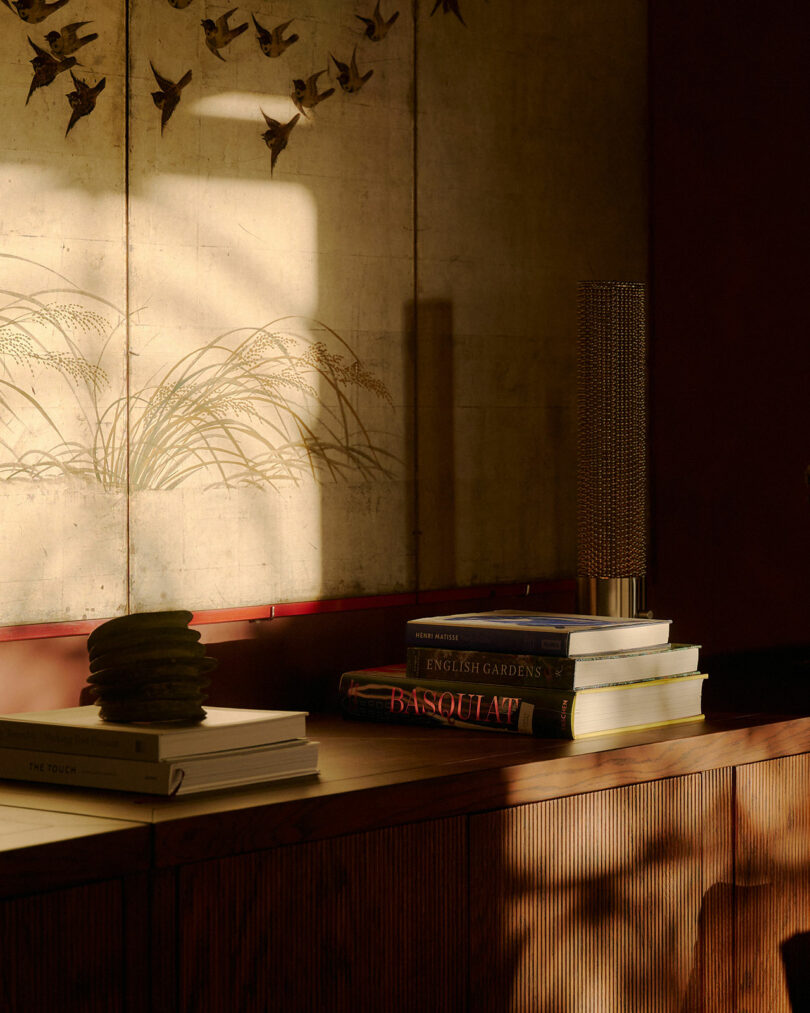
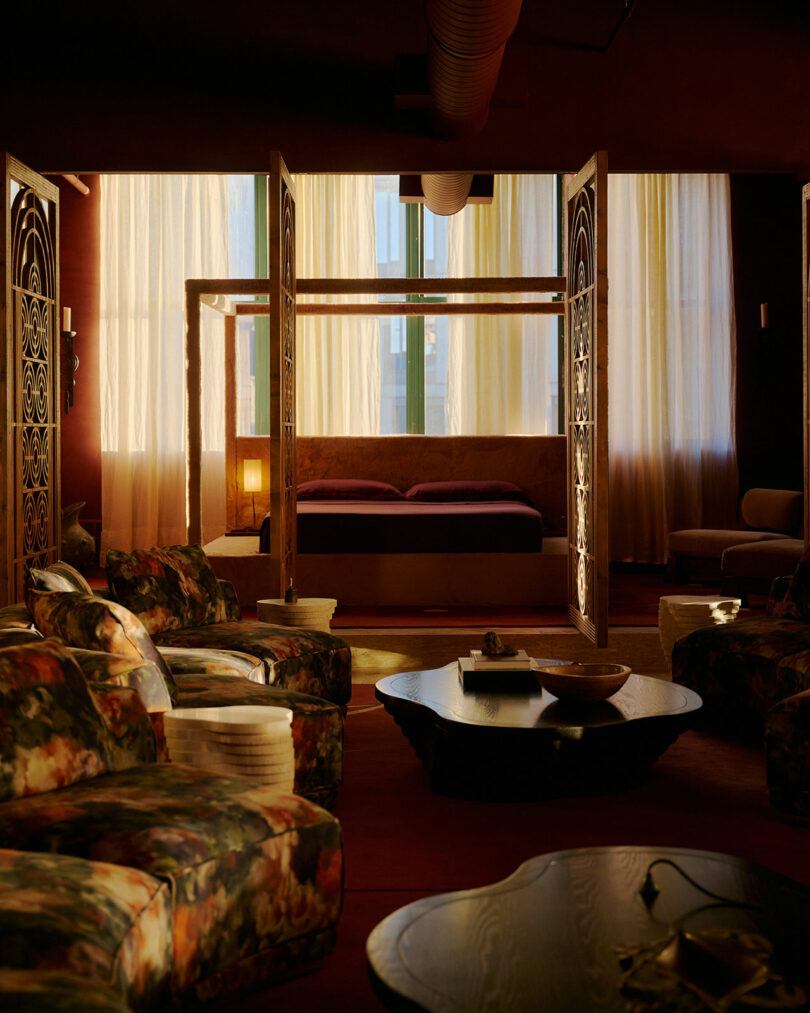
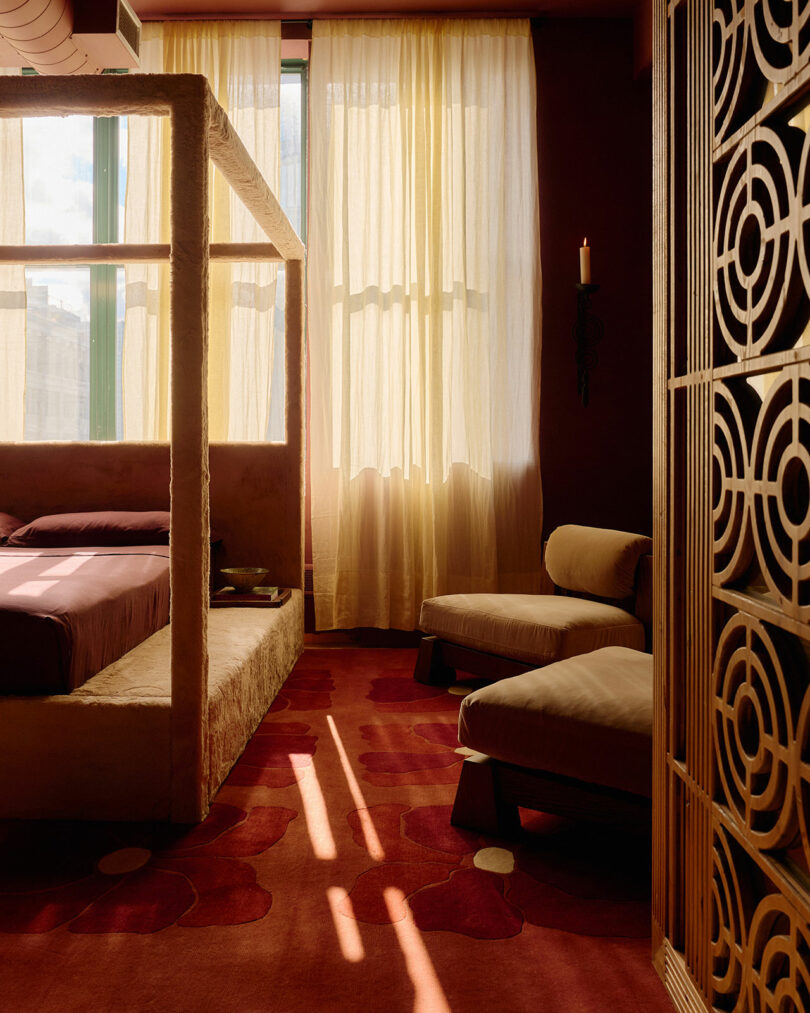
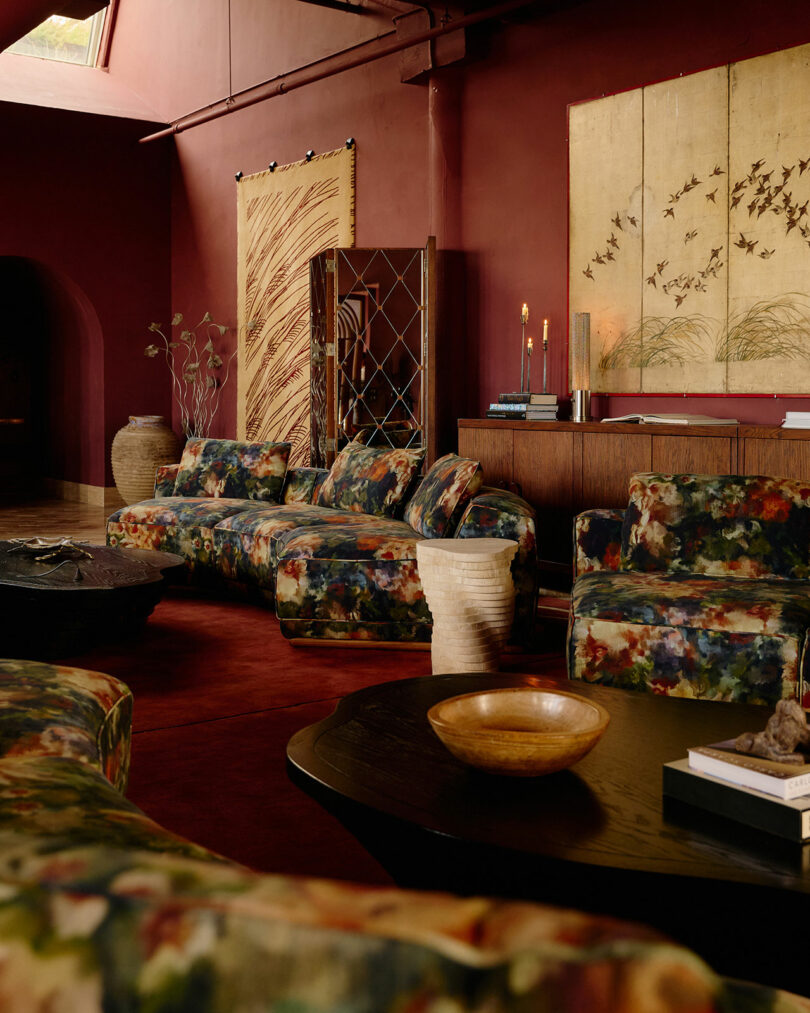
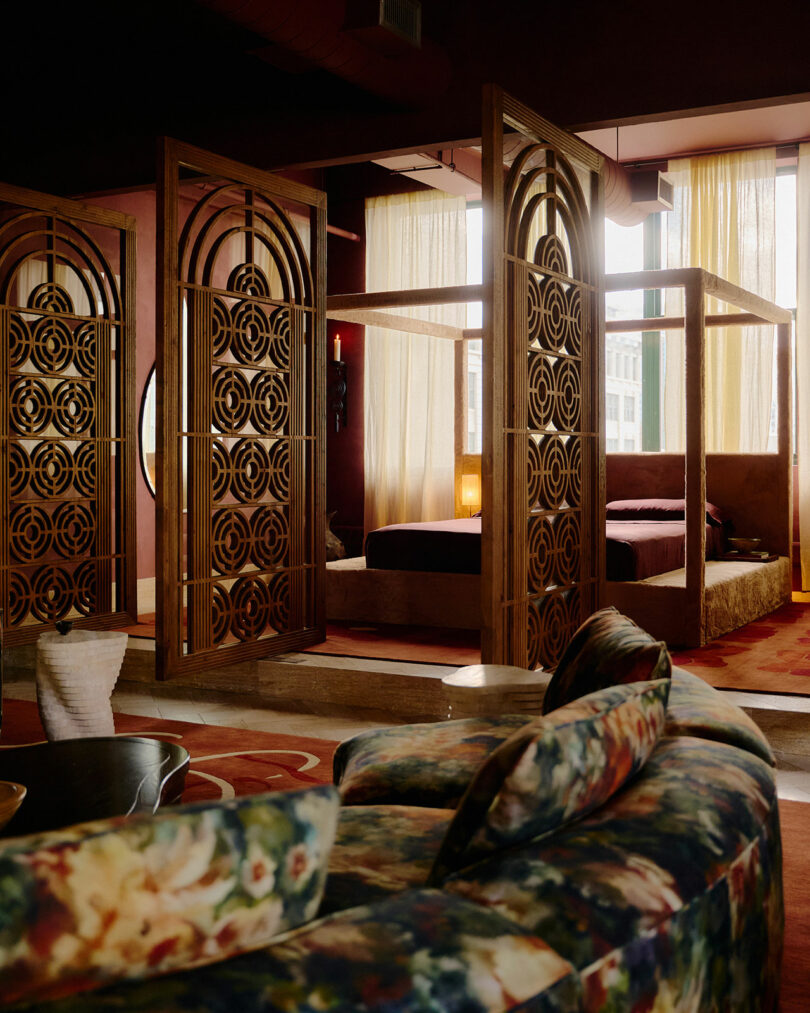
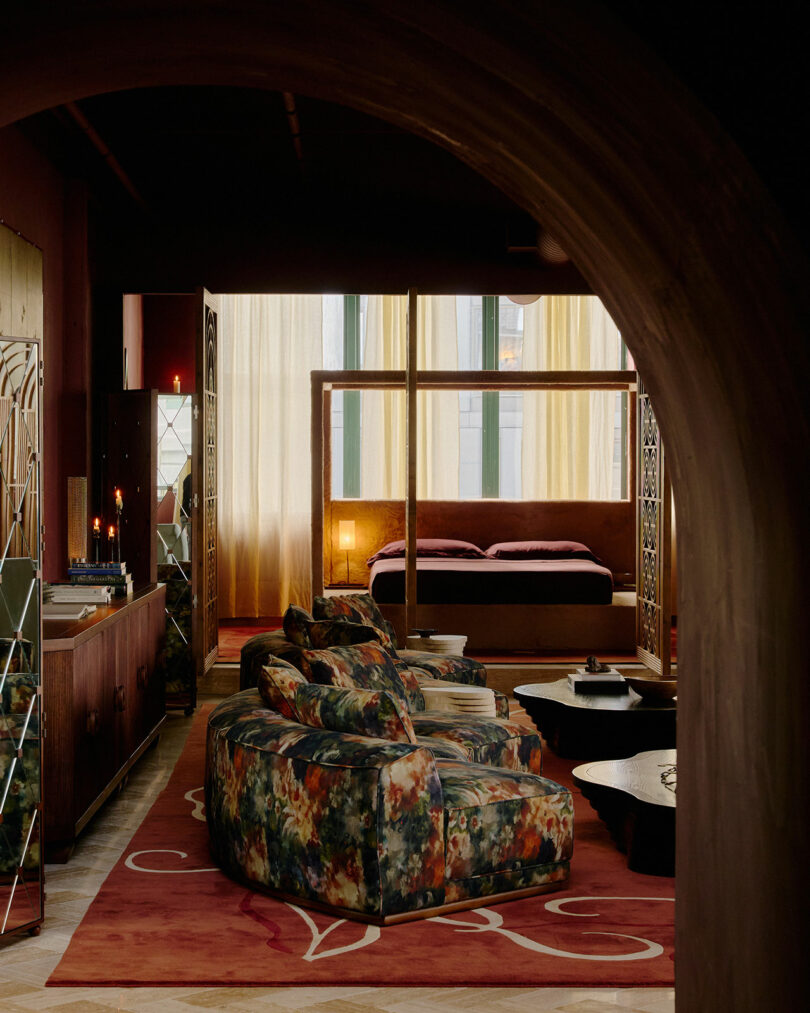
A dimly lit room with ornate folding screens, a canopy bed in the background, sculptural coffee tables, and plush patterned seating arranged in a circle. Soft light filters through sheer curtains.

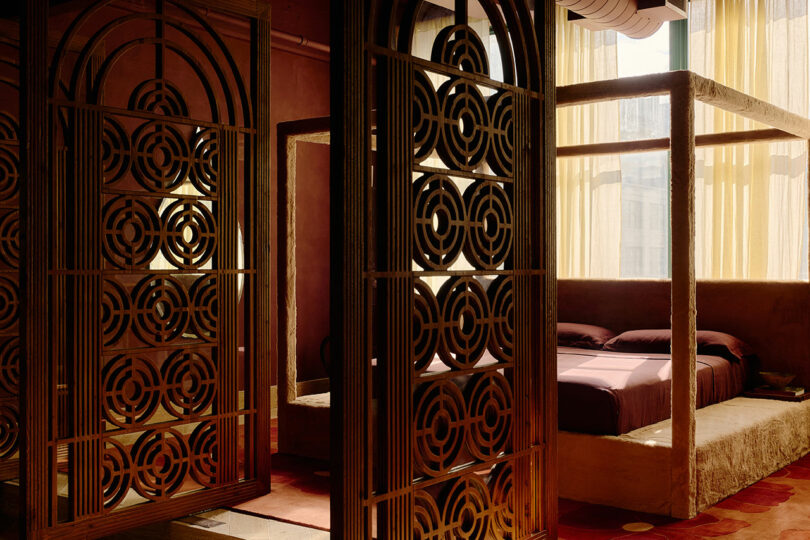
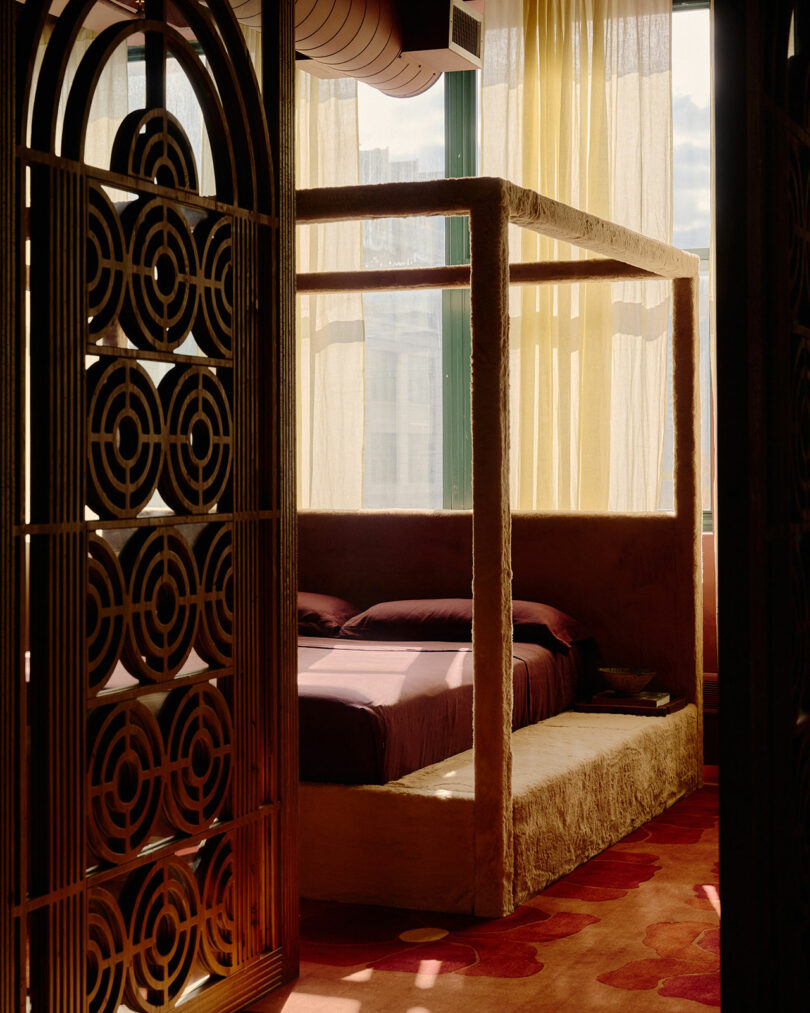
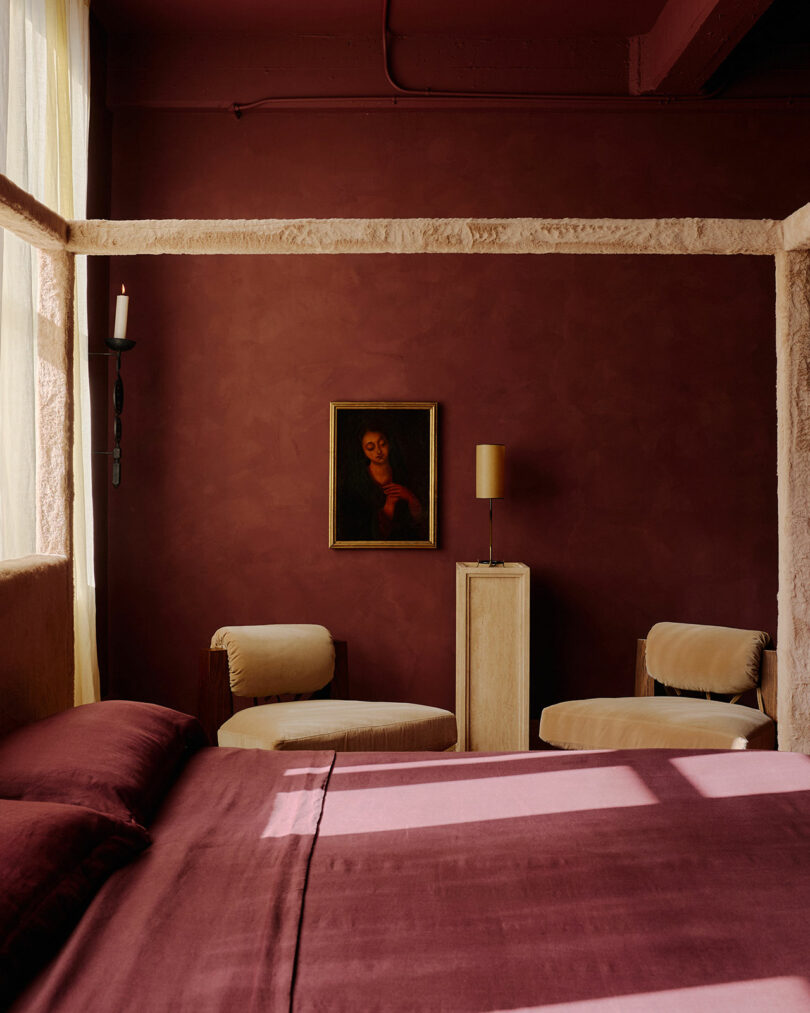
A room with decorative metal screens, a canopy bed with purple bedding, and yellow curtains filtering sunlight through a window.

Whether a sofa with flowing upholstery—recycled vegan polys—with overstuffed pillows—ethically sourced down feathers. Base frames are hand-assembled out of kiln-dried hardwoods. Up until recently, achieving timelessness in these designs centered on using neutral tones.

Wooden decorative room divider with geometric circular patterns stands in a warmly lit interior with earthy walls and a clay jug in the background.

A sunlit bedroom with a four-poster bed, sheer curtains, geometric patterned screen, and red patterned carpet.

That changes with the new Wild Air print, a striking interplay of rich yellows, greens, and reds. The fabric—wrapping various existing designs—centers on a sfumato effect blending together what appears to be Mannerist-style watercolors of flowers.

A bedroom with burgundy walls and bedding, two beige chairs, a framed portrait, a small lamp on a pedestal, and sunlight streaming through a window.

The move was so bold that Sixpenny CEO and Head of Design Robert Natale chose to completely retrofit the brand’s Dumbo, Brooklyn loft. Rather than the stark white, post industrial interior they might expect to encounter, visitors are transported in what appears to be an Art Deco haveli.

Dimly lit lounge with floral-patterned chairs, dark wooden tables, and a canopy bed in the background, separated by decorative screens and sheer curtains.

A living room with patterned floral sofas, a wooden coffee table, red walls, a decorative screen, and a large wall art piece featuring birds. Natural light enters through sheer curtains.

The orangey red found in the printed textile covers the walls in an almost stucco-like effect and carries across to subtly ornamented rugs. A dramatically staged lounge gives way to a platformed bedroom accessed through intricately detailed (concentric circle pattern) panel doors.

A sectional sofa with abstract, multicolored upholstery in shades of green, orange, and brown, positioned in a warmly lit room.

Two cushioned chairs sit in a dimly lit room with textured red walls, a tall window with sheer curtains, abstract art, a lamp, and a wall-mounted candleholder.

The moody time capsule—a retreat from the concrete, glass, and steel of the surrounding area—showcases an expanded product range alongside a vast collection of accessories, plants, and art works. Nods to the historic Art Deco style fascination with Japanisme are emphatic. Each carefully arranged vignette throughout the ever-unfolding interior reveals something new about Sixpenny’s aesthetic ambition, if not also, its agility.

A sculptural, layered beige stone side table with a twisting design sits on a reddish floor next to a floral-patterned chair.

A sculpted stone side table with layered, organic shapes holds a small decorative dish, placed between floral patterned upholstered chairs.

A framed, faded portrait painting hangs on a red wall above a beige pedestal with a modern, cylindrical beige lamp.

A wooden lounge chair with beige upholstered seat and backrest sits on a red floral-patterned rug against a reddish-brown wall.

Two beige cushioned chairs sit on a red floral-patterned carpet, with sunlight casting two bright lines across the floor.

A stack of books and a decorative object on a wooden sideboard, with sunlight casting shadows and a bird-themed folding screen in the background.

A dimly lit room features a canopy bed with decorative panels, floral armchairs, a sculptural coffee table, and sheer curtains covering tall windows.

A sunlit bedroom with sheer curtains, a canopy bed, two cushioned chairs, and a carpet with circular patterns next to a decorative wooden screen.

A living room with deep red walls, patterned floral sofas, a wooden coffee table, decorative screens, candles, and large wall art featuring birds and grasses.

A floral-patterned sectional sofa sits in a sunlit room with red walls, mirrored panels, and wooden accents.

A large abstract-patterned rug hangs on a red wall above a parquet floor, with two textured vases and a mirrored cabinet nearby.

A floral-patterned sofa sits in front of a wooden sideboard with candles, books, and a decorative screen featuring flying birds and grass, set against a deep red wall.

A wooden sideboard against a dark red wall with a large artwork of flying birds above, two candles, stacked books, a lamp, and an open book; a floral-patterned sofa is in front.

A stylish room features a floral-patterned sofa, a bed with a canopy frame, wooden decorative screens, and large windows with sheer curtains letting in natural light.

A clear glass vase with three flowers—one white, one red, and one dark purple—stands on a wooden pedestal against a reddish-brown background.

A white upholstered chair with a matching cushion is placed next to a wooden table, with yellow curtains and a red carpet in the background.

A dimly lit room with a maroon tablecloth, four white chairs, a candelabra with melting candles, and two books on the table near a window with sheer curtains.

A sunlit room with red walls, a long wooden table, upholstered chairs, chandeliers, and fabric samples hanging on racks by arched windows with sheer curtains.

A kitchen with burgundy walls, wood cabinets, marble countertops and backsplash, a brass sink, and decorative glass, metal, and ceramic objects on the shelves.

A round marble-top table with a wooden base stands on a red carpet, holding a tall glass vase with long-stemmed dark red flowers, against wood-paneled walls and a large mural.

A small marble-topped table with a tall glass vase of dark red flowers stands on a red patterned rug in a wood-paneled room, viewed through ornately carved wooden double doors.

A dimly lit room with floral-patterned sofas, a red rug, and a canopy bed in the background, viewed through an arched doorway.

To learn more about the brand and shop their extensive collection, visit sixpenny.com.

Photography by William Jess Laird.

F5: Erika Hardman Talks Architectural Shoes, Cold Plunge, the California Desert + More

F5: Erika Hardman Talks Architectural Shoes, Cold Plunge, the California Desert + More

Erika Hardman spent time in the corporate world as a recruiter, but when she began working alongside her partner Liam in their furniture studio, she realized that it was not just a career but a calling. “I would wake up thinking about new possibilities,” she says. “That’s when it really clicked for me. When something starts running through you like that, you know it’s where your energy belongs.”

Originally founded in Berlin in 2012, Hardman Design is now based in Brooklyn. Hardman, the company’s creative director, stepped into her role gradually. She remained curious and became more involved in the different aspects of the process, from shaping initial concepts to building the brand.

A woman with long, wavy hair stands against a plain light-colored wall, wearing a black buttoned shirt and dark jeans. She looks at the camera with a neutral expression.

Photo: Agathe Karsenti

Clients treasure the custom hardwood pieces defined by clean lines and sculptural forms. When Hardman receives an impression in her mind, she usually jots down some quick notes, not all of which make sense at first. Then she collects references and screenshots of architecture, natural materials, and travel destinations to put on a physical or digital mood board.

Hardman finds that this early stage of a project is the most malleable, and the opportunities feel endless. She discusses and filters a design repeatedly until it eventually moves from paper to solid object.

The collaboration with Liam is still rewarding, even though it happens every day. “Design has become such a big part of our daily life that we sometimes find ourselves standing in the middle of the street with a measuring tape, talking about proportions or sketching,” she adds. “Some of the best ideas appear in those unexpected moments.”

Today, Erika Hardman joins us for Friday Five!

A woman in sunglasses sits on grass with two dogs on a sunny hillside, with mountains and a blue sky in the background.

Photo: Liam Hardman

1. My Dogs Mio & Lue

My dogs are a constant reminder of energy and persistence. Their excitement for the smallest things — a walk, a toy, a patch of sunlight — is grounding. Watching their curiosity every day is surprisingly motivating. They bring joy and immediacy to life in a way that’s hard to ignore.

2. Sauna & Cold Plunge

Sauna and cold plunge have become a weekly ritual for me. I’m drawn to the architecture of spaces like Othership, with warm wood interiors, soft light, and minimal finishes. The contrast between heat and cold clears my often-busy mind. I always leave feeling calmer and more focused.

Two pairs of women's heeled shoes, one with wooden cutout heels and one with block heels, are displayed on adjacent shelves of a wooden shelving unit.

Photo: Erika Hardman

3. Architectural Footwear

I’m drawn to objects where the structure is visible. Certain footwear can feel almost like a designed object in its own right. Maison Margiela approaches this through geometry, balance, and subtle details — the trapezoidal heel on some of their pumps feels almost architectural. Brands like NEOUS explore similar ideas as well, treating footwear from a more sculptural perspective.

A sandy trail winds through a desert landscape with Joshua trees and dry shrubs under a cloudy sky and rocky hills in the background.

Photo: Erika Hardman

4. The California Desert

The California desert has a way of blocking out the noise of the world. The vastness and quiet reset my mind almost instantly. I’m always drawn to its restraint — muted colors, dry air, and dramatic light. There’s a simplicity to it that feels almost elemental. It’s minimal, raw, and deeply inspiring to me.

Overhead view of a turntable playing a vinyl record beside an audio mixer, headphones, and speakers on a wooden table. A potted plant and records are also visible.

Photo: Erika Hardman

5. Music

Music is a constant companion in both my work and life. I tend to gravitate toward electronic music — especially when I’m working. It creates a steady atmosphere without being distracting and helps me focus for long stretches. The right track can completely shift the mood of a space or a moment.

Works by Hardman Design’s co-owner and Creative Director Erika Hardman:

LÜNA
The LÜNA bed continues the subtractive design language introduced in the LÜNA collection — softened edges, rounded transitions, and a restrained silhouette. Sitting low to the ground, the design emphasizes proportion and spatial calm. The curved headboard is sculpted from solid wood boards joined to preserve continuity of grain.

LELA
LELA draws from Danish chair design, focusing on proportion and comfort. Curved wooden armrests and tapered legs create a quiet sculptural form, while the upholstered seat adds softness. The chair is designed for long gatherings around the table.

KAT Dining Table
KAT centers around a strong structural base that gives the table a clear architectural presence. The central column keeps the footprint compact while leaving the surrounding space open for chairs. It’s a simple form that balances stability with a sense of lightness.

ARLEN
ARLEN explores circular forms and softened geometry. The flowing silhouettes of the tables and gently rounded edges create an approachable presence that works comfortably in many interiors. The design blends Scandinavian warmth with modernist clarity.

LULU Sofa
The LULU Sofa pairs soft upholstery with a simple exposed wooden frame. Its curved lines and generous proportions create an inviting place to relax while keeping the overall form visually light. The design balances warmth with a clear structural expression.

Guests Can Now Holiday in Karl Lagerfelds Custom-Designed Private Office

Guests Can Now Holiday in Karl Lagerfeld’s Custom-Designed Private Office

Throughout his illustrious career, the late Karl Lagerfeld amassed an impressive portfolio of distinctive properties. Recent monograph Karl Lagerfeld A Life in Houses, published by Thames & Hudson, surveys this vast collection: everything from the Memphis-ladden apartment in Monte Carlo to the high-ornate, era-appropriate eighteenth-century mansion Hôtel Pozzo di Borgo in Paris. Regardless of the address, the revered fashion designer always, unabashedly, combined old with new, shedding fresh light on various historical design movements and their most important pioneers. Most of these homes have been the subject of expansive magazine print features and the fodder of tabloid headlines but little focus has ever really been placed on his workspaces.

Modern wine tasting room with glass storage cabinets on both sides, a small bar area with two tall stools, shelves, and recessed lighting in the ceiling and walls.

Modern living room with a large, curved metal bookshelf holding books and decor, beige sectional sofas, a dark coffee table, and a vase of white flowers in the center.

That all changed with the recent uncovering and reformatting of Lagerfeld’s private Saint-Germain-des-Prés office. Luxury apartment and home rental platform HIGHSTAY has deftly, yet carefully, transformed the multi-level bureau into a two bedroom Saint-Germain I accommodation replete with original architectural fit-outs and collected items. This period room of sorts is a timecapsule, preserved in exactly the same configuration as the day the legendary talent left for the last time. Away from the major couture houses he stewarded up to his death in 2019, the space was a more intimate retreat; a stylistic reflection of himself, in which he could carry out private business and entertain close friends.

Modern living room with curved beige sofas, a black coffee table with books and flowers, and a large abstract wall bookshelf with various books and decorative items.

Modern living room with cream modular sofas, a square coffee table with a vase of white flowers, a geometric metal bookshelf with books and decor, and a framed painting on the wall.

Though decidedly indicative of a specific era in design history—not disclosed but easily deciphered as the late 1990s and early 2000s—the sprawling 2690 square-foot unit unfolds with sleek, space-age-like built-ins contoured in curvilinear half polished and half patinated steel surfaces. Even in this once-contemporary pared back setting—somehow timeless and au courant yet again—Laggerfeld still exerted a degree of opulence, if slightly restraint in overall scheme.

Modern interior with a sculptural staircase, geometric wall art, a black statue with a white cloud-like head, and a minimalist metallic chair on a tiled floor.

The near palatial stairwell was custom designed by him in partnership with top-billing Australian product designer Marc Newson. The “La tête dans les nuages” (Head in the Clouds) sculpture standing at its base was created by artist Laurence Perratzi.

A modern hallway with geometric artwork, a black-and-red abstract painting, and sleek metal décor. The floor is dark, with minimal furnishings and neutral-toned walls.

In one of the adjoining lounges, soaring mirrored ceilings expand the visual perspective of twin steel libraries—articulated in the same formal vocabulary—described above—as a custom bedframe-cum-armoire. Normally a stark material that evokes a level of cold industrial conformity was rendered in warm, corporeal form here. Wielded in the more intimate walk-in closets and bar, dark-tone wood paneling emerges a grounding contrast.

Modern metallic chair with geometric, angular design positioned on a tiled floor near a wall with minimalist art and trim.

This matrix of a hybrid complex—an urban retreat featuring a private hammam and sauna—also includes a second en-suite bedroom, separate dining room, and other annexes. There’s a visual consistency of capsule and pixelated elements—hinting at a more sophisticated interpretation of early digital motifs.

Modern minimalist room with metallic furniture, abstract sculpture lamp, a framed artwork, curved shelving unit, and neutral-toned walls and flooring.

A modern interior with curved metallic structures, beige carpet, a desk with two small sculptures, and a statue with white flowers in the background.

Complementing the hard product is a curated Karl Itinerary incorporation stops at the couturier’s favorite Left Bank haunts, Café de Flore and Maison du Caviar among them.

What: Saint-Germain I
Where: Paris, France
How much: price upon request
Design draws: Karl Lagerfeld’s lesser-known private office perfectly preserved as a two-bedroom rental apartment with sleek metallic capsule and pixelated pattern details throughout.
Book it: Saint-Germain I

Go virtually on vacation with more design destinations right here.

Photography courtesy of HIGHSTAY

Hum Tables by KFI Studios Provide a Grounded Presence in Modern Workplaces

Hum Tables by KFI Studios Provide a Grounded Presence in Modern Workplaces

Tables are essential in today’s modern workplaces, utilized as work surfaces and places to gather around. Yet these pieces, ever functional, can often feel basic and rather cold, like the metal furnishings that dot the office landscape.

A modern KFi STUDiOS conference room featuring a rectangular wooden table, six cushioned chairs on wheels, neutral decor, and a window adorned with beige curtains.

A modern living room by KFi STUDiOS features modular red sofas, a round coffee table with a vase and book, and a neutral rug set against a dark accent wall.

So when contract furniture manufacturer KFi STUDiOS tapped Union Design to create a new line of tables, the team envisioned furnishings that acknowledge the constant motion and noise of the workplace, but don’t add to it—which the name Hum perfectly captures. “We wanted to have a cohesive look across the product, while changing the sizes and shapes for different spaces,” says Jeff Theesfeld, founder of Union Design. “Then we started looking at which forms would convey a sense of calm.”

Modern living room by KFi STUDiOS with large arched windows, light gray sofa, two armchairs, a round coffee table, side tables, and a tall potted plant on a neutral rug.

A small KFi STUDiOS meeting area features a white oval table, three wooden chairs on wheels, a wall-mounted board, and a large window overlooking the city.

Unlike traditional furniture with hard edges, Hum’s versions include softly shaped round, square, triangle, rectangle, and line-of-sight tops. These selections encourage comfortable interaction among those gathered around the worktable. There are seven wood tops, from a classic natural shade to navy and evergreen. Solid surfaces come in lighter tints like Designer White and creamy Bisque. Laminate tops are available in 26 Wilsonart colors.

A modern dining area by KFi STUDiOS features a wooden table with a green base, three wooden chairs with light cushions, a vase with branches, and sunlight streaming through a large window.

Three green upholstered chairs by KFi STUDiOS surround a round wooden coffee table on a beige rug in a modern, minimalist room with shelves and decorative items.

Offered in 16-inch and 20-inch occasional heights, plus a 30-inch meeting height, Hum tables span lounge and conference applications. Each item can also adapt for casual touch-down moments or be utilized to enhance conference spaces.

A round table with four chairs by KFi STUDiOS is set in a modern office space with large windows, a pendant light, and beige cabinetry in the background.

A modern KFi STUDiOS conference room with a white oval table, four gray chairs on casters, a large black wall panel, a potted plant, and a floor-to-ceiling window overlooking a cityscape.

A fully upholstered pedestal base is available in a large selection of graded-in fabrics or COM. This tactile element has an inviting presence that adds warmth to corporate interiors. Specifiers can choose from woven, coated, or leather textiles to complement a range of interiors.

A modern KFi STUDiOS lounge chair with wooden legs sits next to a round side table with a small vase, in a sunlit room with light curtains and wooden flooring.

The triangular and line-of-sight bases feature a magnetic panel for easy access to cables and audio-visual equipment. When multiple bases are used, a hollow beam connects them, which provides a pathway to help neatly manage cables. Hum offers multiple integrated power options, including standard outlets and USB charging ports. Adjustable glides allow employees to move the tables from room to room throughout the day.

Modern conference room by KFi STUDiOS featuring a large oval table, six chairs, wall-mounted screen, wood panel walls, floor-to-ceiling windows, indoor plants, and neutral decor.

A modern conference room by KFi STUDiOS with a white oval table, six beige chairs, a wall-mounted screen, and plants in large pots by wood-paneled walls.

Traditional hierarchies continue to shift, and Hum tables reflect this blurring of boundaries. “If you look in an executive boardroom, no one is wearing a tie anymore,” Theesfeld notes. “Everything is softening and I wanted to express that.”

A modern conference room by KFi STUDiOS features a round table, six white chairs, a wall-mounted screen, a laptop, and natural light streaming through large windows.

Three modern tables by KFi STUDiOS feature cylindrical bases and oval tops in white, brown, and wood finishes, set against a plain, neutral background.

Three modern KFi STUDiOS tables of different heights and colors with cylindrical bases and round or square tabletops are arranged on a neutral background.

Three round tables from KFi STUDiOS, in varying heights and colors, are arranged on a neutral background; the largest is brown, the medium is light wood, and the smallest is white.

To learn more about the creative brands behind Hum, visit kfistudios.com and createwithunion.com, respectively.

Photography courtesy of KFi STUDiOS.

This La Jolla Beachside Home Is Built Around Restraint and Craftsmanship

This La Jolla Beachside Home Is Built Around Restraint and Craftsmanship

The fundamental tension at the heart of this San Diego residence is one familiar to anyone working along California’s coastline: how to make something genuinely new from a structure that, by regulation, must remain. Bound to a 1950s footprint that could not be fully demolished under Coastal Commission guidelines, architect Daniel Joseph Chenin approached the La Jolla beachside project less as renovation and more as recalibration—working with contractor Hill Construction to strip the house to its essential framework before reconstructing an interior that feels wholly reauthored, yet quietly in dialogue with what came before.

A beige sofa with green cushions sits below a large abstract painting; a side table, books, and vase with pink flowers complete the warmly lit living room scene.

A sunlit living room with a beige sofa, a large seaside window, minimalist furniture, a wall painting, and a vase with branches. Ocean view in the background.

Beyond spatial reconfiguration, the result is a disciplined study in restraint. The kitchen island, carved from solid onyx, becomes the project’s conceptual anchor—selected not for decorative veining, but for its capacity to hold and refract light, mimicking the rhythmic shimmer of the Pacific just beyond. Its sculptural, rounded form operates in the round, shifting from workspace to bar, dissolving boundaries between utility and hospitality. Above, a rudder-inspired fixture underscores this sense of orientation and balance, while warm oak millwork runs throughout the home, establishing a continuous tonal field against which these moments of expression can register.

Modern kitchen with light wood cabinetry, a marble island with three barstools, built-in appliances, and a round window letting in natural light.

A modern kitchen with wood cabinets, a marble island with three beige stools, a built-in oven, and a vase of greenery on the counter.

Nautical references surface repeatedly, though never as overt motif. The living area’s oak-paneled ceiling pitches subtly overhead, recalling the hull of a ship in a way that reads as structural logic rather than decoration. In the powder room, a steel porthole mirror frames a hand-painted underwater tableau, while a circular port window in the main living space captures a precise view of the peninsula—each gesture operating as a controlled aperture, making the act of looking outward feel intentional, almost choreographed.

Modern kitchen with marble countertop, built-in cabinets, and decorative plants, featuring large windows with ocean views and warm sunlight filtering into the room.

Modern kitchen with light wood cabinets, built-in refrigerator, marble countertops and backsplash, induction cooktop, stainless steel hood, and a vase with flowers.

That same preoccupation extends to how the house manages light and movement over time. Morning sun enters first through a central courtyard—conceived as both threshold and communal core—before tracking across onyx, lacquered surfaces, and finely tuned wood grain.

A wooden abstract sculpture on a stone pedestal stands in sunlight near a doorway with vertical wooden slats and beige walls and flooring.

As the day progresses, the interior shifts in register, textures revealing themselves gradually, never all at once. Rather than performing under a single, static condition, the material palette is calibrated to respond to change, allowing the house to unfold in tandem with the coastal atmosphere that surrounds it.

Minimalist dining area with a curved stone counter, black vase of flowers, round table, white chair, and a circular window with sheer curtains and a beige cushion.

Minimalist dining area with a round table, two chairs, a sofa, and a large window offering a view of the sea; neutral tones and natural light fill the room.

The owner’s brief—shaped by a life of travel and a preference for environments that feel both curated and calm—called for tranquility and material authenticity over overt expression. Chenin’s response is one of rigorous spatial editing, where absence becomes an active design tool. Integrated storage, concealed systems like a hidden television lift embedded within the central bar, and furnishings selected for proportion and tactile quality rather than statement all contribute to a space that resists excess while remaining deeply sensorial.

A modern dining area with a round table, white chairs, a built-in bench, a round window, and a large window with white curtains overlooking the ocean.

A modern dining area with a round table, a white cushioned chair with dark wood accents, a beige sofa, a round wall mirror, and vases with flowers on the table.

Even where conventional art might typically occupy walls, architecture itself assumes that role. Curved ceilings echo the motion of nearby waves, custom vanities blend wood, leather, and metal into singular compositions, and every touchpoint is considered for its physical and emotional resonance. As Chenin notes, “In a home like this, anything the hand touches should feel exquisite,” reflecting a practice that elevates the everyday into something quietly ceremonial.

A modern living room with a cream sofa, throw blanket, brown cushions, wooden coffee table, abstract wall art, lamp, and large window with garden view.

A modern bedroom with wood-paneled walls, an abstract painting, a beige bed with tan bedding, a black lamp, and a glimpse of a marble bathroom in the background.

“He wasn’t looking for an ornate or overly stylized space,” Chenin explains. “It was about distilling the essence of simplicity, order, and material authenticity—an understated luxury that isn’t overt, but felt.”

A modern bathroom with light wood walls, a black countertop and sink, an oval mirror, and a small potted plant, set against a marbled stone wall.

A neatly made bed with beige and brown bedding sits beside a dark wood nightstand with a modern black lamp, glass dish, and a vase with a single stem; abstract art hangs on the walls.

Modern bathroom sink with a marble countertop, oval wall mirror with gold frame, and a gold faucet, set against marble-patterned walls.

A modern bathroom sink with a dark green marble countertop, metal faucet, and a round mirror featuring a fish pattern, set against light-colored marble walls.
Architecture, material, and light are held in careful equilibrium—each one calibrated to the steady, unhurried rhythm of the sea.

A modern bedroom with a large upholstered bed, beige bedding, bedside tables with lamps, and floor-to-ceiling windows showing a view of the ocean.

Modern bedroom with a large bed, wooden walls, a stylish black ceiling light, bedside lamp, and sliding glass doors opening to a balcony with an ocean view.

A neatly made bed with tan bedding next to a wooden nightstand with a lamp, a book, and a phone, with a window showing a view of the sea.

A wooden-paneled bedroom doorway opens to a marble hallway with framed art on the wall and natural light illuminating the corridor beyond.

A hallway with marble floors and walls, wood-paneled doors, glass accents, and a mirrored console table, leading to a room with wooden shelving.

Modern bathroom with a marble countertop, dual sinks, large mirrors, wall-mounted lighting, and marble flooring; shelves below the vanity hold towels and decor.

Modern bathroom with marble walls, double sinks, a large mirror, and wood accents; a small plant in a vase sits between the sinks.

A modern walk-in closet with wooden cabinets, glass doors, hanging clothes, drawers, and two textured round ottomans on a beige carpet. Marble wall partially visible on the right.

A marble bathroom countertop with a modern chrome faucet, a black vase with pink flowers, and a soap dish beside a large mirror.

A marble-walled bathroom with a bathtub faces a large window overlooking a minimalist patio with a manicured tree, plants, and a blue outdoor chair.

A minimalist patio with two cushioned chairs, a small round table, potted plants, and a sculpted tree against a tiled wall, lit by sunlight.

A minimalist courtyard with a sculpted tree, potted plants, and two blue chairs, opening into a modern interior with large glass doors and an ocean view in the background.

Hallway with light wood ceiling and tiled floor leads to a patio with potted plants and a view of the ocean through glass doors. Modern, minimalist architecture.

Modern house entrance with light stone and dark wood paneling, a Buddha head statue on a pedestal, potted plants, and a partially open glass door.

Modern house exterior with black and beige walls, large potted plants, a Buddha head statue by the entrance, and a partially open glass door.

Modern single-story house with black and beige exterior, large window, black garage door, potted plants, and a sculpted bust near the entrance.

A man with short gray hair wearing a black long-sleeve shirt sits on the edge of a light-colored table next to a vase with white flowers, in a minimal modern room with a round window.

Architect Daniel Joseph Chenin

View this and other works by the internationally-recognized firm by visiting djc-ltd.com.

Photography by Tim Hirschmann and courstey of v2com.

Form Us With Love Breaks the Traditional Fair Display Model With Testing Grounds Showroom

Form Us With Love Breaks the Traditional Fair Display Model With Testing Grounds Showroom

The annual design calendar is undeniably saturated with various well-entrenched events taking place across the globe almost every other week. Traditional convention center-beholden trade fairs have largely operated along the same lines for decades now. Visitors with a vested interest enter one of these poorly lit, badly insulated, and cavernous voids only to find rows and rows of white cube booths and narrow, overcrowded passageways between them. The proposition is clear: bringing a wide range of brands—specialized in different types of design products—under one roof.

For well over a decade now, a handful of these exhibitors have sought to break out and showcase within offsite city center showrooms; welcoming in visitors in a more intimate and impromptu fashion. These not necessarily opposing and perhaps more complimentary formats are now the norm at major happenings like Milan Design Week, New York Design Week, and 3Days of Design in Copenhagen. Until now, no-one has really challenged the duality.

Modern office space with grey walls, large window, blue office chairs, white desks, and red stools; geometric furniture and minimal decor inspired by Form Us With Love.

Two blue upholstered chairs with curved backs by Form Us With Love are positioned next to a white speckled tabletop, with sunlight casting shadows on the wall.

To the perceived chagrin of an ever-thriving Stockholm design scene—one that gets easily overshadowed by the boisterous Danish capital to its south—its annual design week and furniture fair were cancelled this year. Instead of throwing their hands up and accepting this fate, the Swedish capital’s small but internationally impactful crop of independent studios and manufacturers mounted a series of more informal and scrappy happenings. Inherently—by nature of these industriously collective efforts—the resulting but not necessarily aligned program felt more authentic. The exchange was less prescriptive; fresher and more honest.

An iMac displaying a 3D modeling program sits on a green cabinet, alongside a white keyboard and mouse. A green checkered stool inspired by Form Us With Love design sensibilities stands in front, with cables visible on the floor.

A green office chair with wheels sits in front of a green pegboard counter and cubby shelves holding colored folders in a modern, minimalist office space designed by Form Us With Love.

One such endeavor was local powerhouse industrial design practice Form Us With Love’s (FUWL) Testing Grounds Showroom project. Bringing into the fold various local and international industry players, the studio chose to re-assess the efficacy of this model, as well as the larger fair format.

A close-up of a green patterned stool designed by Form Us With Love sits next to a green, perforated metal box, both on a light gray surface.

Two round stools with chrome bases and casters, upholstered in green and grey patterned fabric with different geometric designs—showcasing a style reminiscent of Form Us With Love.

FUWL brought in Dutch textile producer BYBORRE, Swedish acoustics company BAUX, modular storage system brand String, office chair maker Savo, and French sustainable flooring manufacturer Tarkett for a four-month-long showcase (on view through the end of May). FUWL collaborated with each on new concepts.

A digital screen by Form Us With Love displays the word “SHOWROOM?” in white text on a green background, mounted on a pegboard cart beside a blue box on a gray floor.

Running for much longer than any fair, even a conventional gallery exhibition, the presentation champions a hyper contextualized approach, putting these complementary solutions to the test in a sincerely demonstrative fashion. It allows those vested visitors mentioned before to slow down a bit and truly engage with the concepts; have time to make their own substantively critical assessments. In a more traditional context these myriad releases would be disassociatively exhibited across a sprawling convention center.

A close-up of a patterned green chair seat by Form Us With Love sits next to a light green perforated metal panel, with part of a chrome chair leg visible in the background.

A close-up of a fabric cushion with a geometric pattern beneath a green perforated surface, featuring evenly spaced small holes—a design inspired by Form Us With Love.

Tying everything together is a series of live event workshops that push far beyond the typical panel talk. The carefully coordinated program is earnestly addressing the main question of what a showroom is today through a wide variety of lens. Topics range from color accuracy in digital workflows and the role sound technology plays in communicating brand value to how showrooms themselves can become the most effective devices for decision making.

A green flyer reading "Stockholm Creative Edition 3-7/12/2026" lies on a speckled, light blue surface with stacked steps visible, capturing the innovative spirit of Form Us With Love.

A green poster by Form Us With Love with repeated text "SHOWROOM?" hangs in a window, with cars and a snowy outdoor scene visible outside.

A green poster with white text advertises "SHOWROOM?" at Testing Grounds, Stockholm, from 02 Feb to 02 Jun 2026, featuring Form Us With Love among the event partners listed at the bottom.

A person places a green dot sticker on a white board labeled with words like "RELATION," "CONNECT," and "MEET," surrounded by multiple green dot stickers—a participatory design inspired by Form Us With Love.

A man in a gray coat and blue cap sits at a speckled table with orange Form Us With Love stands, while another person's hand reaches across the table.

Overhead view of a round stool seat upholstered in orange houndstooth fabric, with chrome hardware visible on the side—a contemporary design by Form Us With Love.

Two people stand at a table with illuminated orange poles by Form Us With Love, one reaching towards a pole and the other drinking from a can. Several other people are visible in the background.

A group of people are gathered around a lit Form Us With Love table in a dimly lit room, some sitting and some standing, engaging in conversation and observing.

Four people sit and talk at a small table with blue lamps designed by Form Us With Love, while two others stand in the foreground, partially out of focus.

Shelves by Form Us With Love hold bottles of wine and olive oil, clear pitchers, a blue box, and stacked boxes of canned drinks in a bright, organized space with white pegboard walls.

Three people are gathered around a green table indoors, talking. There are cans, a backpack, and a jacket on the table—creating an atmosphere reminiscent of a creative session at Form Us With Love. One person stands while two are seated.

Interior of a green metal storage cabinet with a perforated back panel, fluorescent light, and various hardware components including a caster wheel, clamp, and fasteners—a practical design inspired by Form Us With Love.

Green fabric or banner with a repeating white "SHOWROOM" text pattern, featuring brand logos such as BAUX, Form Us With Love, Forming & Function, SAVO, and BYBORRE along the bottom.

To learn more about the pioneering brand, visit formuswithlove.se.

Photography Courtesy of Form Us With Love.